Showing posts with label Taos. Show all posts

June 09, 2025

When Your Dog Sends You a Message


L
ate in May (a month when I did not blogging, sorry, but I had reasons), my wife and I made a short trip to Taos, New Mexico, to decompress and spend the evenings having dinner with various friends there. 

We had rented an AirBnB that permitted dogs, so Marco the Chesapeake was coming along. 

Like every dog I have known, he recognizes when you are packing, whether for a trip to town or a long trip, and he is right there expecting to come along. Sometimes, yes, sometimes no.

This time, I had left my bag on the bedroom floor while I tossed in last-minute items. I came back to it after doing something else — and there was his Kong toy in the bag

"Don't forget me."

It gave me great pleasure to send him the "You're doing, for sure!" signal, which was to load his crate into the Jeep.  

October 02, 2024

Pot Creek: The Ruins of the Interpretation of the Ruins

Back in 2017, a columnist for the Taos News wrote about Pot Creek, the area's "best-kept secret archaeological site." It was not until earlier this summer, a mere seven years later, that I thought to check that out.

I had seen the entrance signage many times,  but I did not know that "For 25 years or so this little gem has been closed to visitors. But while still officially closed, the Forest Service turns a blind eye to eager curiosity seekers." (Yes, grammarians, that is a "dangling modifier." Evidently no one edited "Backpackerbill.") 

This is a site that was re-discovered by Luria Vickery in the early 1970s while doing work on an advanced degree in archaeology. In 1992 a Forest Service team, under the cultural guidance of a Picuris Pueblo representative Richard Mermejo, and a representative of Taos Pueblo, spent a considerable sum shoring up the remains of an ancient Pot Creek pueblo dwelling and kiva, making it available to the public.

It included a dozen interpretive signs spaced out along a hardened pathway with benches for contemplation at rest stops. The signs and benches are still there in surprisingly good condition after 25 years of neglect.

Back then, the Forest Service also developed a paved parking area with rest rooms, which sadly deteriorated beyond repair. A docent lived on the site at the time, providing information and guided tours. Of course, there is none today. Since then, the site has gone into serious neglect and has been closed for the past few decades.

Aggressive signage that the locals ignore.

Part of the problem may be a joint ownership of the site between the US Forest Service and Southern Methodist University, whose Fort Burgwin satellite site is nearby. 

I pulled in there, seeing one other vehicle (never met its occupant) and a barbed wire fence. It was easy to find the path along the fence that led to a break and to step through.

There was a map of the interpretive trail. It felt like something left by the Ancient Ones, although I could read it.

Marco the dog and I followed the trail. We walked through today's piñon-juniper forest through land that at one time was cornfield and dwellings and kivas. Few if any trees, most likely.

There are other Ancestral Puebloan sites like that in the hills south of Taos along NM 518. I was once walking one of the many "social trails" and came across a complete kiva, boarded over, with a very rickety modern ladder leading down into it.

A similar boarded-up kiva at Pot Creek itself.
I thought for a moment about exploring that other kiva, but then considered that if the ladder broke, I would be down there alone, and expecting a Chesapeake Bay retriever to punch 911 into a cell phone is expecting a bit too much.

But all was not static at Pot Creek. Forestry crews had been on-site quite recently, thinning the timber. Piles of juniper logs were everywhere — great firewood for somebody. Here they are paired with signage. Yeah, the "magic of juniper" would be in my wood-burner. Unfortunately, it is more than a hundred miles away

So clearly there is no money in the public-education archaeology budget, but there is money in the wildland fire-mitigation budget, and someone decided to spend some of that at Pot Creek, perhaps as a gesture toward preserving the site.

Finally the trail led to this parking lot, with vegetation slowly cracking the asphalt. Room for fifty or more vehicles, but none on that day. And the handrails were overdue to be repainted. 

The Ancestral Pueblo people who lived at Pot Creek abandoned it centuries ago. Maybe they were too vulnerable to incursions by mounted Comanche raiders and moved to either Taos or Picuris pueblos. 

Perhaps someday, someone will re-interpret the interpretive site: "This flat area, now thickly covered with pine duff, was once a gathering place for pilgrims who came to visit these more ancient sites. Excavations have revealed a layer of pebbles mixed with bitumen, possibly a ceremonial site or a site of athletic contests."

Or maybe the clash of bureaucracies can be resolved.

September 18, 2022

Marco Gets a Poem at the Taos Farmers Market


The Saturday farmers market in Taos, New Mexico, is a rarity: sellers of food outnumber the sellers of homemade soap, crocheted potholders, and other non-edible items. Especially now, when local tomatoes, corn, pears, etc. are flooding in. 

I bought some pears that were small, with brown patches, not pretty enough for a supermarket display—but wow, the fresh pear flavor! 

And you can buy poetry. There are often one or two poets for hire who sit with portable typewriters, ready to produce a poem for any prompt—which is a great way to develop your poetic virtuosity.

 I ordered a poem a few years ago about a long-gone downstairs bar on the plaza after I overheard two guys talking about it. I had my first legal (American) drink down there when I turned 21, while working here. (This is not counting a certain Third World country where I think I had my first drink in a bar at 16.)

Today it was for Marco, the new Chesapeake Bay retriever. I introduced him to itinerant poet Marshall James Kavanaugh, who started tapping the keys. It's one draft only, no capital letteers but one, no revision, don't keep the buyer waiting too long!

a big day
for a big fella
finding the small world of home
extends into a community at large
a place for harvests to grow
for friends to be had
every tail wag of golden splendor
ricochets with raucus energy
such sweet tastes
and alluring smells

to be Marco at the market
is to be a gentle discoverer
sailing ancient seas
tapping the toes to paths leading
in every direction

like a dream, there are things
to chase that give themselves
up to our impressions

a companion that grows
like this scene of abundance
he is the explorer
that gives curiousity its name.

Your dog deserves a poem too.

November 13, 2020

3D Adobe Printing Could Be an Option for Southwestern Builders


Me in my good black shirt at a job site.

Back when I was a college student, I spent a couple of summers laying adobe bricks in Taos, New Mexico. Under the tutelage of the foreman, Phil Rael, I got to be fairly good at spreading the zoquite [local slang, from Nahuatl] and setting the bricks. 

In the project pictures, the bricks were trucked down from San Luis, Colorado, where they were made in some rehabilitation program for junkies, or something similar. They were top-quality, asphalt stabilized, a little larger than the local homemade variety.

They arrived on an old flatbed truck by two middlemen. I was trying to document this project, and those two were a little camera-shy. Here is one of them, Pat W. I kind of think he dealt in more than one kind of bricks. 

But that is so old-school! Now they are using 3D printers with adobe in the San Luis Valley -- at least in one pilot project. Sweet!

Combining indigenous mud-based building materials with 21st century robotics, California-based Rael San Fratello created the oddly beautiful structures of “Casa Covida,” their “proto-architectures” that connect high- and low-tech traditions. Its name is a nod to both the pandemic and the Spanish word for “cohabitation.” The project recently took a virtual bow in an impressive hour-long event hosted by the Architectural League NY. (The video is online.) The partners, Ronald Rael and Virginia San Fratello, spoke from Antonito, in southern Colorado, and took questions about their work and about “the social agency of design" . . . . .
Pat did not like being photographed.

The creators’ overall goal is to prove that low-cost, low-labor construction is possible, efficient and safe. Think of it as the highest of low-tech. Or down-to-earth high tech.

Using clay, water and wheat straw found onsite, the project aims to“push the boundaries of sustainable and ecological construction.”

It's still an early-stage project, not open to the public. 

What I always liked about adove was the plasticity. You want an arch over there? OK, we'll make one. Was that course of bricks a little out-of-plumb? We'll make it up on the next one. Once it's plastered, no one will know the difference.  

But this new approach goes so much farther! Check out the photos and videos here.

July 22, 2019

Who Says There Is No Gain in Reading?

I was reading The Raw and the Cooked, a book of food-related essays by Jim Harrison that appeared mostly in Esquire magazine in the 1980s and 1990s, when a partly full packet of 34¢ postage stamps fell out. That price dates them to 2001, the year of publication.

Who says there is no gain in reading?

It was a used copy bought in Taos last June, and it had been sitting in the bedside pile atop the dog crate.

When Harrison died in 2007, several of my friends and I all independently turned to one of his poems, "Barking."
The moon comes up.
The moon goes down.
This is to inform you
that I didn't die young.
Age swept past me
but I caught up.
Spring has begun here and each day
brings new birds up from Mexico.
Yesterday I got a call from the outside
world but I said no in thunder.
I was a dog on a short chain
and now there's no chain.
I should go thaw some venison, make some chimichurri sauce or at least a cheese sandwich, stop staring at those words.

June 16, 2019

June 14, 2019

The Poppies of Taos

One strong visual memory from the two summers that I spent working in the Taos, New Mexico, area during my undergrad years — away from Portland's drizzle -- was orange Oriental poppies against adobe walls. It is always rewarding to come back in June and see them again.

These are at the museum named for Taos artist Ernest Blumenchein (appropriate name, right?), but you can see them all over town.

May 29, 2018

Kokopelli is Laying Low


The rented Taos apartment's doormat depicts Kokopelli, "hump-backed flute player," a fertility deity of some Southwestern tribes. And here he is, minus the erect penis of some old-time images, reproduced in synthetic fiber — probably in China. (His "hump" may originally have been a sack of goods for trading.)

And you're wiping your feet on him, you racist, you cultural appropriator.

I don't care. When I see him, I know I'm in my home region, and that's what matters. Lift a glass to Kokopelli, be he god, culture hero, or Aztec pochteca. I am not one of those people who thinks that sacred matters must be kept at arm's length. He is here.

When culturally appropriating, grasp firmly with both hands and shake.

May 17, 2013

Taos County Says No to Family Dollar

Not even if you give it a faux adobe facade.  Culture trumps convenience.
El Prado resident Manuel Trujillo worries giving Family Dollar a foothold would lead to bigger chain retailers moving in. Trujillo lives in a fourth-generation house in El Prado that’s more than 200 years old, and he doesn’t want the character of his neighborhood to shift toward box stores.
There is already a Walmart on Paseo del Pueblo Sur, so maybe the dollar stores will pop up there.

March 26, 2013

Blog Stew on the Rio Grande

Image from EarthSky.org
• Prof. Margaret Soltan on the Jane Goodall (yes, that Jane Goodall) plagiarism case:
I wonder how many trees have had to die so that Goodall could shred hundreds of thousands of Seeds of Hope: Wisdom, Wonder, and Plagiarism from the World of Plants.
• In the Denver Post, Colorado environmental journalist praises outgoing Interior Secretary Ken Salazar for protecting open spaces: 
Salazar also has a large legacy in the Colorado River, where again, this work in Washington flowed from his prior experience as a water attorney and then administrator in Colorado government. Under his supervision, a broader, forward-looking vision for the Colorado River has been shaped.

"What I think he brought was the need to look at the river as a full and complete system, from top to bottom, instead of its component parts." says Chris Treese, external affairs director for the Glenwood Springs-based Colorado River Water Conservation District.
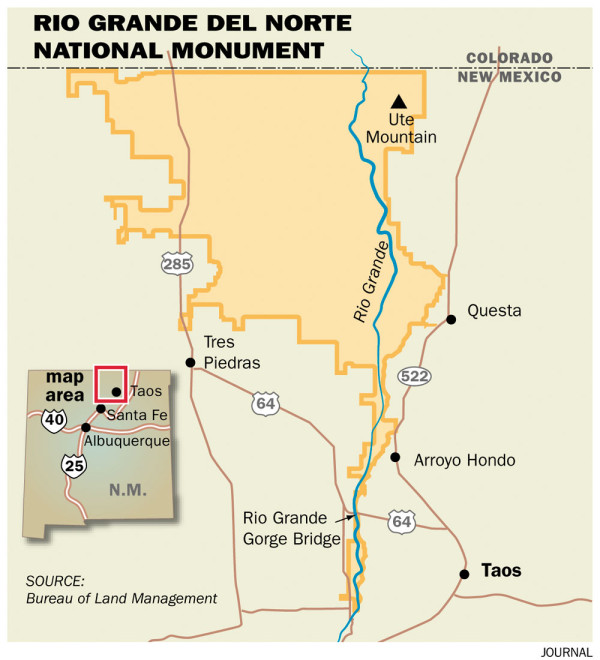
• The New Mexico chapter of Backcountry Hunters & Anglers is happy about designation of the new Rio Grande del Norte National Monument. 
"There are many great public lands to hunt in New Mexico, but what makes the Rio Grande del Norte unique is the wide variety of wildlife that it offers, combined with the area's overwhelming natural beauty. It truly is some remarkable country and fishing in the spectacular Rio Grande Box is a special experience" said Laddie Mills, a longtime New Mexican hunter and angler.
 Further comment from Indian County:
“I applaud President Obama protecting Rio Grande del Norte National Monument because many of the wildlife species that live in that corridor come in and out of this area.  Left unprotected, there may be very few animals available that the Native American people of Taos Pueblo depend on for food, clothing and shelter," says Benito Sandoval, Taos Pueblo War Chief.