Showing posts with label Teller County. Show all posts

February 27, 2024

Lettuce Get Down to Business

Photo from 1918 of the Mahon Ranch, west of Buena Vista.
Pictured are Martha Mahon, her daughter Cassie and Cassie’s husband, George Fields, with crates of head lettuce. Courtesy of Buena Vista Heritage Museum.

An article in the SkiHi News from Grand County, Colo, (Motto: 'The wolves are here, now where are the bucks?") notes the area's success with growing lettuce in the 1920s.

When some of the first settlers arrived in Granby, they realized the sunny days and cool nights were perfect for growing lettuce. The humble lettuce thrived in the mountainous landscape. . . . The Moffat Railroad gave local lettuce producers access to big cities like Salt Lake City. Granby was said to produce high quality lettuce and there are anecdotes that New York’s Waldorf-Astoria Hotel bragged of “Granby Lettuce” on the menu, according to the Grand County Historical Association.

Not just Granby. Back before the time when all fresh vegetables in the typical supermarket came from California, southern Arizona, and northern Mexico, other parts of Colorado were also producing lettuce. 

It was exported from the Wet Mountain Valley [Custer County], from Eagle County, and from Chaffee County, among other locales. The photo above was taken near Buena Vista.

All these locales had higher elevations (6000–8000 feet, typically), irrigation, and in most cases, rail access. A 2014 article in Colorado Central examines this now-defunct commercial agriculture.

By 1922 the Salida growing district was making plans to get in on the lettuce boom with more than 40 people becoming members of the Colorado Cooperative Lettuce Association in the town. Headquarters for the association was in the Unger store and Sid Burleson was a leader, The Salida Mail reported.

That same year there were about 1,500 acres of lettuce being grown in Buena Vista. Westcliffe [Custer Co.] had 800 acres, the Hardscrabble district [Custer Co.] 400 acres, the Divide district [Teller Co.] 300 acres and the San Luis district [Costilla Co.] 500. It was reported in the Chaffee County Republican that Buena Vista shipped 163 cars in 1922, followed by Florence [Fremont Co.] with 85, the Yampa district [Routt Co.] with 75 and Avon [Eagle Co.] with 73.

Since Hardscrabble is about 14 miles from Florence, that may be where the lettuce growers hauled their crop to the railroad. 

The 1941 WPA Travel Guide for Colorado, from the Federal Writers Program, noted that in northeastern Custer County, "fields on the steep [?] slopes grow potatoes, lettuce, and celery." Of Buena Vista it says, "Lettuce Day, combined with a rodeo, is celebrated annually in September." Granby, as noted above, and Alamosa are also described as lettuce-growing areas, as are Divide [Teller Co.] and La Veta [Huerfano Co.].

This production nose-dived by the 1940s. There was World War 2, of course, but as best I can tell, the big factor was improved refrigerated railcars making it easier for larger-scale West Coast growers to send massive amounts of lettuce etc. eastward. 

And with the growing more concentrated in fewer areas, a problem like a plant virus there rolls clear to the Eastern Seaboard as well. From 2023: "Farmers seek rebound after floods, virus hit lettuce crop."

Things were challenging enough for lettuce growers in Monterey County’s [California] Salinas Valley before Mother Nature dealt a one-two punch in this year’s storms.

Farmers in 2022 had suffered an estimated $150 million in crop losses as impatiens necrotic spot virus—a destructive plant disease spread by thrips—moved from field to field.

Then this year, vast flooding from atmospheric storms damaged multiple crops, with lettuce growers suffering an additional $54.4 million in losses, according to figures released by the Monterey County agricultural commissioner.

Most of those Colorado lettuce acres went to hay and cows — or in the case of Eagle County, ski condos. After all, cows are plant-based too.

March 04, 2023

Poachers Do It Mainly for the Thrills — and the Cash

These mule deer were not killed because someone was hungry, but for money. (Colorado Parks & Wildlife)

I was told once that a certain state game warden in my area used to wink at poaching if it was done by people whom he thought "needed the meat." That would have been in the 1950s–1960s. I met him when he was older and retired—only briefly—so I really do not know.

Also in the 1960s, some Western Slope relatives of mine used to cope with rural low wages by poaching deer around the boundaries of Colorado National Monument, I later learned.

I'm sure they "needed the meat" too, but frankly, the one guy was a major thrill-seeker all his (relatively short) life and getting away with something was fun. If crime was boring, there would be a lot fewer criminals.

When you dig into poaching cases, they are usually about money and thrills. This not Robin Hood poaching "the king's deer," although some people bullshit about doing just that.

Ian Petkash, a Park County [Colorado] district wildlife manager, recently stated,

“This year [2022] was far and away the busiest year I’ve had, especially for egregious cases, felony-level cases. I don’t have an explanation on why this year was so bad. I’ve kind of wracked my brain trying to find a pattern"  . . . .

Petkash discovered one common thread in many of his poaching cases: the willful destruction of big game animals, a felony under Colorado law. It generally occurs in one of two ways: shooting and intentionally leaving the entire animal to waste without harvesting its meat, or just claiming the trophy parts, such as the head and hide, and leaving the rest.

Why is it not a surprise that a guy busted in 2019 for poaching deer and bighorn sheep for money in Teller and Chaffee counties then popped into the news again last year, arrested on multiple felony charges for burglaries and weapons possession? (I suppose after his poaching bust, he was by then a "felon in posession.")  Not exactly Robin Hood.

That some poachers are caught after bragging on social media looks like thrill-seeking too

In my area, during the late 2000s, a poaching ring operated killing big mule deer bucks for sale to the trophy-heads market. Of course there was a crooked taxidermist involved, who went down with the others. One must always cherchez le taxidermiste, as Hercule Poirot might say.

One of the ring managed a local cafe, owned by his father. When the arrests came, the locals just stopped going there. His father sent a form letter to everyone in the area: "I didn't know. It wasn't me. Please don't boycott us!" or words to that effect.

But they did, and the cafe closed its doors.

May 15, 2022

What Happens to Wildlife in Wildfires?

Here is District Wildlife Manager Travis Sauder talking about wildfire and wildlife at the site of the High Park Fire in Teller County (west of Colorado Springs and closer to Cripple Creek), which at this writing has burned a little less than 1,200 acres.

I don't disagree with what he says, but I think his view point is slanted towards larger animals, such as deer, elk, mountain lions, etc. Smaller critters may not know until it's too late. But they tend to reproduce faster too. Maybe it works out.

When it comes to the ungulates, he is right about the improved feeding conditions post-fire, after a few months. I have joked that all fires turning mature conifer forests back into a mixture of trees, grass, and brush are set by the Mule Deer Foundation. For evidence, I offer the fact the Colorado's MDF former Colorado regional director has lived in several residences close to major wildfires, or as they say on the internet, he "has links" to them.

Of course, no reputable conservation group would set fires. I do but jest. But their flagship species does benefit from the changes in foods available to them!

October 31, 2011

Some Colorado Springs Ghosts—and the Unquiet Ghosts of Teller County

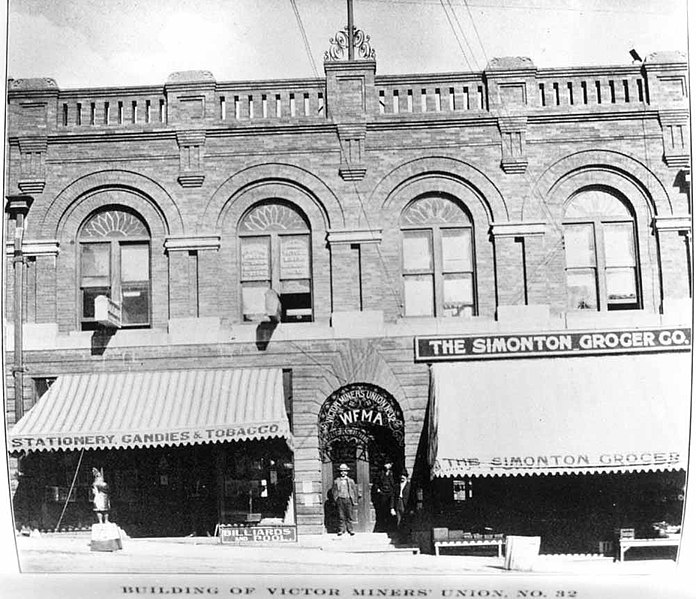
Western Federation of Miners hall, Victor,1903.
A Colorado Springs blogger offers some ghost stories, mostly from the West Side.

In my young newspaper reporter days, I did my part for Cripple Creek and Victor.

At the time, I was covering both the gold-mining boomlet of the early 1980s and also some Colorado labor history, such as the activities of the Western Federation of Miners in the early 1900s.

They did not make it into the book, but I had a couple of woo-woo experiences in Cripple Creek and in the nearby ghost town of Goldfield of my own.

In one of them, I was walking into faded glory of the 1904 Teller County Courthouse to cover a hearing about leakage from a cyanide heap-leaching operation killing some horses. Just ordinary reportorial stuff.

I had never entered that building before. At the foot of the staircase leading up to the courtrooms, I almost had a panic attack. I was sure that I was walking up to my doom — but I wasn't "me."


In the second, I was leaving Victor and decided to drive through the site of the mining town of Goldfield, "a strong union town," instead of back via Cripple Creek on the way to Colorado Springs and the newspaper office.

The scene out the windshield was 1980 or 1981 Goldfield, which is to say, not much.  But to my ears and inner senses, it was all shouting and turbulence and emotion of the 1894 miners' strike, when the Cripple Creek police shot down the Goldfield constables, mines were dynamited, the militia was called out, and gunfights flared between miners and sheriff's deputies back by the mine owners.

It was like being in two places at once, one foot in the past and one foot in the now. The experience lasted less than minute but left me feeling emotionally exhausted.

That strike was just the beginning of the Colorado Labor Wars, when things got even worse.

Bad times—more or less swept under the rug of history now. Now we hear only of a street vendor selling  "hot waffles to miners, railroad passengers and barflies."