Showing posts with label politics. Show all posts

December 31, 2024

Did Mister Cooper's Hawk Kill Gospodin Steller's Jay? On the Politicization of Bird (and Mountain) Names


Walking up the dirt road in back of the house on December day, I saw these feathers. Obviously a Steller's jay had met a recent and violent end. But whodunnit? A Cooper's hawk? 

Just thinking about that leads to another thought: Who was Steller and how does he "own" these jays? And who was Cooper likewise?

He was Georg Wilhelm Stöller, russianized to "Steller,"  who lived a short (1709–1746) but productive life as a natural scientist including participation in "the Second Kamchatka Expedition [1741]of Captain Vitus Bering, the legendary Russian explorer whose name wound up on the Bering Sea, Bering Strait, and Bering land bridge."

He gathered lots of specimens but was also shipwrecked with others of the crew on what was named Bering Island, for Capt. Bering would die there. In Steller's memory, four birds and the Steller's sea lion, plus the doomed Steller's sea cow, were given his name, because he was the first to publish scientific descriptions.

Cooper's hawk? Named by the French ornithologist Charles Lucien Jules Laurent Bonaparte (Napoleon's nephew) for his friend Wlliam Cooper, another early 19th-century naturalist.

These names might be going away though. In 2023 the American Ornithological Society announced that all English bird names named after people within the geographic jurisdiction it manages will be changed, with the initial effort set to tackle 70 to 80 bird species present in the United States and Canada, starting in 2024.

These names are, allegedly, "racist and misogynist." So this is all bad stuff from the past that we are getting rid of. It's "racist" when an 18th-century German naturalist works for the Russian government in the Bering Sea? Maybe we should get rid of "Bering" too! There is a certain amount of guilt-by-association here. 

In Colorado, we have purified the past, even when it meant favoring one Indian tribe over another. In November 2022 the Colorado  Geographic Naming Advisory Board recommended changing the name of Mount Evans, the state's highest peak, to Mount Blue Sky, "a name supported by the Southern Cheyenne and Arapaho tribes of Oklahoma."

There was history here: John Evans served as territorial governor from 1862–1865. That was a period of renewed conflict between settlers and some Natives. In late 1864 a force of Colorado volunteer cavalry attacked a peaceful Arapaho camp on Sand Creek in eastern Colorado and massacred many people, driving some of the survivors to align with the Cheyenne, who were more hostile. Evans did not "authorize" the attack -- he was not there -- but he did authorize formation of the volunteer unit that committed it, so in that sense he was "linked" to the Sand Creek Massacre.

But when the proposal went up to the US Board of Geographic Names, other Cheyennes objected: 

The vote has been held up for the past six months because of objections from the Northern Cheyenne of Lame Deer, Montana, the only original Colorado tribe, which is vehemently against the Mount Blue Sky name. The phrase "blue sky" is part of the sacred Tribal Arrow Ceremony and, thus, the Northern Cheyenne believe it would be "sacrilegious" for it to be spoken in common language, the tribe argued.  

Northern Cheyenne tribal leaders have, instead, long advocated to rename Colorado's most famous peak to "Mount Cheyenne-Arapaho."

The Northern Cheyenne tribe lost, because the board wanted to settle the issue. It's Mount Blue Sky, signed and delivered.

But let me speculate: Will a generation of young social-media users now think that the mountain was named for Bluesky, a social media platform that is trying to compete with X (formerly Twitter)? Will they look around to see if there is a Mount TikTok or Facebook Peak somewhere too?

As for the birds, in a year or two, will I be saying that a "stripey forest hawk" maybe killed a "Western crested jay"? Or maybe the Cooper's hawk should be the "mall hawk." On a 2020 visit I saw more of them around a California strip mall parking lot than I ever see at one time here at home in the woods.

(In pre-Communist Russia, "Gospodin" was the term of respect equivalent to Monsieur or Herr.)

January 12, 2024

Colorado Wolves: Faux "Paws" on the Ground

Gov. Jared Polis was on hand Dec, 18, 20203 to release Oregon wolves in Colorado,
but some Coloradans deeply involved with the project never were invited.

Some officials and Western Slope residents are annoyed that Colorado Parks and Wildlife seemed eager to please Governor Polis (if not Marlon Reis, his animal-rightist husband) while forgetting promises to them. They were never on the guest list or even informed about last month's wolf release.

According to the Sky-Hi News in Grand County,

Two [CPW] commissioners in particular, Marie Haskett from Meeker, who represents sportspersons and outfitters, and Duke Phillip IV, who represents agriculture and is from Colorado Springs, both believe a lack of communication and transparency has led to distrust of the agency in rural communities. And they both think the wolf reintroduction created animosity between rural and urban areas. While dismayed at the way the wolf releases were rolled out, the commissioners both expressed gratitude for the hard work CPW staff put into making the historic, voter-mandated reintroduction possible.

Haskett was the first to speak about wolves at the Jan. 10 meeting. She called Dec. 18 – the day the first five wolves were released – a “sad day” because comissioners were not notified. She claims that many of the CPW staff who worked tirelessly on the reintroduction were also not made aware. To her knowledge other members of the legislature and local counties were not alerted about the releases either.

“Even the Grand County commissioner (Merrit Linke) who was on the TWG (Technical Working Group) was not invited to the release, and yet other specific members of the working group were,” Haskett said. “The people who politically drove this issue were present. The divide between rural and urban populations was blown up with this ballot initiative. Now CPW has taken a huge political hit with the public because of these political actions.”

Philip in particular was angry because he had worked on the reintroduction but found that it had occured a day afterwards — by watching TV news.

Haskett said that poor communications with local people puts CPW's work at risk, since it must manage wildlife on both public and private land. I would add that it also feeds the conspiratorial narrative that the wolf introduction was "punishment" to an area that did not vote for Gov. Polis and other Democrats.

For official wolf news, check CPW's "Wolf Management" page.

November 09, 2020

Pouring Bureaucratic Syrup on the Wolves

Gray wolf (Colorado Parks & Wildlife)
The people have spoken: Coloradans voted by a roughly 1% margin to order Colorado Parks & Wildlife to re-introduce gray wolves.   Or as one site put it: "Urban vote decides for rural Colorado."

As the Grand Junction ABC affiliate reports, roughly 62% of Western Slope voters said no to the measure, but it wasn’t enough to overcome the Front Range voter advantage.

Which is usually the way it goes on statewide votes. 

The pro-wolf faction adopted the language of nature:

The Rocky Mountain Wolf Action Fund, a backer of the proposition, said this is the first time citizens have voted to initiate the restoration of a native species.

“Voters throughout Colorado took politicians out of the picture, choosing to restore natural balance by returning wolves to their rightful place in Colorado,” said Rob Edward, fund president.

 CPW director Dan Prenzlow bowed to the inevitable:

“Our agency consists of some of the best and brightest in the field of wildlife management and conservation. I know our wildlife experts encompass the professionalism, expertise, and scientific focus that is essential in developing a strategic species management plan. CPW is committed to developing a comprehensive plan and in order to do that, we will need input from Coloradans across our state. We are evaluating the best path forward to ensure that all statewide interests are well represented."

So where does the money come from?
(Graphic: University of Maine)

When agency heads start talking about "leadership" and "plans" and "stakeholders" and "statewider interests," and other vague terms, I call it "pouring bureaucratic syrup over a problem." Lots of soothing talk, sort of telling a child who awoke from a bad dream to just go back to sleep, Mommy is here.  Glug-glug-glug.

(I knew one US Forest Service district ranger who absolutely mastered it; I don't know if she accepted Smokey Bear as her personal savior, but she sure could drop twenty buzzwords in one sentence.)

Colorado now has a Wolf Management Website where you can track the process of trying to do what the voters requested while trying to find the money to pay for it. There is good information there on the legalities of "introduced" wolves versus those who wander in on their own, which agency (federal or stte) manages which wolves, and so on.

UPDATE: Newly elected State Senator Bob Rankin, who represents the area that included both self-transplanted wolves and the proposed wolf release, plants to introduce a bill to re-locate an equivalent number of wolves to Boulder and Jefferson counties. (Jefferson includes most of Denver's western suburbs.) 

“I do intend to do that,” Rankin — who won formal election to the state Senate last week — said following his victory. “I’m going to have to admit: it’s more just a protest, more than anything else, to call attention to the fact that the people most affected voted against [Proposition 114].”

 The bill stands no chance, and he knows it. There was a "credible" sighting on the Eastern Slope earlier this year though.


January 21, 2017

When Liberals Turn Preppers

A new meme has been going around news media lately, the "liberal prepper."
The signs of change are surely in the air. Groups that cater to gun-toting bleeding hearts — such as the aptly named Liberal Gun Club — say they’ve seen a surge in paid membership since the election. Candid talk of disaster preparedness among progressives is showing up on social media. Even companies that outfit luxury “safe rooms” — which protect their wealthy owners from bombs, bullets, and chemical attacks — attribute recent boosts in business to the incoming administration.
Terrified by the so-called "Trumpapocalypse," this (presumably) Hillary voter is stocking up on guns and canned food — example: Colin Waugh of Independence, Mo., an "unapologetic liberal . . . no fan of firearms."

Read the article, watch Colin Waugh make a string of newbie mistakes, but don't be too judgmental.

And remember, we don't say "survivalist" any more; we say "prepper." 

For instance,  Waugh has been "browsing real estate listings in Gunnison County, Colorado, which he’s determined to be a 'liberal safe-haven.'"

Does he know that the average low temperature this month in Gunnison is -6° F. (-21° C)?  Does he know how short the growing season is? Or how expensive the college town/resort-area real estate is?

In the event the "Trumpapocalypse" occurs, does he plan to drive 750 miles across lawless prairies to his Secret Mountain Hideout?

He would be a lot better off staying in Missouri. I recommend Moniteau County. It's close by, has no large cities, and land is much more affordable.

To protect himself against "state-sanctioned roundups of Muslims, gays, and outspoken critics," Waugh has purchased two guns, a 9mm pistol and an unspecified shotgun.  I hope that he gets some serious instruction and practice with them. Start with the assumption that everything you see in movies and TV about guns is wrong. (People do not fly through the air when shot, for one thing.)

But here's the thing. Planning for disaster is a good thing. Sure, there is plenty of apocalypse porn out there, even "Trumpapocalypse"-porn, but you don't have to wallow it it.

Taking care of yourself and yours is a good plan. Government cannot do it — at least when disaster first strikes. Even with good resources and planning, it takes at least 48 hours for the wheels to turn, and that is a best-case scenario. 

(As a member of my county's emergency services board, I have seen plenty of planning and discussion, not to mind that I have been evacuated from my home four times in the last eleven years.)

As blogger Liz Shield writes, "Are we sure this guy isn't one of us? . . . . Welcome to the world of 'taking care of yourself and your family.'"

Anyone who is serious about self-defense, about food, and about general preparedness — "keeping your wits about you," etc. — is going to be a more effective citizen and less of a drain on public resources.

Unfortunately, bullets will not stop a Missouri ice storm.

October 01, 2014

No, You Won't Be Charged to Take Photos of Your Wilderness Hike

Lots of hysteria recently around an admittedly poorly present U. S. Forest Service announcement on fees for commercial photographers in wilderness areas. Typical was this from the Outdoor Wire's Jim Shepherd:
It may sound far-fetched, but a program like this could mean a wilderness visitor who snapped a photo using a smartphone and later posted it on a personal blog could be considered a "media outlet" and face a $1000 fine.
It not only may sound far-fetched, it is far-fetched. As this headline reads, "No, the Forest Service is Not Planning to Charge You $1500 to Photograph the Wilderness."
Put away the pitchforks, folks. After reading some of the recent horribly misleading media coverage of a proposal by the US Forest Service, you might think that members of the media (down to – and yes, including! – us lowly bloggers) are about to be banned from all National Forest lands. You might even be forgiven for thinking wildlife, landscape, or casual photographers selling their prints online or at a local art show or gallery are about to be hit with an onerous fine.
I checked with semi-pro photographer Jackson Frishman, who does lots of photography in designated wilderness areas. His response, via email
I'm guessing the FS is mainly viewing it as a way to keep productions out of wilderness that don't really need to be there (e.g., the Lone Ranger 2 doesn't need scenes filmed inside the wilderness boundary, find a non-wilderness location instead), but I'd question whether that's actually a common enough problem to merit a solution, given the existing rules of wilderness and the logistical needs of major productions. I could see those guidelines being used to harass investigative journalism critical of FS policy (though to be fair, such a situation might also be pretty much non-existent in practice).
Read the Forest Service's "we didn't mean it like that" news release here.

What we have here is just fed-bashing from the usual suspects. Given that it is an election year — and we have a Colorado Republican gubernatorial candidate who wants to see public lands handed over to the state or privatized (Colorado, that can barely fund its state parks, is going to take over, e.g., Rocky Mountain National Park??) — I can't help but see a connection.

January 29, 2014

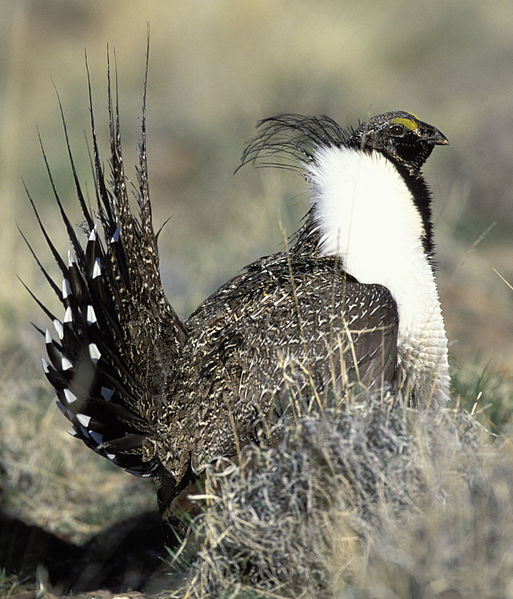
Pity the Sage Grouse, Victim of Politics

Sage Grouse (Wiki Commons)
Sally Jewell, shiny new Secretary of the Interior, comes to northwest Colorado to discuss the threats to sage grouse — then shuts local news reporters out of a "public meeting," is rebuked by the Colorado Press Association.

She has not been in office long, but evidently she has picked up this "most transparent administration's ever" operating style.

Later she issues a typical bureaucrat's non-apology in which it's no one's fault.

Forgotten in all of this: what, if anything, can be done to help the sage grouse. Secretary Jewell has managed to make the story all about her blunders instead.

Her trip was supposed to be about a local, ground-up plan to preserve sage grouse without listing them as endangered or threatened, with the associated federal regulations. But the controversy over Jewell's disrespecting of the local news media drowns that out. One might wonder why. With her way, people who did not personally attend the "public" meeting will never hear about how the local plan works and how the feds reacted to it.

December 05, 2013

Browns Canyon and a New Spin on Wilderness Advocacy

Senator Udall outlines his bill.
Senator Mark Udall (D-Colo.) stood up in front of a group of mostly Chaffee County folks on Tuesday to announce that his bill to create the Browns* Canyon National Monument soon start its perilous journey downstream through the dark canyon that is Congress.

As snow swirled outside the venue, the reception area at Noah's Ark Whitewater Rafting, no doubt some of those present were mentally calculating what percentage of a decent snowpack had accrued thus far in the season.

This proposal has been a long time coming. I remember seeing Browns Canyon from a raft for the first time in 1986 or '87 — and that trip was a junket organized for some conservation group (Trout Unlimited?) connected either with Browns Canyon or the proposed Arkansas River state park. And I can recommend testifying at a public meeting in Buena Vista six (?) years ago before Ken Salazar when he was in the Senate. And there has been a lot more done along the way.

Part of the proposed national monument — to be administered by the Bureau of Land Management and the Forest Service, not the Park Service — has been a BLM wilderness study area (WSA) since the 1980s, at least.

Like a lot of the BLM WSA's, it is a not a high-altitude alpine forest-and-snow area, but would protect lower elevation forest (important big game habitat) and riparian areas. It had a road into it to an old mining camp. And lots of people wanted a say for or against the proposal: recreational gold miners, hunters, dirt bikers, four-wheelers, cattlemen, commercial rafters, private rafters, anglers . . . and one group that surprised me, but whose inclusion makes perfect sense.

Over the years, compromises were made, and the original proposal shrank down to about 10,000 acres.

Udall praised the effort as "emblematic" of how a public lands bill should be crafted, from the bottom up and as a "common sense proposal" that would "protect all existing legal uses."

Then came brief statements from supporters. There was the motel owner-real estate agent from Buena Vista, who said that a designated national monument would bring more visitors. I suspect that he is right. The vice president of the commercial rafters association made a similar point, noting that whitewater rafting on the Arkansas is a $54 million industry.

Another outfitter, Bill Dvorack (holder of Colorado outfitting license #1) spoke about protecting wildlife habitat. Bill Sustrich of Salida, at 87 years probably the oldest life member of Backcountry Hunters & Anglers, talked about ATVers ruining elk hunting.

Interestingly, there was another speaker from a nonprofit group helping veterans reintegrate into society. He identified himself as a former Army sniper in Iraq, and talked about the part that public lands recreation played in his own de-stressing from his war experience.

That rang a bell — I remembered outdoor writer and vet Galen Geer writing an article about how hunting did something similar for him after his tours in Vietnam. His article seemed to stand alone at the time (the late 1980s or early 1990s), but now people are organizing such outdoor experiences.

* About a century ago, the US Board of Geographic Names or some such agency decided that the possessive apostrophe was too complicated for them.

September 29, 2012

Playing the Rancher Card in a Legislative Race

Down at our one-clerk post office, I was talking with A. behind the counter about how it seemed that we were getting more election-related mailing pieces this year than ever before.

She was angry at a 9:30 p.m. telephone polling call ("When my kids are asleep!"). Me, I like the survey calls that you respond to by pressing numbers on the pad. To paraphrase the famous New Yorker cartoon, in the voter survey, no one knows that you're a dog.

Here in my state senate district, the two candidates are attempting to out-rancher and out-family roots each other.

But have I been missing something? Is it the new fashion to not mention party affiliation?

Exhibit A: Crestina Martinez is a young (for a politician) rising political figure from Costilla County. She knows retail politics — she called me twice (herself, not a robo call) during the primary season, and I could not even vote for her.

Her campaign slogan is "As Independent as Southern Colorado."

Independent? I spotted the "union bug" on her mailing piece. Only Democrats make a fetish of hunting up a unionized printing shop — there are a few* —to print their campaign brochures.

Exhibit B: Unlike Martinez, who can talk about working as a kid on the family ranch near San Luis, the other candidate, Larry Crowder ("Farmer. Rancher. Veteran.") grew up outside the district, though he pointedly mentions that he is a "fifth-generation Coloradan." His mailing piece does say "Republican" in one spot.

And there is more about "rural values" and "protect our rural economy."

A recent High Country News piece explored how candidate wearing the "rancher" or "farmer" label — this time in Montana — actually might be more or other than those labels suggest.

Today's mailer  is a hit piece (from a PAC that specializes in them) on Martinez, accusing her of having a "political agenda that is from New York City — not southern Colorado."

Yep, vote for Martinez and soon you won't be able to buy 40-oz. soft drinks at the Loaf 'n' Jug in Alamosa. You see, Mayor Bloomberg has made the "maximum legal donation" to her campaign.

I wonder if this campaign shows that Mitt Romney's coattails are not very long, while Barack Obama's are nonexistent. 

* How you find them, I don't know. The website of the Communication Workers of America, which absorbed the old ITU, is not very helpful. The Pueblo local's website domain name has expired — way to go, communications workers.

January 19, 2012

SHOT Show: Zombies Out of Control

Marketer with poster for Leupold's zombie-hunting rifle scope.
Heard in the crush of humanity between the exhibitors' booths: "This whole zombie thing is way out of control."

Someone in the outdoor-products industry once told me that you could sell more of anything if you made it in a camouflage pattern.

Leupold VX-R scope for zombies.
Nowadays you put fluorescent lime-green accents on it and use the word "zombie."

Here are some 2012 SHOT Show zombie-defense products.

Scope flip-up lens cover.
Leupold optics has a scope for zombie-hunting, complete with covers showing the optimal head shot.

Maybe it could be mounted on a rifle along with the back-up anti-zombie chain saw.

Anti-zombie loads are available for 12-gauge shotgun or for rifles firing .223 Remington.

If you run out of ammo, defend yourself against the living dead with a Ka-Bar anti-zombie knife. It's not the famous Marine Corps knife — this one has a fluorescent-green handle.
Lightfield's anti-zombie buckshot.
Hornaday's anti-zombie load.

Zombie gun-cleaning kit from Otis.
For the zombie ammo.
When the shooting is over, clean your weapon with Otis Technology' s gun-cleaning system in the zombie-themed pouch. It's not just tactical, it's zombie-cal.

"You have to get aboard [the zombie craze]," one marketer told me.

Another predicted that zombie-themed marketing was far from dead (sorry) because "Brad Pitt just signed a movie deal" for a zombie film — maybe even a trilogy.

There has to be more than Brad PItt driving the zombie theme.  For some people, it's just Halloween all year (earlier post: Zombies in Vermont).

In the shooting world, is zombie-preparedness just a way to think about shooting other upright bipeds — ones that are no longer human?

During and after the Cold War, zombies were seen as analogues for Communists. They were "brainwashed," as the 1950s expression had it.

I had breakfast with an editor who suggested that the political symbolism was still there — like the Lilliputians and Yahoos in Gulliver's Travels.

"A lot of zombies voted in 2008," he said.