Showing posts with label rain. Show all posts

July 10, 2023

Colorado Is Now Out of Drought, But New Mexico Is Not

Click to embiggen.
This graphic displays moisture changes in Colorado over the last 90 days. As you can see, the Eastern Slope and High Plains have been wet. Nearly 11 inches (28 cm) have fallen at my house, and other places have more. While in some climates that counts as "somewhat damp," for us it is "Oh my gawd when will it stop?"

 The plains in particular have had tons of hail, which threaten the wheat harvest.

"Heavy rains and severe thunderstorms continue in the Southern Plains where producers are watching forquality impacts. In Colorado, Wyoming and South Dakota, producers are hoping for dryer and/or warmer weather ahead of harvest." (US Wheat Associates harvest report, July 7, 2023).

On the other hand, it is starting to look like a good summer wildlflower season, although spring was not so good.


A quarter of New Mexico is "abnormally dry," while the southeastern quadrant is in either "moderate" or "severe" drought.

If you find this information endlessly fascinating, visit the .gov "Drought Portal." Your tax dollars at work.


June 30, 2023

A Summer When Some Signs Fail

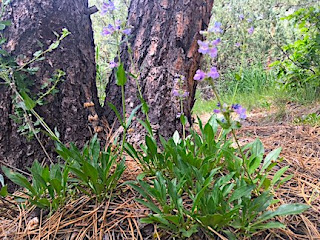
Last of the low penstemon.

A now-gone rancher friend used to say, "All signs fail in times of drought." Maybe they fail in times of heavy rains as well.

Spring started dry. I was out on a couple of small fires in April, and we all worried what was coming next. Rain was coming next: from mid-May to mid-June we got more than nine inches (24+ cm). 

All my May outdoor projects — plantings, rail-fence repair, house-painting — were postponed.

The natural world was similar. The usual spring wildflowers were never seen or only rarely. Spring beauties (Claytonia) not at all. Sand lilies — just one or two. Pasque flowers, hardly at all.

Bird life changed too. A flock of evening grosbeaks (as many as eighteen) that had hung around all spring finally dispersed, except for a couple, when M and I went down to Taos for a week in early June, taking away their free food, because we don't leave bird feeders out all night when the bears are about.
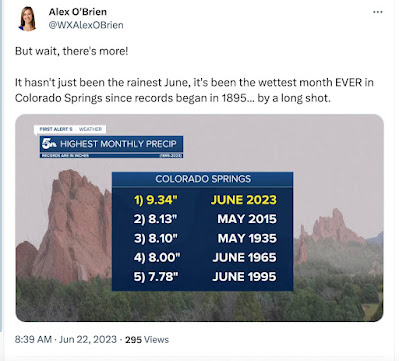
Colorado Springs had the wettest June since record-keeping began.

I don't know if it was the cold and rain or what, but the roll call of spring migrants was incomplete.

The broad-tailed hummingbirds arrived in April as usual, and two males are busy disputing rights to the sugarwater feeder. Black-headed grosbeaks are here, although perhaps not as many as I expected.

But spotted towhees, which are usually screeching from every oak thicket as they proclaim their nesting territories, don't seem to be here at all.

I miss Lucinda. There were many Lucindas over the years.  Back in the 2000s, every year a little cordilleran flycatcher would nest in some inconvenient (to us) place, like on the front porch light, and so we named all the mother birds Lucinda.

A few years ago, I built the Official Flycatcher Nesting Shelf high up under the eaves on the quiet back side of the house, and the birds liked it. They would nest mid-June, and the young would be out of the nest by late July. 

In 2023, as I recall, some eggs were laid but never hatched.  Did some predator nab that year's Lucinda? And this year, no flycatchers. The chain seems to be broken, and I am surprised  how sad that makes me feet.

So many things seem to be happening late, and I keep hoping, but I don't think it is likely that they will show up to build a nest two weeks later.

Wildflowers recovered better. June saw a burst of blue-flowered low penstemon in every forest clearing, supported by some vetches, clover,  feral lilacs and others. Wild plums bloomed profusely , but ponderosa pine pollen was scanty.

 In late June, we flipped from rainy to hot with highs hitting 90° F, all of which goes to show that when it comes to weather, "average" is just a number. So M. and I are still setting out plants and even seeds, hoping for a long warm fall, with backup plans of moving some container plants into the unheated greenhouse if need be. 

And mushrooms! Thanks to all the rain, we're picking here around the house, mostly shaggy parasols, but a twenty-minute drive put us into some giant puffballs, sitting in the high grass creekside like skulls on an ancient battlefield. Two of those in a shopping back feel like serious food. Maybe 2023 will go down as a great mushroom year.

I can't tell what it all adds up to though. Some things good, some puzzling.

July 08, 2022

Colorado Drought Map July 5, 2022


Right now I call this good news, getting upgraded to "abnormally dry." And there was more good rain the evening of the 6th as well.

July 12, 2021

Will This Be Mega-Mushroom Year? Or, Foraging Texas-Style


I was hiking on June 25th with my wife and my niece when I found the giant puffball on the right.  I cut it in half to make sure it was still fresh enough to take home—and it was.

Then as we were driving the little road out from the trailhead, my niece, who was in the right-hand back seat, starts shouting, "Wait! Wait! Stop!"

She had spotted the other puffball. She has good instincts — she spent her teen years on my sister's farm, where aside from electricity and motor vehicles, it was pretty much 1890 — hand pump for water by the sink, wood heat, and the privy was out back. You blast the kudzu with a shotgun when it tries to crawl in through the screen door, that kind of thing.

"I never foraged from a car before," she said, climbing back in. 

"That's doing it Texas-style," I said.

But seriously, while the Western Slope is baking, here in southern Colorado we are getting early tastes of monsoon weather, and I have never picked so many mushrooms this early at this altitude (below 8500 feet, give or take). It was the first year that we had the dehydrator running in June.

M. and I will be heading for higher country soon. We have hopes.

February 16, 2016

Is DWR as Dangerous as Scotchguard for Your Outerwear?

Interstate 5 in southern Oregon, with a sign reading "San Francisco."
When I was a college student — and for a while afterwards — I had this two-layer Egyptian cotton anorak — from REI, as I remember. It was a well-made garment in a sort of burnt-orange color.

I loved it. It was my magic hitch-hiking anorak. But it was cotton — and I lived then in the Pacific Northwest.

It had a waterproof coating, which wore out, so I think that I sprayed it with Scotchguard. Later we learned that Scotchguard was bad stuff to be around. (See comments.)

Now it is 2016, and there is a debate around another waterproofing compound for outdoor gear,  DWR, "Durable Waterproofing Repellent."

In this article at the Section Hiker blog, "Why Does DWR Suck?" Phillip Werner raises questios about both cost and health:
When water soaks into the fabric of a rain jacket, you can just forget about breathability. The system is a complete sham but people keep buying into it, including the need to reapply the DWR coating several times a year. It’s the hidden cost of owning a waterproof/breathable rain jacket: the need to keep buying Nikwax TX-Direct or Gear-Aid Revivex to repair the DWR when it wears out so the (really expensive) breathable fabric part of your jacket can work.
The debate continues in the comments.

Everyone is looking for the magic waterproof-but-light-and-breathable combination. I am glad that I live now in Colorado where rains rarely last all day, and I can put on a poncho (even a heavy old coated-nylon Army poncho) and then put it away again. What would I do if I still lived in Oregon?