 |
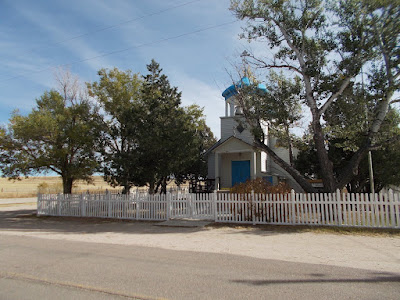
St. Mary's Holy Dormition Orthodox Church, situated on the prairie east of Colorado Springs.
|
When I set out on the annual trip to North Dakota in October, I was under the spell of a 19th-century Polish novelist,
Henryk Sienkiewicz (1846–1916).
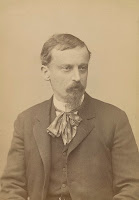 |
Sienkiewicz in the 1880s,(Wikipedia)
|
On the advice of a friend teaching at a Polish university, I was reading one of Sienkiewicz's epic novels,
With Fire and Sword, published in 1884.
Undying friendship! Massive battles! Heroism! True Love! Massive Battles! Sword-swinging Zaporozhian Cossacks! Sly and dangerous Tatars! Invincible Polish heavy cavalry, the "winged hussars"! A fat Falstaffian knight who still wins some fights! And did I mention true love?
It is set in the 1650s in what is now Ukraine, then ruled by the Polish-Lithuanian Confederacy, which was a regional power at the time.
But when Sienkiewicz was writing in the 1880s, there was no such political entity as Poland. There were Polish people, of course, but their nation had been partitioned between imperial Russia, the Austro-Hungarian Empire, and Germany. So in writing of lost glories he was feeding his people's national spirit.
But here is the irony: according to my friend, Sienkiewicz never visited the areas he was writing about. Perhaps such travel was politically sensitive or difficult.
He had, however visited the American West. He was traveling by train on what is now the route of Amtrak's California Zephyr when he and his fellow passengers got the news about the 7th Cavalry's defeat at the Battle of the Little Bighorn. In California he traveled widely, among other things seeking a location for a utopian commune of Polish expatriates near Anaheim (which never came to pass), hunting grizzly bears with Spanish vaqueros, and enjoying city delights in San Francisco. He also wrote about the experiences of Polish immigrants in the US—all for the newspapers back home that were paying his way. You can find his articles collected and translated as Portrait of America (various editions).
Therefore, my friend argues, Sienkiewicz's views of the forests, wheatfields, and grassland of Ukraine owe more to the American West than to the places he is writing about. Those steppes are actually our steppes!
A few years had passed since I had last seen St. Mary's Holy Dormition Church in eastern El Paso County, Colorado, but nothing says "steppes" like Orthodox church domes against the tawny grasslands, so I stopped by to take some photos. It is still a functioning parish with a complicated history.
Read Part 2 here.


