After being bitten by a rattlesnake while playing golf, Albuquerque lawyer Tim De Young searched the Web and found my tale.
I gave him some information on my own recovery, but he is blogging his experience.
Based on my own experience, his blog has a life expectancy of about 30 days, unless it sheds its skin and becomes something else.
September 13, 2006

The Neanderthals' last stand
A cave near the tip of Spain might be a candidate for the last surviving encampment of Neanderthal people.
Whenever I read such items, I always think back to Stan Gooch, a maverick British psychologist who advocated for the absorption of Neanderthal into Cro-Magnon people (i.e., us) through interbreeding.
The more recent DNA evidence does not seem to bear out the absorption theory, however.
Gooch offers some other interesting ideas. One was that mythological bulls were really "folk memory" of Neanderthals, who fought with bull-like rushes against their opponents, or so he claimed.
Hence Theseus slaying the bull-man Minotaur on Crete would be a folk memory of fighting Neanderthals in their caves. Likewise Mithras slaying the bull.
Physiologically, the Neanderthal was symbolized by the cerebellum (more developed in them) and Cro-Magnon by the cerebrum.
His recent book The Dream Culture of the Neanderthal argues that "direct descendents of the moon-worshiping Neanderthal are still living in Central Asia today, although they do not physically resemble their ancestors. This influence of Neanderthal occult wisdom remains strong."
Alas for mythic bulls in caves, there is that pesky DNA evidence.
Whenever I read such items, I always think back to Stan Gooch, a maverick British psychologist who advocated for the absorption of Neanderthal into Cro-Magnon people (i.e., us) through interbreeding.
The more recent DNA evidence does not seem to bear out the absorption theory, however.
Gooch offers some other interesting ideas. One was that mythological bulls were really "folk memory" of Neanderthals, who fought with bull-like rushes against their opponents, or so he claimed.
Hence Theseus slaying the bull-man Minotaur on Crete would be a folk memory of fighting Neanderthals in their caves. Likewise Mithras slaying the bull.
Physiologically, the Neanderthal was symbolized by the cerebellum (more developed in them) and Cro-Magnon by the cerebrum.
His recent book The Dream Culture of the Neanderthal argues that "direct descendents of the moon-worshiping Neanderthal are still living in Central Asia today, although they do not physically resemble their ancestors. This influence of Neanderthal occult wisdom remains strong."
Alas for mythic bulls in caves, there is that pesky DNA evidence.
German children playing with fire!
Another article on the "nation(s) of wimps" theme, this one from Maclean's.
It's all working to keep kids from doing what they've done since humanity began: going outside into spaces where they can jump streams, climb trees, use sticks as swords, and do unjust things to ants and flies. According to a decade's worth of largely overlooked research, this free play is key to developing physical, mental and emotional skills -- such as self-reliance, risk-taking, altruism and delayed gratification -- that help children form into competent, functioning adults. "We seem to need to get our hands dirty and our feet wet from time to time," says Richard Louv, author of last year's landmark Last Child in the Woods, which compiled the mounting evidence supporting the need to reconnect kids to the outdoors. "We don't fully understand why that's necessary to our mental and physical health, but there does seem to be something there."
Hat tip: Cronaca.
UPDATE: A related piece from the BBC. Have we reached meme status yet?
It's all working to keep kids from doing what they've done since humanity began: going outside into spaces where they can jump streams, climb trees, use sticks as swords, and do unjust things to ants and flies. According to a decade's worth of largely overlooked research, this free play is key to developing physical, mental and emotional skills -- such as self-reliance, risk-taking, altruism and delayed gratification -- that help children form into competent, functioning adults. "We seem to need to get our hands dirty and our feet wet from time to time," says Richard Louv, author of last year's landmark Last Child in the Woods, which compiled the mounting evidence supporting the need to reconnect kids to the outdoors. "We don't fully understand why that's necessary to our mental and physical health, but there does seem to be something there."
Hat tip: Cronaca.
UPDATE: A related piece from the BBC. Have we reached meme status yet?
September 06, 2006
The greening of Wally World
Wal-Mart is so big that whatever it does affects the environment. (Yes, there is a Colorado connection here.)
On its fleet of 7,200 trucks Wal-Mart determined it could save $26 million a year in fuel costs merely by installing auxiliary power units that enable the drivers to keep their cabs warm or cool during mandatory ten-hour breaks from the road. Before that, they'd let the truck engine idle all night, wasting fuel.
Yet another example: Wal-Mart installed machines called sandwich balers in its stores to recycle and sell plastic that it used to throw away. Companywide, the balers have added $28 million to the bottom line.
"Think about it," Scott said in his big speech to employees last fall. "If we throw it away, we had to buy it first. So we pay twice - once to get it, once to have it taken away. What if we reverse that? What if our suppliers send us less, and everything they send us has value as a recycled product? No waste, and we get paid instead."
That was talk any Wal-Mart executive could understand, even if few knew it came straight from the pages of Natural Capitalism, an influential book by Paul Hawken, Amory Lovins, and Hunter Lovins that lays out a blueprint for a new green economy in which nothing goes to waste.
Not coincidentally, Lovins and his Rocky Mountain Institute were also hired as consultants by Wal-Mart to study a radical revamp of its trucking fleet.
I heard Amory Lovins talk back in the 1980s, when he and then-wife Hunter were still a team. I thought then that he should have been put in charge of US energy policy because he could crunch numbers in a non-dogmatic way.
Will this change make me a Wal-Mart shopper? Probably not, except in extraordinary circumstances -- like the time I was in Taos, N.M., last winter, setting out on a road trip, and I realized that I had forgotten to pack any underwear. You can buy art in Taos, you can buy crafty stuff, you can buy sheepskin coats, and rugs from Central Asia--but about the only place to buy underwear is at Wal-Mart.
(Ventilated summer hat tip to Rebecca Blood.)
On its fleet of 7,200 trucks Wal-Mart determined it could save $26 million a year in fuel costs merely by installing auxiliary power units that enable the drivers to keep their cabs warm or cool during mandatory ten-hour breaks from the road. Before that, they'd let the truck engine idle all night, wasting fuel.
Yet another example: Wal-Mart installed machines called sandwich balers in its stores to recycle and sell plastic that it used to throw away. Companywide, the balers have added $28 million to the bottom line.
"Think about it," Scott said in his big speech to employees last fall. "If we throw it away, we had to buy it first. So we pay twice - once to get it, once to have it taken away. What if we reverse that? What if our suppliers send us less, and everything they send us has value as a recycled product? No waste, and we get paid instead."
That was talk any Wal-Mart executive could understand, even if few knew it came straight from the pages of Natural Capitalism, an influential book by Paul Hawken, Amory Lovins, and Hunter Lovins that lays out a blueprint for a new green economy in which nothing goes to waste.
Not coincidentally, Lovins and his Rocky Mountain Institute were also hired as consultants by Wal-Mart to study a radical revamp of its trucking fleet.
I heard Amory Lovins talk back in the 1980s, when he and then-wife Hunter were still a team. I thought then that he should have been put in charge of US energy policy because he could crunch numbers in a non-dogmatic way.
Will this change make me a Wal-Mart shopper? Probably not, except in extraordinary circumstances -- like the time I was in Taos, N.M., last winter, setting out on a road trip, and I realized that I had forgotten to pack any underwear. You can buy art in Taos, you can buy crafty stuff, you can buy sheepskin coats, and rugs from Central Asia--but about the only place to buy underwear is at Wal-Mart.
(Ventilated summer hat tip to Rebecca Blood.)
September 02, 2006
Dogs' lives
The loneliness of the long-distance collie: Slate writer Jon Katz profiles Rosie, a working stock dog whose performance is exemplary but who is not, well, a pet.
I think there is perhaps a price to pay for letting a working dog work: A working dog can't be a pet, at least not in the conventional sense of the term. She does the things I need, but few of the things that often please us most about dogs—snuggling, playing, tagging along, making friends with dogs and people.
I think there is perhaps a price to pay for letting a working dog work: A working dog can't be a pet, at least not in the conventional sense of the term. She does the things I need, but few of the things that often please us most about dogs—snuggling, playing, tagging along, making friends with dogs and people.
Mushroom Days - 3
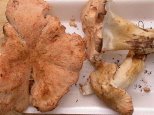 This probably will the last of the 2006 mushrooming posts. M. and I went back to our favorite patch of the boreal forest, at about 10,800 feet, on Friday. Mushroom-hunters who belong to clubs are apparently require to call such a trip a "foray," or everyone looks at them funny.
 Similarly, god forbid you use the phrase "field trial" at a Hunting Retriever Association event, unless you are engaged in snidely putting down American Kennel Club events. Petty language rules are one reason that I don't seem to do well in clubs.
In the woods, exempt from language rules, we found a few king boletes, although some of the largest were past their picking peak. Likewise, the hawk's wing (Sarcodon imbricatus) were turning dark, and their caps were often covered with green mold.
The big crop--a new one for us--was Albatrellus confluens, which looks something like boletes (spore tubes instead of gills) but is classified as a polypore. It does not seem to have a common name--although, I suppose, if we belonged to a club, we might hear one. Anyway, big fleshy mushrooms and lots of them.
We keyed it, it looked OK, so we brought a couple of sacks-full home and checked it in other sources. Heartened, we started the process of cleaning, slicing, and loading up the dehydrator.
Interestingly, my Google image search turned up mostly European site: the image here came from the wonderfully named www.svampefestival.dk.
Along with his mushroom guides, I inherited Dad's ulu, the crescent-shaped Eskimo knife, a souvenir of one of his Alaska trips. He did not use it much. But it makes a good mushroom-cleaning knife--the points work for scraping the caps, and the whole length of the blade slides the mushroom thin for drying. Mushrooms do not feature much in Inuit cuisine, so this was just a fortuitous discovery.
The down side is that using it makes me think of him as a young ranger loading his saddle bags with boletes in a different boreal forest, the Del Norte Ranger District of the Rio Grande National Forest, and I start to missing him.
August 25, 2006
Mushroom days - 2
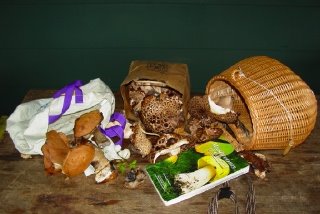 With thunder in the distance, M. and I took a walk in the Wet Mountains on Thursday looking for mushrooms.
We walked into a mother lode of hawk's wing mushrooms (Sarcodon imbricatus), getting that crazy mushroom visual effect where you see one and then suddenly your eyes adjust and you realize that you are surrounded.
I think the king bolete-hunters had already been through, because we were finding only a few old ones (and we were close to the access road), while other similar-appearing mushrooms had been knocked over but left in place.
Then, in a tight, doghair stand of little firs that we had to push into head-down, we found a sackfull. It's like elk hunting: "They're in the thick timber, boys."
The book in the photo is, of course, Vera Stucky Evenson's Mushrooms of Colorado and the Southern Rocky Mountains.
To stay bemushroomed in the literary sense, read Andy Letcher's Shroom: A Cultural History of the Magic Mushroom, which is actually about much more than Amanita and Psilocybe.
For one thing, Letcher demolishes R. Gordon Wasson's distinction between "mycophobic" and "mycophilic" cultures with clear historical evidence.
August 20, 2006
Blogroll update
SE Colorado Birding lets you follow SeEtta Moss of Canon City as she lists species that I, for one, never knew lived in this area, like the yellow-billed cuckoo. (Mockingbirds, yes.)
Reading Patrick Burns' Terrier Man blog makes me want to use the word "feral" again, and that would be the second time today that I have used it. Only now I use it in a good way.
Burns is a craftsman as a writer and as a hunter, putting me in mind of this line from the Spanish philosopher Jose Ortega y Gasset's famous Meditations on Hunting:
For hunting is not simply casting blows right and left in order to kill animals or to catch them. The hunt is a series of technical operations, and for an an activity to become technical it has to matter that it works in one particular way and not in another.
(I just noticed that Meditations on Hunting is not included in Wikipedia's list of his publications. Interesting. . . .)
Reading Patrick Burns' Terrier Man blog makes me want to use the word "feral" again, and that would be the second time today that I have used it. Only now I use it in a good way.
Burns is a craftsman as a writer and as a hunter, putting me in mind of this line from the Spanish philosopher Jose Ortega y Gasset's famous Meditations on Hunting:
For hunting is not simply casting blows right and left in order to kill animals or to catch them. The hunt is a series of technical operations, and for an an activity to become technical it has to matter that it works in one particular way and not in another.
(I just noticed that Meditations on Hunting is not included in Wikipedia's list of his publications. Interesting. . . .)
'There are no innocent victims in this place'
 The bitter pill of environmental history goes down much more easily if you mix in meth dealers, tree thieves, feral gold prospectors, and suicial bridge-jumpers.
Nature Noir, Jordon Fisher Smith's memoir of days as a California state parks ranger, led one reviewer to state, "I can't make up my mind whether Jordan Fisher Smith is John Muir at the crime scene or Elmore Leonard with a backpack."
Can Smith write "noir"? Try this:
She was stoop-shouldered woman in her late thirties who looked like this [automobile] crash wasn't the first bad thing that had happened to her. Her clothing was asexual--old jeans and a lumpy brown blouse. She wore no makeup. Her face was weathered and plain, and bore an expression of blank-faced sadness you see in women whose main talent in life is getting mixed up with the wrong men.
Another excerpt here.
Definately a good read, and you come away knowing more about California parks history, the social history of map-making, what happens when dams are rushed to completion, and Lyme disease.
August 14, 2006
Mushroom Days -1
The past weeks' rains, at least in the southern part of Colorado, have stoked mushroom hunters like Roger Kahn of Crested Butte. Read the article (before it expires) for a list of Colorado mushroom festivals.
'Rags over the River' wrap up
"JC" at High Plains Messenger summarizes the problems with Christo's "Over the River" project from both the human and other-than-human viewpoints.
He comes to southern Colorado and "makes nice" to the residents about how his project will fully consider their views and feelings, but I don't trust him. I read a subsequent article, which I wish I could find online, in which during a presentation in Austin, Texas, he basically referred to people here as ignorant hicks who failed to appreciate (his) great art.
He comes to southern Colorado and "makes nice" to the residents about how his project will fully consider their views and feelings, but I don't trust him. I read a subsequent article, which I wish I could find online, in which during a presentation in Austin, Texas, he basically referred to people here as ignorant hicks who failed to appreciate (his) great art.
August 11, 2006
Jim Harrison on dogs and money
Jim Harrison is a novelist, poet, essayist, and screenwriter. If you are not familiar with his work, a little Googling will bring up a lot of information.
I am reading his memoir/collection of rants, Off to the Side, and offer one of its many aphorisms, this one about his bird dogs:
A dog can escort you away from our current empire and into a more private world where literature is allowed to thrive.
In one online interview, Harrison discusses the moment that writers never forget: the first time that they ever did it for money.
(For me, it was a short story that won a $100 Scholastic Magazines prize when I was a student at Fort Collins High School. I bought a Smith-Corona portable typewriter with my winnings.)
I am reading his memoir/collection of rants, Off to the Side, and offer one of its many aphorisms, this one about his bird dogs:
A dog can escort you away from our current empire and into a more private world where literature is allowed to thrive.
In one online interview, Harrison discusses the moment that writers never forget: the first time that they ever did it for money.
(For me, it was a short story that won a $100 Scholastic Magazines prize when I was a student at Fort Collins High School. I bought a Smith-Corona portable typewriter with my winnings.)
August 10, 2006
Everything listed in the banner is here
Nature (as social construct): Make some time in your life for Jordan Fisher Smith's memoir of days as a California state parks ranger, Nature Noir.
"I can't make up my mind whether Jordan Fisher Smith is John Muir at the crime scene or Elmore Leonard with a backpack," writes Mike Davis in a cover blurb.
M. and I are also reading (listening to on CD, actually) Nevada Barr's Hard Truth. It's a tightly plotted mystery, starring her series protagonist, the indestructible National Park Service ranger Anna Pigeon,but Barr should fire her field researcher. (She is living in Mississippi now.) There is no manzanita in Rocky Mountain National Park, and Abert squirrels on Colorado's Eastern Slope are solid black, without the white tail of the Kaibab Plateau race.
Culture: Bumper sticker seen on a Range Rover in Chama, New Mexico: "Never mind the car. My real treasure is in Heaven." Evidently the Range Rover's owner is a member of the Elect and knows it. Translation: "I am rich, and I am saved."
Environmental news: After my Mexican spotted owl post, I had lunch with Erik Brekke, the BLM biologist who supervised M's and my owl-census fieldwork in the early 1990s. He said that several of the owls banded then are still alive, two of them 13 and 15 years old, which seems ancient for a wild bird. Tough little guys!
He also said that he started hearing Eurasian collared doves in Cañon City, Colorado, as long as four years ago. So maybe this was just the year that M. and I became sensitized to their presence.
Dogs: Radley Balko writes The Agitator blog and works for the Cato Institute, where you will find this essay on family pets killed in SWAT team raids.
The "poster dog" was the Labrador retriever shot down in the misconceived raid on Randy Weaver's house, just before FBI sniper Lon Horiuchi gunned down Vicki Weaver as she held her baby. (Big terrorist that she was, y'know.)
"I can't make up my mind whether Jordan Fisher Smith is John Muir at the crime scene or Elmore Leonard with a backpack," writes Mike Davis in a cover blurb.
M. and I are also reading (listening to on CD, actually) Nevada Barr's Hard Truth. It's a tightly plotted mystery, starring her series protagonist, the indestructible National Park Service ranger Anna Pigeon,but Barr should fire her field researcher. (She is living in Mississippi now.) There is no manzanita in Rocky Mountain National Park, and Abert squirrels on Colorado's Eastern Slope are solid black, without the white tail of the Kaibab Plateau race.
Culture: Bumper sticker seen on a Range Rover in Chama, New Mexico: "Never mind the car. My real treasure is in Heaven." Evidently the Range Rover's owner is a member of the Elect and knows it. Translation: "I am rich, and I am saved."
Environmental news: After my Mexican spotted owl post, I had lunch with Erik Brekke, the BLM biologist who supervised M's and my owl-census fieldwork in the early 1990s. He said that several of the owls banded then are still alive, two of them 13 and 15 years old, which seems ancient for a wild bird. Tough little guys!
He also said that he started hearing Eurasian collared doves in Cañon City, Colorado, as long as four years ago. So maybe this was just the year that M. and I became sensitized to their presence.
Dogs: Radley Balko writes The Agitator blog and works for the Cato Institute, where you will find this essay on family pets killed in SWAT team raids.
The "poster dog" was the Labrador retriever shot down in the misconceived raid on Randy Weaver's house, just before FBI sniper Lon Horiuchi gunned down Vicki Weaver as she held her baby. (Big terrorist that she was, y'know.)
August 08, 2006
Mushroom days
M. and I spent Thursday-Sunday camped on the Conejos River in far southern Colorado. Driving in the thick fir forests near Trujillo Reservoir, we saw several groups of people walking into the woods with plastic buckets.
It's mushroom time. It rained every day we were there, sometimes torrentially, like a Pacific Coast rain--no thunder, just downpour.
She picked some boletes on one walk, which went into that night's soup. Had we brought a dehydrator (memo for the future), we could have it plugged in right now at our Taos motel, surprising the maid who wonders why the room reeks of fungus.
Monday's Albuquerque Journal noted that this is the best mushroom year since 1931 in northern New Mexico. (Story behind a pay-wall, but you can wait through the ad.)
In a weird juxtaposition, the same section carried an Associated Press item about Mexican Indians dying from eating poisonous mushrooms.
Wait a minute, aren't they the experts? Maria Sabina and all that?
The story continues, "But recent genetic mutations have made some form of mushrooms consumed for years in Indian communities newly poisonous, officials say."
"Officials say" . . . what officials? The local mayor? What in fact is going on? Is this just bureaucratic bafflegab or an actual biological change?
It's mushroom time. It rained every day we were there, sometimes torrentially, like a Pacific Coast rain--no thunder, just downpour.
She picked some boletes on one walk, which went into that night's soup. Had we brought a dehydrator (memo for the future), we could have it plugged in right now at our Taos motel, surprising the maid who wonders why the room reeks of fungus.
Monday's Albuquerque Journal noted that this is the best mushroom year since 1931 in northern New Mexico. (Story behind a pay-wall, but you can wait through the ad.)
In a weird juxtaposition, the same section carried an Associated Press item about Mexican Indians dying from eating poisonous mushrooms.
Wait a minute, aren't they the experts? Maria Sabina and all that?
The story continues, "But recent genetic mutations have made some form of mushrooms consumed for years in Indian communities newly poisonous, officials say."
"Officials say" . . . what officials? The local mayor? What in fact is going on? Is this just bureaucratic bafflegab or an actual biological change?
August 02, 2006
A New Mexican's tips for beating the heat.
Beat the heat like a Southwesterner.
One of John McPhee's essays mentioned an old-time Wyoming rancher who carried an umbrella as a sunshade. He set it down and ate his lunch in little patch of shade. Can you imagine seeing them at the ranch-supply store? Or in a Colorado mountaineering shop? Someone's missing a marketing opportunity here.
One of John McPhee's essays mentioned an old-time Wyoming rancher who carried an umbrella as a sunshade. He set it down and ate his lunch in little patch of shade. Can you imagine seeing them at the ranch-supply store? Or in a Colorado mountaineering shop? Someone's missing a marketing opportunity here.
Subscribe to:
Posts (Atom)