August 27, 2011
The Well-Traveled Sunflower
Sunflowers originated in the Western Hemisphere, yet one of the most popular varieties is called the Mammoth Russian. It's a plant with a transoceanic history.

August 26, 2011
Blog Stew with Disappearing Spiders
• An EMT's tips on keeping butt-crack spiders away.
• Re-thinking cosmic rays, clouds, and climate change: New evidence from CERN. Apparently current climate models leave out something big.
• M. and I will be going back to Yellowstone this fall, we hope. Evidence shows that concealed-carry in national parks has not led to an outbreak of violent crime. Quite the contrary.
August 25, 2011
Between Life and Death, No Balance
 |
| Out of its cardboard carrier, the red-tailed hawk heads for the trees |
At the edge of the prairie, some little birds (horned larks?) flew up from the road, and one thudded into the windshield right in front of M.'s face, stopping her mid-sentence.
A life for a life? I felt like an ambulance driver running down a pedestrian.
We ate brunch at the Coyote Grille, then went next door and picked up our hawk, already caught and boxed by one of the Raptor Center volunteers.
Driving into the mountains, I ran over a little ground squirrel that darted in front of the Jeep. They do that. The crows and ravens will clean it up, I tell myself. Balance,
A few more curves, and there is a porcupine lying in the road. OK, it needs to be moved off the asphalt if any scavengers are going to deal with it.
I parked and pulled on the welder's gloves that I had brought in case I needed to handle the bird (which I did not). I walked up to the porky—and it was still alive.
It looked to have been scraped or dragged by a car—quills missing from its back—and its hind legs were limp, not working.
Quick decision: I carried it off the road into the grass, drew my pistol, and shot it.
 | |
| Porcupine quills in my glove. |
We had a somber drive to the Lake DeWeese State Wildlife Area, where I carried the boxed hawk off out of sight of the road, slit the tape, and whoa! it was ready to go!
The hawk flew up into a ponderosa pine tree and flapped its wings as it adjusted its position. After months in the big flight cage, where all the perches are fixed, maybe it needed to readjust to flexible tree branches.
We drove into Westcliffe and bought some homemade goat cheese at the farmers' market. Back into the world of human commerce.
Half a day, 120 miles driven. Three small deaths, one second chance for a hawk. It is probably a mistake to impose any desire for a meaning when you are dealing with wild lives.
UPDATE: Read more on death and the other-than-human world in the October 2013 Animist Blog Carnival.
Western Vocabulary Quiz: Drainages
 | |
| Californian reacts to the place name "Schoolmarm Draw" in Colorado |
- Arroyo
- Canyon
- Coulee
- Draw
- Gorge
- Gulch
- Gully
- Ravine
- Valley
August 23, 2011
Afternoon on the Upper Huerfano
 |
| Here endeth ye brooke. |
Fortunately, there is more water down lower from springs and tributaries, and I caught some trout. (Sorry, no fish photos. They were browns.)
 |
| Wildflowers placed in a desiccating medium. |
 |
| An out-the-windshield shot of retreating bear cubs |
 |
| Mule deer fawn with summer spots. Another grab shot through the dirty Jeep windshield. |

We stopped for bar burgers on the way home and tried to remember if we had ever heard of anyone with peanut allergies when we were kids. Like where did that come from?
August 21, 2011
Shelby 1, Black Bear 0
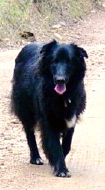 | |
| Shelby five years ago. |
Now she is about 12 years old (we don't know for sure), and she sleeps a lot. She gets glucosamine tablets in her food, but runs with a stiff sort of rocking-horse gait. Her muzzle is graying.
Yet today she charged a full-grown black bear, and her "victory celebration" afterward suggested that she was sending a message—to somebody.
Shelby, Fisher the Chesapeake, and I started our walk about 8 a.m., up through our property and onto a narrow Forest Service road that runs through a small meadow, pines and Gambel oak on both sides, and a deep gully or ravine on one side parallel to the road.
As usual now that she is 12, Shelby poked along, sniffing things, eating a bit of grass, peeing beside the road. A "sniff walk," as one dog writer called it.
Fisher, by contrast, galloped about 70 yards up the road, came back, turned and galloped off again, just bursting with excess
I stepped past some trees and saw him on the far side of the gully, pursued by a bear. He likes to charge down into the deep gully and up the other side, but this time he must have come nose to nose with the bear, who was now chasing him at a half-serious lope.
I called him, "Fisher, come!!" He came out of the gully, the bear paused on the far side, I kept calling. I had just one leash with me—for Shelby, when she is too pokey. After all, she was just strolling along, sniffing the roadside vegetation, the elderly dog.
She shot past me, full tilt, no creakiness, head down, tail streaming, barking a little. She zipped past Fisher, who seemed momentarily undecided whether to follow her back down into the gully or come to me. Fortunately, he came to me.
The bear turned and ran. Maybe all this yelling and dog action was too much for it. Shelby chased it into the thick oak brush. Visions of mauled dog ...
Then there was the black flag of her tail visible, and she came trotting out into the open, whereupon she squatted with her back to where the bear had gone and "marked," demonstrating with a few drops of urine her opinion of that bear.
(She has been known to pee on the door mats of houses wherein live dogs whom she despises.)
We went home then. Shelby has just lain around the house the rest of the day. The weather is hot, and she has that thick coat from the collie side of her ancestry. (The other side is Labrador retriever, we were told.)
She let us all know: she is still the Bandit Queen.
August 20, 2011
Radio-tagging Rattlesnakes
Once piece of folklore that I heard repeatedly after my rattlesnake bite five years ago was that baby rattlesnakes were more dangerous than adults. This researcher says otherwise.
Katie Colbert, a naturalist at Sunol-Ohlone Regional Wilderness, has often heard people warn that a baby rattlesnake is a greater threat due to the fact that they're unable to control the amount of poison they inject into their victim when they bite. According to Colbert, this is just not true: all rattlesnakes, babies and adults, can control their venom. In addition, Colbert says, "Baby rattlesnakes can only produce and stash a very small fraction of [venom] an adult can." This does not change the fact, however, that a bite from any rattlesnake, regardless of age, is a dangerous bite and requires medical attention.Watch for the rattlesnake living in the wall of the visitor center. I don't expect that they tell all the little kids about that one.
August 19, 2011
Not Exactly the Civilian Conservation Corps: Politicians' Promised 'Green Jobs' Are Not Appearing
Certain politicians have been promising that "green jobs" will lead the way out of the recession.
So far it is not happening, not in California and not in Seattle, Washington.
But I have to wonder if the villain is energy conservation—that is hard to believe—or if it is clumsy, top-heavy government programs.
Forest Army is a blog about the CCC—no recent posts, but good stuff in earlier posts.
So far it is not happening, not in California and not in Seattle, Washington.
But I have to wonder if the villain is energy conservation—that is hard to believe—or if it is clumsy, top-heavy government programs.
[Seattle Mayor Mike] McGinn had joined Vice President Joe Biden in the White House to make it. It came on the eve of Earth Day. It had heady goals: creating 2,000 living-wage jobs in Seattle and retrofitting 2,000 homes in poorer neighborhoods.People who go to meetings get jobs. People who might be climbing a ladder and turning a wrench don't get jobs.
But more than a year later, Seattle's numbers are lackluster. As of last week, only three homes had been retrofitted and just 14 new jobs have emerged from the program. Many of the jobs are administrative, and not the entry-level pathways once dreamed of for low-income workers. Some people wonder if the original goals are now achievable.
"The jobs haven't surfaced yet," said Michael Woo, director of Got Green, a Seattle community organizing group focused on the environment and social justice.
"It's been a very slow and tedious process. It's almost painful, the number of meetings people have gone to. Those are the people who got jobs. There's been no real investment for the broader public."
In the Bay Area as in much of the country, the green economy is not proving to be the job-creation engine that many politicians envisioned. President Obama once pledged to create five million green jobs over 10 years. Gov. Jerry Brown promised 500,000 clean-technology jobs statewide by the end of the decade. But the results so far suggest such numbers are a pipe dream.The Civilian Conservation Corps of the 1930s, whose benefits we still reap in state and national parks, national forests, scenic parkways, etc., started—so I am told—with a one-page document. Maybe someone needs to dig it out of the federal archives.
Forest Army is a blog about the CCC—no recent posts, but good stuff in earlier posts.
August 18, 2011
A Couple of Poisonous Plants & One Useful One
 |
| Monkshood |
 | |
| False hellebore pods |
Rather than photograph the showy striped leaves, which you can see at the link, I snapped one of the pods. Too bad I did not catch it in bloom—but you can see blooms here too.
Monkshood, also known as wolfbane, has poisonous roots and leaves. The man who taught me to identify it was surnamed Bane (which means slayer, poison, etc.), so he got a kick out of that.
 | |
| Usnea |
False hellebore is poisonous to sheep in particular.
The whole plant is poisonous, containing highly toxic alkaloids that affect the heart and nervous system."This area is elk range, but apparently they are not bothered. One article I found while browsing suggests that deer, if not elk, not only eat some plants poisonous to livestock but follow the approach of "a little bit won't kill you."
Sheep which eat false hellebore while during the first trimester of pregnancy have lambs with severe abnormalities of the brain and face (known as Cyclopia).
Continuing our walk, we came to stand of firs that were a real Usnea (old man's beard) plantation, both live trees and dead ones.
M. wanted some for an herbal wound powder that she is making, so we partly filled what was supposed to have been a mushroom sack with Usnea.
August 17, 2011
Cowboy Talk
 |
| Nebraska cowboy, 1886 (Library of Congress). |
Cowboys lay awake nights trying to think of "good ones" to play on the tenderfoot. We tied an old cowboy to a tree once and told the tenderfoot that he was a madman, had spells and was very dangerous. At the appointed time the cowboy broke loose and the new comer made it to town, five miles on foot, in a very short time.And the work:
"Boiled beef and Arbuckle Coffee was our standby. The boys used to say if old man Arbuckle ever died they'd all be ruined and if it wasn't for Pecos water gravy and Arbuckle Coffee we would starve to death.
"I have known cowboys to ride one hundred miles per day. I know this sounds unreasonable but they were off before daylight and rode hard until after dark. Their usual day's work was to be off as soon as they could see how to catch their horses, throw the round-up together around 10 o'clock then work cattle or brand until dark and often times stand guard one-third of the night after that.No wonder many cowboys were ready to look for easier work once out of their twenties.
Or you can just read the memoirs of E.C. "Teddy Blue" Abbott, who started cowboying in the 1870s. His book We Pointed Them North is available from the usual sources.
All that open-range stuff lasted just one generation, and by the 1890s late-middle-aged stockmen were getting all nostalgic about it, hence the Cheyenne Frontier Days, etc. etc. etc.
Greeley Schools Build a Better Burrito
The New York Times reports on how public schools in Greeley are going to back to making their own cafeteria food for better nutrition:
Consider the bean burrito: last year, in arriving from the factory wrapped in cellophane, each one had more than 35 ingredients, including things like potassium citrate and zinc oxide. This year: 12, including real cheddar cheese. Italian salad dressing went from 19 ingredients to 9, with sodium reduced by almost three-fourths and sugar — the fourth ingredient in the factory blend — eliminated entirely. . . . .They promise the kiddies their familiar bright yellow mac-and-cheese, but colored with tumeric instead of some industrial chemical.
“The biggest myth is that it costs more money,” said Kate Adamick, a food consultant based in New York and co-founder of Cook for America. She said federal reimbursement rules could actually give poorer school systems some advantages in shifting back to scratch, especially for meat, which many districts buy with deep discounts. Cooking the meat themselves, rather than paying a processor, can drastically reduce total costs, she said.
August 16, 2011
Re-creating 1924 on Mount Everest

Last year's documentary The Wildest Dream, which M. and I only got around to watching this year, offers a few sequences (filmed in 2007) in which climbers Conrad Anker and Leo Houlding test the old-style silk and woolen garb.
Their verdict: comfortable and all right while moving, but not so much insulation when one is standing still on the mountain. And the boots . . . Anker and Houlding are seen stripping off the leather hobnailed boots and frantically rubbing and blowing on their frigid feet. (Nails conduct heat out, for one thing.) When it comes time to free-climb the infamous Second Step, they opt for modern gear.
The Wildest Dream begins with Anker's discovery of Mallory's body on Everest in 1999. The rest is a two-track sequence in which the 1924 expedition is re-created through still photos, old movie footage, and voice-overs of Mallory, his wife, Ruth, and other participants.
[Conrad Anker writes:] On May 1, 1999, my life as a climber intersected with that of George Mallory. At an elevation of 27,000 feet, I came across his dessicated and frozen body. It was a humbling moment – for it was on his shoulders that future generations of climbers built their ability. As I gazed out across the Tibetan plateau I thought of the incredible journey these men had undertaken – stepping into terra incognita of the physical and emotional boundaries of human endurance. No one had been as high as Mallory and Irvine.Interwoven with this historical chronology, Anker and Houlding set out to climb the mountain by the same North Col route. Obviously, the mid-forties Anker is analogous to Mallory (who was 37 when he died), while Houlding, in his late twenties, stands in for Sandy Irvine, 22 at his death—the difference being that Houlding brings more climbing experience to the mountain than did Irvine, although Irvine was strong, athletic, and presumably learned fast.
My life changed. Mallory was no longer a figure out of the history books. He was, although dead 75 years, a real person to me. I honored who he was and what he stood for. The maelstrom of press that followed the discovery was intense and heated.
With each passing year the mystery of Mallory and Irvine grew within me. The story of their challenge and disappearance haunted me. I decided that I would delve into their story, to seek out the minutaie of their expedition and find a thread of parallel events between 1924 and our current time frame of climbing. Addressing the challenges they sought, aspired to and eventually gave their lives for will allow us to appreciate who they were.
As an attempt to explore Mallory's psyche, the movie succeeds well enough. Anker clearly clings to the hope that Mallory and Irvine might well have made the summit before they died. Lacking the camera they are believed to have carried, which might possibly be with Irvine's as-yet-undiscovered corpse, this hope stands on three pieces of circumstantial evidence:
- The photo of Ruth that Mallory said he would leave on the summit was not in his pockets.
- His tinted sun goggles were, however, in his pocket, suggesting that the two were coming down at dusk, meaning that they might have summitted.
- His oygen cylinders were missing, discarded somewhere when empty, again suggesting that they had not turned back early. (Various calculations of oxygen use versus climbing speed can be used to argue for or against this possibility.) Mallory's partisans argue that if he got close enough, he would have gone for the summit, alone or with Irvine.
August 13, 2011
Late Summer Arrives
Out walking Fisher this morning, a faint whiff of humidity in the air, wind from the east, might mean something.
Climbed the ridge to where I had set two scout cameras—now that we own that land (which we treated as ours for nineteen years in terms of walking on it), I can leave them up for longer times, just changing out the rechargeable batteries weekly. Sitting in slippery pine needles doing just that when there is a thump and a wet nose in my ear—back from her self-directed walk, Sheby (the collie-mix dog) has come and found us.
No good images this week.
I sit the bird feeders on top of the Jeep's spare tire and fill them with sunflower seeds. Evening grosbeaks and mourning doves wait for me to arrive.
There is that change in the air that means Late Summer, a hint of coolness in the heat, a slight drop in the sun's power. M. and I hope for a rainy weekend that will bring up some mushrooms on the fir-covered ridges. Some salvage for a summer that we just endured. And I am feeling edgy, like I want to get out of my weekly routine.
August 12, 2011
How to Fail at Hiding Out in the Mountains
 |
| Lee Grace Dougherty, failed camper (Associated Press). |
Their mother says, "I'm glad they were found," as though they got lost on a Boy Scout hike. But isn't that always part of the script?
Life in Walsenburg, Colo., was considerably disrupted yesterday.
Back from our supply run to Pueblo today, M. and I ate supper as the sun sat over Holt Mountain and chuckled at such lines as "the remote San Isabel National Forest in southern Colorado" from the Boston Herald.
They camped one night in a pullout off a paved state highway. Not what I call "remote". Not more than two miles away, a road gave access into the heart of the Wet Mountains with many obscure little spur roads off it. But when they were shopping for camping gear and ammo in Colorado Springs and/or Cañon City, they evidently did not pick up national forest maps.
Then they drove down onto Interstate 25 and into their eventual fate. One night in the woods and their nerves failed them?
I tell you, it's sad. No one knows how to hide out in the mountains anymore.
August 11, 2011
No Simple Answers in Salvage Forestry and Water
 |
RIGHT: Butch Siegel, a contract logger, stacks trees cut down near the Wildernest subdivision in Silverthorne in January 2010. Foresters had hoped that the trees would be sold to timber mills near Montrose and South Fork and a government-supported pellet factory near Kremmling. (Daniel Petty, Denver Post file)
It's complicated. Different parts of the state have different beetle infestations. They affect mostly ponderosa pine around here, lodgepole pine in northern Colorado, and spruce in the San Juans and the Rio Grande headwaters. Reinholz was forced to reach back to the 1940s for an analogous situation—in yet a different part of the state:
One study that did look at the impacts of spruce beetle infestation examined the White and Yampa river basins over a 14-year period after massive blowdowns sparked the bug's rise in the 1940s.And then there is always the bright guy who wants to know if more logging would not have stopped the outbreak.
The White saw a 22 percent increase in stream flow while the Yampa jumped 14 percent, but Reinholtz said the increases came largely at the latter end of the study.
He said water yields could also be dependent on whether spruce stands were mixed in with other tree species like aspen, which might absorb part of the water yield.
Forty-eight percent of the [Rio Grande National] forest's spruce stands sit in wilderness and backcountry areas that are off limits to logging or other forms of treatment.And one other reason goes unsaid in that article. There are a lot fewer sawmills in Colorado than there were two generations ago. Once every town seemed to have a sawmill. (And the smoke from teepee burners filled mountain valleys.) They could not compete with the big corporations shipping in lumber from the Pacific Northwest and British Columbia.
Moreover, the nation's recession has not spared timber markets, shrinking the demand for the wood that's available, he said.
In northern Colorado, beetle-killed lodgepole pine logs are piling up with no one to mill them. (See Denver Post photo above.)
Dead-tree cutting across northern Colorado and southern Wyoming — to reduce the risk of catastrophic wildfires and of dead trees falling on people — has left an estimated 170,000 piles of trees and slashed branches, Forest Service supervisors said last week. Contractors contend they can't find markets because Colorado has few mills and Canadian timber imports keep prices low. . . . .
Federal foresters who received $40 million in emergency funds from Washington initially assumed that contractors would be able to sell cut trees to timber mills near Montrose and South Fork and a government-supported pellet factory near Kremmling.So the logs have to be trucked a couple of hundred miles over mountain passes to a mill—or to a government-subsidized factory? Don't you love the economics of it?
But there is always someone who thinks they have the simple solution.
Subscribe to:
Posts (Atom)