They figure in "Sad River Roundup, a short short story by Tim Cooper from Mountain Gazette.
"Texas Vertigo" is a useful phrase for southern Colorado and New Mexico—I am going to remember it.
November 05, 2011

November 03, 2011
How the Humane Society of the US Does Not Help Animals
It's too busy managing its investments.
From the New York Post:
From the New York Post:
HSUS's advertisements employ the images of downtrodden dogs and cats to tug at the heart strings and wallets of America's pet lovers. But CCF's new analysis finds HSUS is a "Humane Society" in name only, sharing a meager $527,566, or 0.4 percent of its $120 million budget with sheltering organizations nationwide in 2010. In the same year, HSUS spent $47 million in fundraising-related costs (37 percent of its total budget) and put $32 million in hedge funds.
November 02, 2011
Light-Colored Cars Get Better Mileage
That is, if you are running the air conditioner.
I never understood why anyone in the sunny Southwest would buy a black car or truck, but some do. They're looking cool while being hot—and not in a good way.
I never understood why anyone in the sunny Southwest would buy a black car or truck, but some do. They're looking cool while being hot—and not in a good way.
October 31, 2011
Some Colorado Springs Ghosts—and the Unquiet Ghosts of Teller County
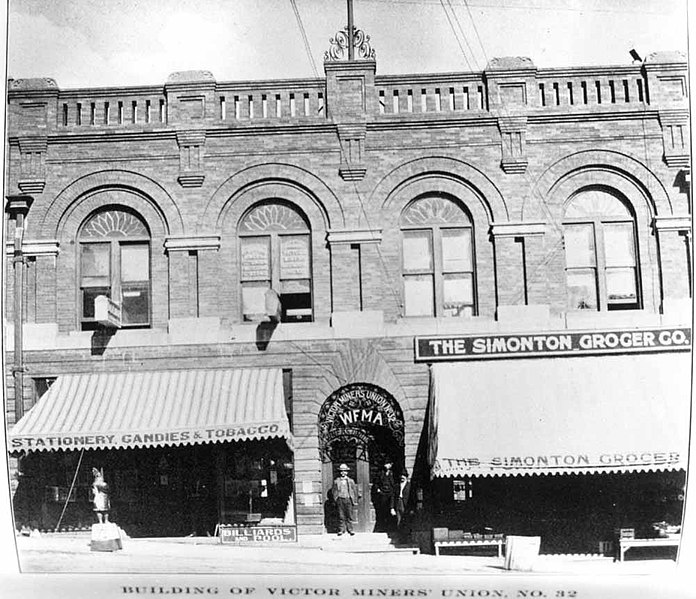 | |
| Western Federation of Miners hall, Victor,1903. |
In my young newspaper reporter days, I did my part for Cripple Creek and Victor.
At the time, I was covering both the gold-mining boomlet of the early 1980s and also some Colorado labor history, such as the activities of the Western Federation of Miners in the early 1900s.
They did not make it into the book, but I had a couple of woo-woo experiences in Cripple Creek and in the nearby ghost town of Goldfield of my own.
In one of them, I was walking into faded glory of the 1904 Teller County Courthouse to cover a hearing about leakage from a cyanide heap-leaching operation killing some horses. Just ordinary reportorial stuff.
I had never entered that building before. At the foot of the staircase leading up to the courtrooms, I almost had a panic attack. I was sure that I was walking up to my doom — but I wasn't "me."
In the second, I was leaving Victor and decided to drive through the site of the mining town of Goldfield, "a strong union town," instead of back via Cripple Creek on the way to Colorado Springs and the newspaper office.
The scene out the windshield was 1980 or 1981 Goldfield, which is to say, not much. But to my ears and inner senses, it was all shouting and turbulence and emotion of the 1894 miners' strike, when the Cripple Creek police shot down the Goldfield constables, mines were dynamited, the militia was called out, and gunfights flared between miners and sheriff's deputies back by the mine owners.
It was like being in two places at once, one foot in the past and one foot in the now. The experience lasted less than minute but left me feeling emotionally exhausted.
That strike was just the beginning of the Colorado Labor Wars, when things got even worse.
Bad times—more or less swept under the rug of history now. Now we hear only of a street vendor selling "hot waffles to miners, railroad passengers and barflies."
October 30, 2011
Michael Pollan's New Food Rules
Michael Pollan's new food rules, from the upcoming of the book of the same name.
I like #7, "Enjoy Drinks That Have Been Caffeinated by Nature, Not Food Science"
This also reminds me of the advice that I gave to students in magazine-writing class: you can always sell a story built around a list.
I like #7, "Enjoy Drinks That Have Been Caffeinated by Nature, Not Food Science"
This also reminds me of the advice that I gave to students in magazine-writing class: you can always sell a story built around a list.
October 28, 2011
What Do You Think about Falconry?
Two British researchers, Helen Macdonald (University of Cambridge) and Mike Nicholls (University of Greenwich) have created an online survey on people's understanding of falconry and their opinions about it.
Although some questions are particular to the UK, respondents from other countries are welcome.
Although some questions are particular to the UK, respondents from other countries are welcome.
October 27, 2011
Not Always Happy Endings
 |
| Two day-old mule deer fawns after their rescue. |
I learned yesterday that the smaller fawn, the little male seen here being fed from a syringe on the day he arrived, had gone into a sudden decline and died.
His caretakers were a married couple, both retired schoolteachers, and yesterday she wrote,
[Tuesday] morning he didn't want his bottle, and that was very strange. I noticed he had a very runny stool and then it turned to blood. He made it through the day quite comfortably and I had some hope Last night when everyone left for the night I kept him in the shelter, knowing that if I didn't he would have a very miserable death out in the snow. The little guy never got to see the snow. I slept in the shelter with him til about eleven and then went inside. This morning I found him in his favorite corner in the fresh straw.You have to be emotionally strong to do that job year after year. Yes, maybe this fawn was too undeveloped, being the smaller of the two survivors. Yet I had seen him just a week ago, running around the pasture and looking OK.
It is even worse at the Raptor Center, I know, where only something like 25-30 percent of the birds brought (if that) survive. Like the great horned owl that I picked up in September—it was alive and feisty, but a wing was shattered beyond repair—probably from a power line collision—and the director decided to put it down.
They have a couple of one-winged birds in captivity, but those birds never can get around well, and the protocol nowadays is to euthanize them.
Supporting San Juan Wilderness Act
 |
| Click to embiggen |
October 26, 2011
Improbable Mountains

Anyone with a little historical sense could get it right. All the names were assigned in the 19th century, and there were no moose in the state then, so "Moose Range" has to be the right answer.
But a lot of people thought that the Wet Mountains were mythical. Perhaps that is a Good Thing.
Colorado Seeks Big-Game Hunting Photos, Stories
News release:
Colorado Parks and Wildlife is giving big-game hunters the opportunity to share their hunting accomplishments with others. Hunters who were successful during Colorados 2011 big-game seasons can submit stories and photos to be posted on a Hunter Testimonials page featured on the Parks and Wildlife website.
Hunters of all experience levels, ages and backgrounds are encouraged to participate. The best photos may be used as covers for upcoming regulations brochures or in future editions of Colorado Outdoors magazine.
Hunting stories should be limited to 250 words and be accompanied with high-resolution, digital photos detailing the experience. All submissions will be edited and reviewed to ensure rules and hunting regulations are followed. Publication is not guaranteed, and all submissions become the property of CPW.
For submission instructions and to view the "Big-Game Hunter Testimonial" page, click here.
October 25, 2011
Hunting, Fishing Video Games Threaten the Real Thing
Indoor pseudo-birding on a computer screen is bad enough. Maybe it is not a threat to real birding.
On the other hand, hunting and fishing video games like "The Strike" and "The Hunt" from Bass Pro Shops could threaten real hunting and fishing while pretending to promote them. In the fishing game,
And as a Nintendo Wii "hunter,"
When you go hunting and you kill a rabbit, for example, you have ended the life of a living creature with whom you share the earth.
Its heart stops pumping, its brain stops buzzing, its essence goes to wherever a rabbit's essence goes. It was not a creation of pixels and electrons—it was alive the same as you are.
So eat it with respect and understanding.
Why would a game like The Hunt, to pick that one, threaten hunting?
• If it were realistic, it would show you that there are more places with no deer than with trophy bucks. But to keep game play moving, you have to find a pixel-deer quickly. Real hunters might walk or watch or sit in a stand all day and see nothing. Can't have that!
Of course, when you "see nothing," there is a lot to see. Real birds, for example. All the processes of nature—a coyote hunting mice while you watch him through binoculars.
Consequently, someone who plays the game and then goes hunting—unless it is on a well-stocked commercial game farm—will probably feel cheated. How come they have to wait for hours for the action to start???
They will end up more interested in the video version of hunting than in real hunting—until another game comes out that they like better.
• There is no emotional investment in place. If I hunt an area for deer, I want to see it protected. I don't want to come back next year and find an oil well or an illegal off-road motorcycle track or anything else incompatible with the deer's existence as a species. Pixel-hunters probably could not tell you plants deer eat in their area.
• They may end up confusing living, sentient animals with "targets." Bang! And your score goes up. They will never have to confront their direct, personal, bloody-handed involvement in processes of life and death. Instead, they just see what is on the screen.
They will never have to think things through: Should I take that shot? If I miss, will the bullet sail off toward the ranch house? If I kill an elk in this canyon, how will get I get it out?
• They will not understand that the work only starts when the animal is down. Field-dressing, transporting, butchering, cooking, and eating—those are all part of the hunting experience too.
• They will not be participating in the inevitable politics around hunting and fishing: habitat protection, gun rights, public input on wildlife management—all vital.
• Their hearts may race when the play the game, but they will never experience love—love of a place, love of wild animals (yes, even though we kill some of them), love just being "out there."
Put down the Wii controller, pick up a real fishing rod or gun. And if it's off-season, the membership fees at a lot of shooting ranges (around here, at least) are less than the cost of the game.
On the other hand, hunting and fishing video games like "The Strike" and "The Hunt" from Bass Pro Shops could threaten real hunting and fishing while pretending to promote them. In the fishing game,
The player starts out as a rookie looking to climb the ranks against competitive pros, collecting sponsors, boats and prize money that players can use to upgrade their equipment as they progress. Each tournament features a Sports Ticker to keep you updated on how the competition is doing. [from a news release]See anything in there about species knowledge, about conservation, about habitat, about ethics? No, me neither. It's all about things.
And as a Nintendo Wii "hunter,"
The player also has to stay alert for one-of-kind Legendary animals as well as Dangerous predators hunting you. Each level also allows the player to hunt a real life record-setting King of Bucks™.Real hunting is not a "tournament." And the "King of Bucks" is not something you find in real life.
The new Career Mode offers more realistic hunting challenges set in a Last Man Standing tournament structure.
When you go hunting and you kill a rabbit, for example, you have ended the life of a living creature with whom you share the earth.
Its heart stops pumping, its brain stops buzzing, its essence goes to wherever a rabbit's essence goes. It was not a creation of pixels and electrons—it was alive the same as you are.
So eat it with respect and understanding.
Why would a game like The Hunt, to pick that one, threaten hunting?
• If it were realistic, it would show you that there are more places with no deer than with trophy bucks. But to keep game play moving, you have to find a pixel-deer quickly. Real hunters might walk or watch or sit in a stand all day and see nothing. Can't have that!
Of course, when you "see nothing," there is a lot to see. Real birds, for example. All the processes of nature—a coyote hunting mice while you watch him through binoculars.
Consequently, someone who plays the game and then goes hunting—unless it is on a well-stocked commercial game farm—will probably feel cheated. How come they have to wait for hours for the action to start???
They will end up more interested in the video version of hunting than in real hunting—until another game comes out that they like better.
• There is no emotional investment in place. If I hunt an area for deer, I want to see it protected. I don't want to come back next year and find an oil well or an illegal off-road motorcycle track or anything else incompatible with the deer's existence as a species. Pixel-hunters probably could not tell you plants deer eat in their area.
• They may end up confusing living, sentient animals with "targets." Bang! And your score goes up. They will never have to confront their direct, personal, bloody-handed involvement in processes of life and death. Instead, they just see what is on the screen.
They will never have to think things through: Should I take that shot? If I miss, will the bullet sail off toward the ranch house? If I kill an elk in this canyon, how will get I get it out?
• They will not understand that the work only starts when the animal is down. Field-dressing, transporting, butchering, cooking, and eating—those are all part of the hunting experience too.
• They will not be participating in the inevitable politics around hunting and fishing: habitat protection, gun rights, public input on wildlife management—all vital.
• Their hearts may race when the play the game, but they will never experience love—love of a place, love of wild animals (yes, even though we kill some of them), love just being "out there."
Put down the Wii controller, pick up a real fishing rod or gun. And if it's off-season, the membership fees at a lot of shooting ranges (around here, at least) are less than the cost of the game.
October 23, 2011
On Building Ski Fences
 |
| Photo: Jon Kovash |
If you live in a ski town, you can amass old skis with a perusal of ski swaps, free boxes and dumpsters. Most prized are skis without bindings because the bindings are a pain in the ass to remove. If you want a tall fence, with the advent of short skis, the old 200s will be harder to find. For colors, I prefer just going with the random cacophony of industrial day-glo, which gives you a kind of happy camo look, but you can also look for matches or color groupings.The trouble is, you can't build one if you live in some planned development — "The Turds at Elk Meadow" — because of all the covenants.
And as Kovash experienced, some towns like Telluride reject "new vernacular architecture that supports our lifestyles and doesn't hog energy" because it doesn't fit the Mining Era historic-district look.
Leadville or Salida or Walden would probably let you build one though.
October 22, 2011
Federal Appellate Court Upholds the 2001 Roadless Rule
 |
| Doesn't enough of Wyoming look like this already? (Source: The Wilderness Society) |
The state tried to argue that by protecting roadless areas — which is a Good Thing for animals like elk — the Forest Service was creating "wilderness."
And "wilderness," in the legal sense, must be created by Congress, not the executive branch.
But the judges disagreed:
In a 120-page decision, the court said that full wilderness protection was far deeper than the mere banning of roads in certain places and that the Forest Service had broad jurisdiction in setting the balance of uses on the lands that it manages.This was the Tenth Circuit Court in Denver—the Ninth Circuit had reached a similar conclusion two years ago.
“The Forest Service did not usurp Congressional authority because the roadless rule did not establish de facto wilderness,” the court said in a decision written by Judge Jerome A. Holmes, who was nominated to the court by President George W. Bush.
I am no legal scholar, but I think that as long as the different federal appellate courts agree, the Supreme Court is less likely to be interested in such a case. Qualified legal experts are welcome to enlighten me. But Wyoming could always try another appeal.
October 21, 2011
Why Hunting is not a "Sport"
Two interesting pieces of writing popped up this morning.
In a blog post, Galen Geer questions the very term "sport hunting." I tend to agree. (It comes after the part about checking his blood pressure in the duck blind to prove something to his physical therapist.)
Plus there is a list of outstanding contemporary books on hunting, and I was happy to see that I have an essay in one of them, A Hunter's Heart: Honest Essays on Blood Sport, David Petersen, ed.
But there is that "sport" word again. Galen has been researching its employment and concludes that it no longer fits. (It's like the term "sports coat," a 19th-century British coinage fossilized in the menswear industry.) Today the term "sports" means organized athletics, people wearing numbers on their backs.
In a blog post, Galen Geer questions the very term "sport hunting." I tend to agree. (It comes after the part about checking his blood pressure in the duck blind to prove something to his physical therapist.)
[At a recent Orion institute seminar there] was a lot of free discussion about the present state of recruitment to the outdoors but I heard something that was, to me, very important for the future of hunting, and it was the simple statement that hunting would be referred to as “hunting” and not “sport hunting” or have any other adjectives affixed to it. This is something that I totally agree with. I believe that we must stop the practice of trying to hide hunting under a pile of adjectives. I make this argument even after a great deal of research has shown me that the basis for “sport hunting” goes back to ancient Greece when the phrase “hunting for sport” actually appears in the writing of Xenophon.Meanwhile, in an interview on the Huffington Post, Holly Heyser discusses the difference between male and female hunters, advice for beginners, and her philosophy on eating wild foods.
Yeah, I may be a bit of a radical with some of my thinking on this subject, but what the hell, here goes: When I decided to take up hunting, my secret fear was that I would become callous toward animals. Surprise, surprise - the opposite happened. My respect for animals has grown exponentially, as has my love for them.(If you hear echoes of Paul Shepard there, you are right.)
I can hear the shrieks of horror already. "Respect? Love? But you kill them." I know it doesn't appear to make sense at all. Work with me: Most human relationships with animals are with domestic animals, and whether they're pets or food animals, they've all been reduced to a perpetual state of childhood, not just in their dependency, but often in terms of their mannerisms and behavior. The more I saw wild animals, though, the more respect I had for their amazing capabilities (and the more respect I had for wild humans, too).
Plus there is a list of outstanding contemporary books on hunting, and I was happy to see that I have an essay in one of them, A Hunter's Heart: Honest Essays on Blood Sport, David Petersen, ed.
But there is that "sport" word again. Galen has been researching its employment and concludes that it no longer fits. (It's like the term "sports coat," a 19th-century British coinage fossilized in the menswear industry.) Today the term "sports" means organized athletics, people wearing numbers on their backs.
We don’t box with, play tennis or football with, or any other organized activity, the animals we hunt. We don’t need to lie to ourselves or to the non-hunter by falling back on euphemisms to soften our language. We can start by removing one word and simply saying that we hunt, we go hunting, we are hunters.
October 20, 2011
Audubon Society Promotes Indoor Birding without Real Birds
I think that I just lost some respect for the Audubon Society.
I thought that they were about conservation, birds, and stuff like that. But now they have some West Coast public-relations firm promoting "online birding." And it is competitive, because outdoor recreational experiences should always be competitive, not, y'know, experiential.
Why not tell people that playing Angry Birds on their smart phone is a genuine interaction with nonhuman nature?
I suppose that someone that "kids these days" have to be introduced to an online experience before they can have the real thing. Really? Stay indoors? Look at a screen?
No links. If you think that "birding the net" is a wizard idea, look it up yourself.
I thought that they were about conservation, birds, and stuff like that. But now they have some West Coast public-relations firm promoting "online birding." And it is competitive, because outdoor recreational experiences should always be competitive, not, y'know, experiential.
While “Birding the Net,” players are challenged to collect dozens of virtual birds on over 100 highly trafficked websites. The game is both educational and fun, helping the next generation learn about the natural world around us. Whether you live in a city or on a farm, you can spot these birds from the comfort of your own home, no binoculars necessary!No, Liza Nedelman of MPRM Communications, that is not how you "learn about the natural world." As another large corporation's slogan put, "just do it."
Why not tell people that playing Angry Birds on their smart phone is a genuine interaction with nonhuman nature?
I suppose that someone that "kids these days" have to be introduced to an online experience before they can have the real thing. Really? Stay indoors? Look at a screen?
No links. If you think that "birding the net" is a wizard idea, look it up yourself.
Subscribe to:
Posts (Atom)