Where Nature Meets Culture—Plus Wildfire, Dogs, Environmental News, and Writing with a Southern Rockies Perspective.
May 13, 2019
Nevertheless, She Pointed
Wendy, the visiting German wirehaired pointer, is a . . . pointing dog. She is impressive on pheasants, but she cannot pass up a robin in a city park either.
Tonight it was the broad-tailed hummingbirds that earned her concentrated and beady/birdy stare. They. Are. Birds.
Evidently that's how it works.
'False Spring' Pasta
We are used to "false spring" along the Eastern Slope of the Rockies.
Maybe now, with the last snow melted, this is the real spring, but I am still calling this dish pasta falsa primavera — with fillaree, lamb's quarters (quelite cenizo), clover, and dandelion, all picked within yards of the house.
May 09, 2019
Tranquilized Mountain Lion Bites Game Wardens
![]() |
| Colorado Parks and Wildlife photo, as far as I can tell. |
[Colorado Parks and Wildlife] said that while the cat was being lowered down, it awoke from the tranquilizer and bit two officers before being subdued again.I know these guys, so I will have something to say the next time that I see them. Leather gloves, at least?
The cat was then put in a bear trap and relocated.
April 27, 2019
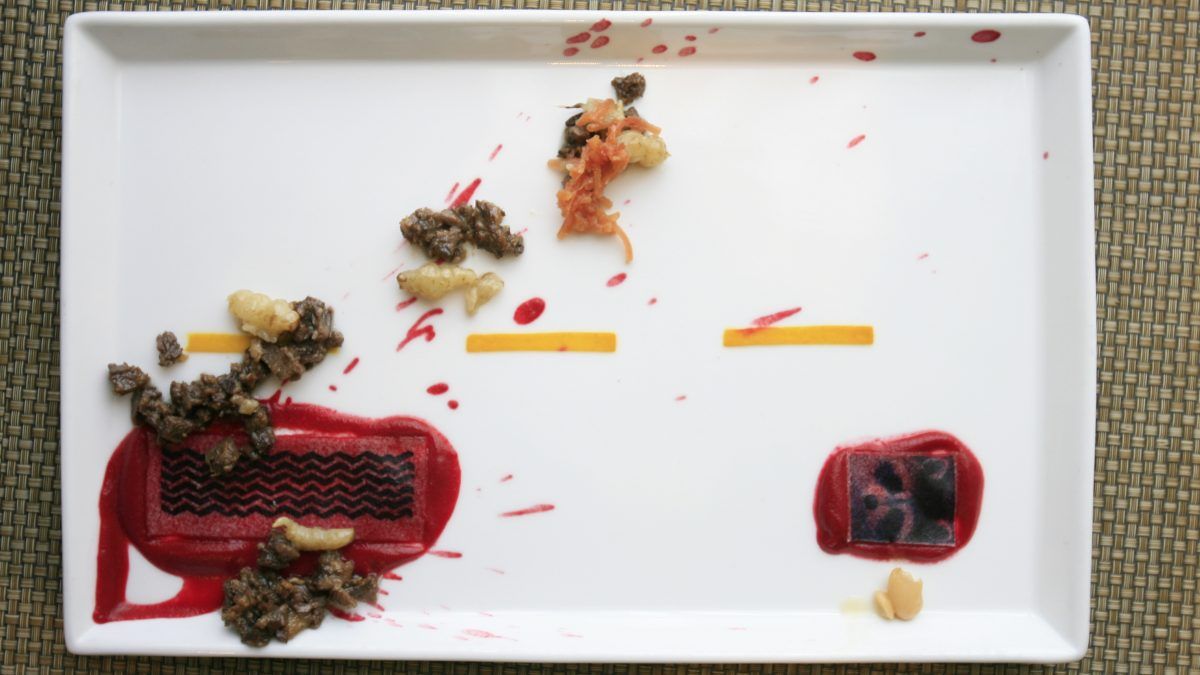
Trendy Chefs, Libertarians Discover Roadkill Cuisine
![]() |
| A presentation of raccoon meat resembling the scene of roadkill created by the late Moto executive chef Homaro Cantu and Chris Jones, chef de cuisine, at their now-closed restaurant at Fulton Market on the west side of Chicago, Illinois. (Alex Garcia/MCT/Newscom, published in Reason magazine.) |
One of them was the "roadkill pickup," inspired by the time when, while following him along US 50 in Cañon City, I had seen another car smack into a cock pheasant near Colon Orchards, and I had stopped, hopped out, grabbed it, and driven on as though someone were standing behind me with a timer.
His wife cooked it that evening. It was fine.
At Hit & Run, the blog of Reason magazine, food lawyer Baylen Linnekin applauds laws (including Colorado's) that liberalize the collection of road kill.
Bizarrely, though, many states prohibit the practice. In fact, as I detail in my recent book, Biting the Hands that Feed Us: How Fewer, Smarter Laws Would Make Our Food System More Sustainable, nearly half of U.S. states prohibit harvesting roadkill. Nevada, for example, conflates roadkill harvesters with poachers. Last year, a Louisiana man faced a fine of up to $750 and up to a month in jail for harvesting a dead fawn.
But help is on the way. Oregon's roadkill law, which I discussed in an earlier column, was adopted in 2017 and took effect this January. Subject to certain conditions, the law allows anyone who obtains a permit to harvest a deer or elk, which a person can eat, share, or give away. (Sorry, no skunk meat; though it's fine to harvest stink steaks in Idaho.)Then there are the "concern trolls":
"Our concern really is where people might intentionally hit animals for trophy or food," says John Griffin, senior director of urban wildlife programs with the Humane Society of the United States. "Like an elk or something large. It's incredibly dangerous. For both species."Does John Griffin know what hitting an elk does to your car, and maybe you? How many people would sacrifice a minivan or SUV for a free meal? He just does not want anyone eating wild game under any circumstances, that much is obvious.
April 24, 2019
Quick, It's Nest Box Time!
![]() | |
| American robin (Cornell) |
The Cornell University has an interactive guide that will help you download appropriate building plans and place your nest box: Right Bird, Right House.
Want to Monitor Bird Nests for Citizen Science?
You can sign up to monitor a wild bird's nest through Cornell's Nest Watch program.
Participating in NestWatch is easy and just about anyone can do it, although children should always be accompanied by an adult when observing bird nests. Simply follow the directions on our website to become a certified NestWatcher, find a bird nest using our helpful tips, visit the nest every 3-4 days and record what you see, and then report this information on our website. You can also download the NestWatch Mobile App for iOS and Android and record what you see at the nest in real time.
Why It Is All Worthwhile (Besides Science)
The inimitable Helen Macdonald, author of H is for Hawk, writes how seeing birds enter her childhood birdhouses provided "a little flush of pride dangerously near possession" and muses,
In Britain, the class system inflects nestboxes as it does everything else. You can buy boxes that resemble scale models of pubs or churches, ones with poems or flowers painted on the front, with tiny glued-on gates and picket fences. These are frowned upon by the gatekeepers of British nature appreciation, who recommend plain wooden ones. The RSPB explicitly warns against using decorative boxes in case their bright colours might attract predators, even though there’s no real evidence for this. Yes, metal boxes are a bad idea because they can overheat nestlings, but a handwritten “home sweet home” isn’t much of an issue when robins can and will nest happily in discarded teapots.Read the rest of her "Spring Reflection: A Birdhouse Makes a Home."
April 21, 2019
Spring Flowers &c. Seen While Walking the Dog
![]() |
| Sand lilies, Leucocrinum montanum. |
| Spring beauty Claytonis rosea (says the guidebook). |
| Dropped feather from a Eurasian collared dove, busy breeding already. |
![]() |
| Pasque flower, Pulsatilla patens |
April 20, 2019
This is the Best Bigfoot Podcast
I was trying to come up with the last name of the late Grover Krantz, a physical anthropologist, but having a brief memory lapse when the guy sitting next to me supplied it. An instructor at the U. of North Carolina at Charlotte, he was a walking Bigfoot database.
I had left Johnson Books by then, so I did not get to meet him, but the editorial director sent me a copy. I read a lot of it by lantern light at night, curled up in my van, parked at some duck-hunting spot in the San Luis Valley. It helps to be alone in the dark when reading any Bigfoot book.
The guy sitting next to me offered another piece of information: Lauren Krantz, Gover's distant cousin, a former National Public Radio reporter-producer, started a Bigfoot-related podcast last year, Wild Thing.
Wild Thing is the best-produced podcast that I have ever heard. So many of the podcasts out there consist of one person ranting, or two or three buddies Skyping or calling via cellphone, so that sound levels are inconsistent as they can be. They trash-talk each other or swap in-house gossip or talk about what they are for lunch, and it just drags on.
I can think of one podcast where the main hostess is trying to answer questions in a chatroom while her guests are talking, so you hear the tickety-tock of her keyboard all the time.
Not here. When it comes to production values, Krantz's podcast sounds as good as Radio Diaries or This American Life, if you ever listen to any public radio.
![]() | |
| Wild Thing |
Hear her interviewed on Skeptic magazine's Monster Talk podcast. And here is Krantz interviewed by the Seattle Times: "Bigfoot Hunters Aren't Crazy, Just Curious."
She talks to experts, visits Bigfoot sites, and sits down for an interview with Bob Gimlin, now in his late eighties, but still willing to discuss the social and economic price he paid for being half of the famous "Patterson-Gimin" film of 1967, which purports to show a minute of a female Bigfoot striding through a Northern California riparian zone. There is the world of Bigfoot hunters and their disagreements, and of course, she goes on a Bigfoot hunt of her own.
You can find it on Apple podcasts, Stitcher, Spotify, Android, and on its own website. And buy T-shirts.
April 15, 2019
Ed Abbey Talks about his Park Ranger Days at Arches
Author Ed Abbey talks about his park ranger days at Arches National Monument (now national park) in the 1950s, the experience that produced his landmark book Desert Solitaire, in this 1985 short documentary.
Me, I will never forget visiting Delicate Arch early one morning in 1990, trying to get ahead of the crowd, but then the crowd arrived, and someone said, "It looks just like the [Utah] license plate!"
From Ned Judge, producer and director: "An eight minute film essay that I co-produced and directed with Ed Abbey
in 1985. At the time I was working for a network magazine show. The
executive producer took me to lunch one day. He told me that he was
having trouble with his son who was 18. The son thought his dad was a
corporate whore. He had told his father if he had any balls at all he’d
put Ed Abbey on his show. That’s why the EP was talking to me. Would I
see if it was possible? I had an acquaintance who knew Ed and he
passed the request along. Ed responded that he’d give it a try. He
signed the contract and wrote a script. We met in Moab and went out to
Arches National Park to shoot some practice sessions with a home video
camera. We would review them at the motel in the evening. After a day
or two, Ed was feeling pretty comfortable on camera so we scheduled the
shoot. We were all happy with the way it went. But then we ran head-on
into [NBC] network reality. Roger Mudd, the show’s host, was extremely
negative about putting an “eco-terrorist” on the show. The executive
producer had no choice but to cave. So this Abbey essay was put on the
shelf and never aired. Abbey died 3 years later in March 1989."
Ned Judge's more recent work includes The Medicine in Marijuana, an examination of the claims made for medical marijuana.
I can't embed the video, so watch it here.
April 13, 2019
Bird Festival, Cattle-Rustling, and Elk in Beetle-Kill Forests
• Plan now for the Mountain Plover Festival.
- You’ll get the chance to mingle with farmers and ranchers who choose to live in the local community and learn about their lifestyle.
- Eat home-style food at every meal. Most meal are prepared by the community non-profit organizations.
- Saturday evening includes a chuck wagon dinner with authentic Western entertainment.
- Learn about conservation practices and history of the area.
- Tour Private Land that would normally not be accessible.
- Make new friends! Here's the website.
• Cattle-rustling still happens in 21st-century Colorado.
But even keeping a close eye on livestock sales doesn’t prevent Colorado ranchers from experiencing their share of losses. Annual reports of missing or stolen livestock — the vast majority being cattle — average a little over 100, with losses ranging from a little over 400 to more than 650 head over the past four years. But that’s where the numbers get a little fuzzy.• Pine beetles and the fungus they carry have killed huge amounts of lodgepole pine forest in the northern Rockies. As the dead trees drop their needles and become just standing trunks, more grass comes up between them. So that would be good for elk, right?
The evidence, however, is mixed. Some species do benefit, but not much the elk.
Looking at elk daytime use during the summer in Medicine Bow-Routt National Forest in south-central Wyoming, [University of Wyoming researcher Bryan G.] Lamont’s team expected to find mixed results. The loss of canopy would likely mean a loss in thermal cover, and more downed trees would make it difficult for the elk to move, forcing them to expend more energy. On the other hand, with new understory growth, elk would have more vegetation to forage. They expected elk might avoid the densest areas of downed trees but take advantage of the forage in other places.Time on the elk's side, however, as the dead trees start to fall and decay. Read the whole article here.
Instead, elk tended to avoid beetle-killed areas overall, resulting in much less forest habitat that the elk use to keep cool during summer days. Beetle kill, researchers found, was different for the elk in important ways from wildfires or other disturbances.
April 12, 2019
Droning Around the Neighborhood
It starts with a view of the old Colorado Fuel & Iron steel mill in Pueblo —now a minimill owned by Evraz — and goes on to Bishop (or Bishop's) Castle (one man's dream), a nearby set of ranch ruins, and another historic site in the Wet Mountain Valley (Custer County).
Fisher's Missed Career Opportunity
![]() |
| I could have been a contender! |
Only now do we learn that he could have done something much the same for science!
The article titled "He couldn't hack it as a drug-sniffing dog. Now he's conservation's best friend," shows what he might have become, if I were a wildlife biologist:
Train, a Chesapeake Bay retriever, sniffs out the scat, or poop, of elusive wild animals like jaguars and oncillas in the name of conservation.
Oh well, there are still fresh turds to be discovered here. No jaguar though.It might sound like an unsavory task, but these scat samples are goldmines for researchers like Train's owner, conservation biologist Karen DeMatteo.
April 03, 2019
Trusting Siri in West Texas
![]() |
| Let Siri pick a route, and turn on the cruise control. |
On the other hand, when (female Australian) Siri tells me to veer off State Highway 208 and onto a county road (paved, but not posted at 75 mph like SH 208), I wondered what was going on. There was traffic on the road, though, so evidently there was no chance of dead-ending into the world's largest patch of nopales (prickly pear).
I had driven home-to-San Angelo a couple of times before, so I had an idea of where I was going, but there were lots of route choices. I decided to give Australian Siri her head, although when she tried to get us to our San Angelo motel the last time, she became hopelessly confused in trying to pronounce the street name, Beauregard.
Sheesh, where were we? US 87. Farm-to-Market 400. US 84, US 380, and finally (with a little cut-off), State Highway 208, blasting south at 80 mph through the high-fenced Texas game farms with their fancy gates.
I kept looking for some kind of exotic African antelope or something, but saw only four pronghorn antelope yearlings, locked among mesquite and red cedar, some whitetail deer, and the ubiquitous goats. Also lots of wind turbines, some of which were actually turning.
Y muchos nopales.
March 07, 2019
A Big Year for Colorado Avalanches
Heavy snow this summer has been causing avalanches in the Colorado high country. Interstate 70 was closed on Vail Pass early this morning, in fact.
Here is why there are so many avalanches:
The “historic avalanche cycle” started in October and November, when Colorado got a lot of early-season snow. That snow rotted into facets: imagine ball bearings or sugar-like snow that can’t be formed into a snowball. That’s the weak layer. Then came lots more snow. In the past month, CAIC forecasters started seeing fewer avalanches releasing on that weak layer on the ground.
Then came even bigger storms — like this past weekend when 40 inches fell in two days in the Central Rockies, or the 50 inches that piled up in 50 hours in the Four Corners area two weeks ago. And the slab grew even larger and heavier, all sitting atop the weak layer on the ground. That means every falling flake boosted the chance of a catastrophic slide. And in this latest round of storms, the final flake fell on slide paths above I-70.I lifted this video and quote from an article in the online Colorado Sun — go there for more video and background information.
February 24, 2019
Attacked on the Trail by a Mountain Lion (3)
Part 2 here
![]() | |
| Infrared image of a mountain lion. Scroll down to learn about mountain lion photography from an expert. (Photo: Stanford University) |
During a spring bear/turkey hunt (spring bear hunting in Colorado ended in the early 1990s), the guides decided to provide some after-supper entertainment.
They took the clients (two or three men) and me down into a side canyon of Grape Creek, and Guide 2 showed us how to wail on a mouth-blown predator call. Then he shined his red spotlight across the drainage and there sat two lions — youngsters traveling together, we suspected.
They watched us. We watched them. We were ready to leave, but there they were. Finally a guide pulled out his .44 Magnum revolver and fired a couple of shots over their heads.
Blink. You could imagine them thinking, "It makes loud noises." Top predator, meet top predator.
We started walking back up a rocky path to our vehicles. The guide cast his red light back and forth behind us, but it kept getting dimmer and dimmer. Later, he claimed he had controlled that dimming with a rheostat. I suspect that his batteries were just worn out.
It was dramatic though. By the time we had the clients back to the nearby cabin, one of them, a lieutenant in a Southern California police department who had told us tales of his urban exploits, was about ready to jump out of his skin.
Me, I went out and bought a red spotlight with rechargeable battery and some predator calls. Now and again I like to see what's out there. And of course there are the scout cameras.
If I lived in northern Colorado I would be tempted to take one of these courses
How does "Mountain Lion Photography Workshop" sound?Join local wildlife videographer and conservationist David Neils for a deep dive on the habits and habitat of mountain lions in Northern Colorado. You'll learn how to map the hunting and travel routes of these apex predators using four natural factors to view the landscape like a mountain lion, and capture weekly video of these elusive predators.Here is a list of dates and places.
February 19, 2019
The Cult of "Ute Prayer Trees"
"Bent Trees Part 1: Pseudo-archaeologies" was published last week on the What's Up, Archaeology? group blog. The author, Holly Kathryn Norton, is the Colorado State Archaeologist, and this is only Part 1 of her fisking of this contemporary "old Indian legend."
As you walk through a forest in Colorado, or anywhere else, really, there are trees that have not grown straight. In Colorado, particularly in the Pike’s Peak region of the Front Range, a contemporary mythology has grown around these trees. The myth takes many forms but the foundational logic is that these trees were purposely bent by the Ute Tribe, and the name given to the trees hints at why proponents of the practice think the Ute bent the trees- Prayer trees, burial trees, spirit trees, grandfather trees, marker trees, vortex trees, trail trees. The names change as the loosely formulated hypothesis are challenged by both professional archaeologists and the Ute themselves.A little basic forestry combined with knowledge of history disproves a lot of it. I have made this same challenge to "prayer tree" proponents: Take a forester's increment borer, pull a core, and count the rings. Any ponderosa pine tree "modified" by the Utes on the Eastern Slope of Colorado ought to be at least 150 years old. If it's only 70 years old, then forget it. And if you know pine trees, you will know that many of the trees so described are far too young to have been modified by old-time Ute people.
There have also been serious questions about the age of individual trees that have been identified as “Ute Trees.” Core samples taken a couple of years ago on a tree that was identified as a “prayer tree” aged the tree to 67 years old, well after the Utes were forcibly removed from the Front Range to reservations in the Southwestern part of the state, nearly 8 hours away by modern car travel. I was personally told that this age is not accurate because “bending trees causes the DNA in a tree to change, so modern dendrochronology no longer works for aging a tree.” These kinds of arguments are just false, but no amount of fact-checking can refute such a blatant disbelief in scientific information.And yet . . . and yet . . . this desire to see Ute Prayer Trees (or for some people, trees modified by Bigfoot) is what people have always done, seeing the spiritual side of nature and trying to put a name and face on it, whether it's dryads or Druids or you name it.