Showing posts with label Oregon. Show all posts

December 31, 2023

Wolves Now Add to the 'Colorado Experience'

A wolf who walked in from Wyoming caught on a scout camera
in North Park in March 2023 (Don Gittleson via AP).
Dad was still alive when the debate on reintroducing wolves to Colorado began, soon after the 1995 reintroduction in Yellowstone National Park. His US Forest Service career began and then ended in Colorado, and he had thoughts. 

His days of being a horseback district ranger in the Eastern San Juans were long gone. "Now," he said. "this state is just a big park. There's no place for wolves."

That's setting aside the livestock issues. When Dad was asking herders, "¿Cuántas borregas tiene?" there were no wolves to think about. Those sheep outfits are much diminished, for other economic reasons, but some remain, as do cattle, horses, llamas, alpacas, and other speciality livestock.

The late Ed Quillen, mountain-county newsman and publisher, prided himself on being the only Denver Post editorial columnist who lived outside the Denverplex. He liked to say that Colorado used to be a "colony of Chicago," providing minerals and agricultural products to industrial America. 

But then, he said, we became part of the "Los Angeles economy" — a colony of the entertainment industry. Now Colorado's best-known export is experience

If that is so, then think of wolves as just another tourism experience, like ziplines over canyons

So maybe Dad had it backwards? Colorado is a "park," so it should have wolves? Wolves that will add spiritual value to the Colorado experience without hurting anyone. 

With some wolves already filtering from Wyoming on their own (and killing livestock and dogs) was it necessary to bring in more? The voters in their wisdom thought so in 2020. Now 30–50 wolves are planned to be released in Colorado over the next three to five years.

Wolf 2302-OR, a 68-lb. female yearling, is released somewhere in Grand County on Dec. 18, 2023.


Some  headlines and squabbles:.

Maybe colorful flagging will keep wolves away from livestock. So says Adam Baca,  Colorado's first "wolf conflict coordinator."

Some Oregon ranches think flagging ("fladry") and other counter-measures are not enough.

[Tom[ Birkmaier, an Oregon rancher, expressed his concerns about the relocation, telling Oregon Public Broadcasting, "It's just going to bring the problem over to a lot of ranchers and end up killing a lot of livestock in Colorado."
This sentiment is not limited to Oregon ranchers alone. Lawmakers in other wolf states, including Idaho, Wyoming, and Montana, have also declined Colorado's request for wolves, despite their own sizable wolf populations.

• Cat Urbigkit, Wyoming sheep rancher, writer, and livestock guardian dog expert, points out misinformation in the Colorado Parks and Wildlife press kit and says some of the released wolves came from livestock-killing packs.

CPW wasn’t up front in telling the public about the depredation history of the packs the newly released wolves originated. It was Rachel Gabel who dug into the details and told the public what she’d found.
Gabel is a rancher and ag-journalist from Wiggins, Colo., who has covered the wolf reintroduction extensively.

She was promptly attacked by the governor's husband, Marlon Reis.

Reis doesn’t just differ with Gabel in a lengthy thread of Facebook comments he posted over Christmas weekend. He repeatedly, personally attacks her abilities and standing as a journalist and urges the public to “never trust anything Rachel Gabel writes." . . .

It also makes us wonder whether our politically astute governor winced while reading Reis peevishly accuse Gabel of seeking, “not to report the truth, but to inspire fear.” Or, where Reis pettily huffed in the same post, “I'll never understand how she got hired as a journalist.”

• Wolves did not just wander into Colorado their own. The first pups were spotted in spring 2021. But that did not count as a "self-sustaining population," Colorado Parks and Wildlife said. It was interesting to the wildlife biologists though.

Stay tuned, there is more to come, for sure.

January 05, 2022

Retrievers and Me (1): The Retriever Who Did Not Retrieve


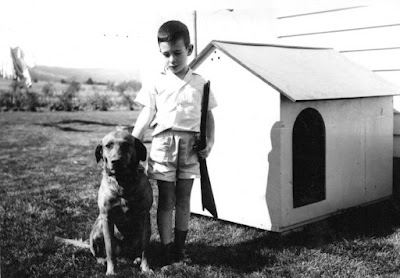
A boy with a shotgun that shot only corks, and a Labrador retriever who did not retrieve.

The yellow Lab's name was Misty. Dad got her cheap. She had been bred several times. He thought she might make a hunting dog. He was wrong. In his phrase, "She wouldn't retrieve hamburger."

He tried to train her, but Misty was just not interested. Maybe he was too impatient. Who knows?

On the other hand, she was sweet-tempered and never harmed anyone. She was an outdoor dog — Dad bought a set of plans and some sheets of plywood and built her that two-roomed doghouse, which was placed on the south side of the house with the inner room generously piled with straw — and she spent South Dakota winters out there. One summer she wandered off, and despite all the searching, was never found again.

The boy, well, he didn't know anything. When Misty followed him to school during first grade, he dragged her home again, then arrived at his classroom crying because he was tardy and embarassed.

The next year, Misty was replaced by Fritz the dachshund, litttermate of Dad's buddy's dog, who for some reason needed a home. Fifteen pounds of dog, but he weighed about sixty pounds in his own mind — which got him into trouble once or twice.

Nevertheless, Fritz went small-game hunting, camping, and backpacking. The month before the boy went off to college in Oregon, Fritz suffered a heart attack or something on a camping trip and never fully recoverered. After an interval, his condition worsened and he had to be put down; the boy never saw him again.

But he knew where Fritz's grave was on the Pike National Forest and visited it occasionally in future years. 

Part 2: "A Professional Golden Retriever"

September 16, 2018

Bears Are Hungry in the Fall

Grizzly bears (US Fish and Wildlife Service)
Tennessee: A black bear killed a man in the Great Smoky Mountains National Park. Some confusion ensues.
Park officials have shot and killed the bear associated with the investigation into a man's death.
Spokeswoman Julena Campbell said it happened around 9:45 Sunday morning [Sept. 9].
A news release Wednesday said the National Park Service had euthanized a male bear after finding it near a man's body in Great Smoky Mountains National Park. On Friday, the park said rangers actually had not yet found and killed the bear.
Wyoming: A bowhunter and his guide were attacked by grizzly bears in the Teton Wilderness; the guide was killed.
As initially reported, a grizzly bear attack on an elk hunter and his guide wounded the client hunter Corey Chubon, from Florida, and left the guide, Mark Uptain, dead. His body was recovered yesterday from the scene in Turpin Meadows at approximately 1:15pm.
After interviews and visiting the scene, Undersheriff Matt Carr said Uptain was rushed by a grizzly bear in “a very aggressive manner.”
“They were field dressing this elk. They were in thick timber and this bear was on them very quickly,” Carr said. “There was apparently no time to react.”
UPDATE: More information on the incident. Apparently bear spray was used.
Oregon: A woman hiking was killed by a mountain lion in the Mount Hood area.
The hiker who went missing on Mount Hood in late August and was found dead at the bottom of a ravine Monday was likely killed by a cougar, authorities said — a shocking twist in the missing persons case. 

The body of Diana Bober, 55, was found Monday [Sept. 10] at the bottom of a 200-foot embankment on the famous Oregon mountain's Hunchback Trail, the Clackamas County Sheriff’s Office said Tuesday.

December 04, 2016

Counting Outdoor Recreation in the GDP and Other Links

(Colorado's bighorn sheep population (never large) has rebounded since the 1990s, researchers say. (The article focuses on northern Colorado).

¶ Can Jim Akenson "give the hunter/conservation paradigm a new boost" in urban-dominated Oregon?
As the first conservation director of the 10,000-member Oregon Hunters Association, Akenson has a job that few might envy, yet one in which he is called to balance the perspectives of rangers and ranchers while he advocates for the role of hunters as latter-day environmentalists.
Providers of outdoor gear and experiences are happy that their revenue will now be added to the nation's Gross National Product (GDP).
“This is a big, big deal for us because it takes us off the kids’ table and puts us at the adult table. Now we can show how much we influence the national economy. Christmas came early for the outdoor industry,” said Luis Benitez, the indefatigable head of Colorado’s Outdoor Recreation Industry Office, who earlier this year gave a speech titled “The Outdoor Recreation Industry Will Save the World.”
Calculating the GDP is complicated, as the Denver Post article suggests, and it does not say which year's GDP will reflect this change.

January 06, 2014

Your Campsite is your "Castle" . . .

 . . . at least in Oregon
The Oregon Court of Appeals has reversed the conviction of a man found guilty of illegally carrying a concealed weapon after he argued the campsite where he pitched his tent for the week was his home and provided an exception to the state's concealed weapon law.
(h/t Alphecca)

July 07, 2013

Blog Stew with 'High Value' Plants

Someone (several someones, probably) tore up 6,500 "Round-Up ready" genetically modified sugar beet plants in southern Oregon last month.

But this is the part that made me smile:
Oregon Department of Agriculture Director Katy Coba issued a statement about the sabotage.

“To my knowledge, this is the first time someone has deliberately taken the cowardly step of uprooting high value plants growing in our state."
"High-value plants"? You mean no one has ever raided a cannabis plantation before? But that was governmental uprooting, so it doesn't count.

• A claim about Bigfoot DNA shot down by lab testing. Bigfoot researcher offers convoluted rebuttal. (Why does this remind me of the pro-Anna Anderson camp's arguments after the DNA analysis showed that she was not the Grand Duchess Anastasia of Russia?)

• Does your rabbit have a disaster plan?

December 24, 2012

Hunting, Hipsters, and the Truths of Conservation

Once you get past the usual cliches —
In modern culture, hunting has been dominated by a stereotype of burly men in camouflage who view the pastime mostly as a sport. [Speak for yourself, Jacki Lyden. My friends and I were writing hunting-related poetry and essays in our twenties.]
— this NPR piece is interesting. Interviewed is Lily Raff McCaulau, author of Call of the Mild: Learning How to Hunt Your Own DInner. (Her book seems to have had two different subtitles.)

McCaulau takes a state-sponsored Becoming an Outdoors Women workshop in Oregon, including a pheasant hunt, of which she says,
And there was one other woman who hadn't shot a bird. So the two of us went up kind of close to where the dog was holding the bird, and when the bird flushed, it flew up in the air. We both took a shot and killed the bird. And I was really shocked by my reaction because I was expecting to just be wracked with guilt and really confused about what had just happened. And instead, I was euphoric. I couldn't believe that I had it in me and that I'd done it. I felt empowered and proud and amazed and relieved.
Others on the program talk about women in their 20s and 30s who take up hunting. Read the transcript.

Meanwhile, Slate says that "hunting is undeniably in vogue among the bearded, bicycle-riding, locavore set."
The expansion of hunting into liberal, urban circles is the latest development in an evolving and increasingly snug coexistence between humans and beasts in North America. Jim Sterba’s new book, Nature Wars, examines the paradox of the rebound of many wild species, particularly in the densely populated East Coast of the United States. Whitetail deer, turkeys, Canada geese, black bears, and trees are all doing wonderfully in 2012, thanks to conservation measures in the past and vagaries of history and cultural change. The problem, Sterba says, is that most modern North Americans have no idea what to do with these species. We gawk and gape; we feed them doughnuts; we run into them with our cars; we are surprised and alarmed by their messy habits and occasional aggressiveness; we manage them all wrong; we want them gone from our neighborhoods, but we abhor the idea of killing them.
(Let's see . . . Beard? Check. Bicyle-riding (well, sometimes)? Check. Locavore? Check. I had no idea that I was so much in tune with the zeitgeist — or maybe the zeitgeist is now in tune with me?)

So hunting is not a red state thing. It is a red meat thing," concludes writer Emma Marris. "And, more than that, it is a necessary thing."

February 06, 2012

Don't Eat the Dog

Oregon mushroom pickers contribute to the Search & Rescue stereotype of "group most likely to become lost in the woods."

In three days, you think that by following drainages down, they could have found a road, given all the logging roads in the Coast Range, but maybe there were factors that the news accounts leave out.