Two million years ago, our human ancestors were small-brained apemen and in the past many scientists have assumed the meat they ate had been gathered from animals that had died from natural causes or had been left behind by lions, leopards and other carnivores.Your job is to figure out a way to monetize this assertion for the outdoor-products industry.
But [Henry T.] Bunn argues that our apemen ancestors, although primitive and fairly puny, were capable of ambushing herds of large animals after carefully selecting individuals for slaughter. The appearance of this skill so early in our evolutionary past has key implications for the development of human intellect.
September 25, 2012
"Hunting Heritage" Does Not Really Express It
A University of Wisconsin paleoanthropologist argues that organized hunting activities — as opposed to opportunistic scavenging — is even older than previously thought.

September 24, 2012
A Chinese Invader in American Agriculture
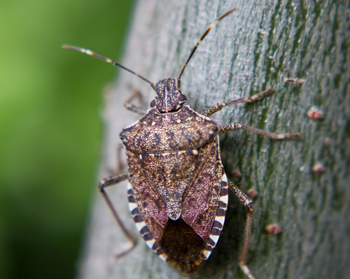 As bugs, stink bugs suck. They suck the juices out of plants. And then they stink — sort of like rotting apples but more repulsive.
We have our native brown stink bug — and I think it is going to be a good (in other words, bad) winter for them invading the house.
Now a Chinese stink bug is working its way across the country, as shown in this website devoted to the brown marmorated stink bug. Read all about 'em.
There is even a section for organic farmers.
September 22, 2012
A Tough Season for Bears
 |
| The bear that knocked over the camera, I suspect, |
 |
| "Black body" — a black bear in infrared light. |
Although the upper photo's bear is out of focus, I think I caught it sniffing suspiciously before it came over and batted the camera, which was on the ground, propped up with rocks, and aimed downhill along a game trail.
And why was it on the ground? Because a bear broke the bracket for the tree strap. I need to make a new T-post mount for it.
All well and good, but this looks like another tough autumn to be a bear. I walked one of my favorite nearby trails this morning and I hardly saw an acorn on the Gambel oaks. When I thought it did, it would just turn out to be one of those pale galls (some kind of wasp makes them) that are the size of a small grape.
There were acorns forming in the spring, but they vanished during the hot, dry summer. Fell off? Eaten while immature?
There were wild plums — they are all gone now, and bear turds full of plum pits lined the county road last week. One was so huge and symmetrical that it could have been entered in the state fair's animal-poop exhibit — if, of course, there were such a category.
But hardly an acorn. How is a bear supposed to bulk up?
A couple of evenings ago, after dark, M., who was outside, heard two shots from down the road. My first thought is always, "Oh no, someone found a bear in the garage/garbage can/wherever and just executed it."
Later, about ten o'clock, we took the dogs for their before-bed walk. Passing a little cluster of houses where the shots might have originated, we heard a couple of large bangs, like someone smacking something metal.
A couple of porch lights were on, but nothing else. No voices. I carry a large Maglite flashlight at night, and I shone it around from the shoulder, cop-style, but what with bushes and trees in the way, could not see any movement or eye-flash.
The breeze was not helping — the dogs did not appear to smell anything.
So had a bear been around earlier too, and someone tried to scare it off? If so, it did not get the message.
September 21, 2012
"Diario de un bombero"
Pine trees . . . yellow-clad firefighters . . . helicopter with buckets— it looks like the Southern Rockies, but it's Spain.
Bill Gabbart links to a short video on Spanish wildfire-fighting.
The use of flappers (batefuegos) in woody brush seems odd to me too, but maybe they make it work when backed up by water drops.
September 18, 2012
On the Road: The Kudzu of the Coast
Of the invasive plants in my country, I think that tamarisk and cheatgrass are the worst.
On the recent train trip to California, I saw stands of tamarisk that looked mostly defoliated along the Colorado River downstream from Dotsero. Maybe the beetles are starting to have an effect.
California has its own problems with invasive species — Scotch broom was one that I knew about.
The Monterey Peninsula, where M. and I were staying, offers every kind of succulent from everywhere (particularly southern Africa). It reminded me of places that I have visited in southern England, where the horticultural spoils of empire adorn thousands of suburban gardens.
There ice plant is the villain. Like kudzu in the South, it was introduced partly for erosion control on highway cut banks and such — and it controlled and controlled until it had driven everything else away and formed big solid monocultural mats.
At least it comes up easier than kudzu.
On the recent train trip to California, I saw stands of tamarisk that looked mostly defoliated along the Colorado River downstream from Dotsero. Maybe the beetles are starting to have an effect.
California has its own problems with invasive species — Scotch broom was one that I knew about.
The Monterey Peninsula, where M. and I were staying, offers every kind of succulent from everywhere (particularly southern Africa). It reminded me of places that I have visited in southern England, where the horticultural spoils of empire adorn thousands of suburban gardens.
 |
| Ice plant on coastal dune, Pacific Grove, California |
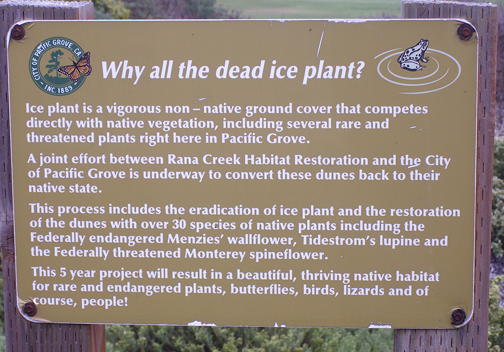 |
| Death to ice plant! |
September 16, 2012
On The Road: M's New Villa
 | ||||
| M. has a new dream house. |

Obviously the residents are tired of architecture fans.

But another big draw for me was this huge Brugmansia, also known as "tree Datura," thriving in that mild climate.
The house is on Lighthouse Avenue in Pacific Grove, California, uphill from the downtown business district, should you happen to be in the neighborhood.
September 15, 2012
Major Conservation Easement for Southern Colorado
Louis Bacon, current owner of what used to be the Forbes Trinchera Ranch, has placed a 77,000-acre conservation easement on the property.
This builds on the June announcement that he would donate a perpetual conservation easement on his 90,000-acre Blanca Ranch.
Together, they bring the total amount of permanently protected land to nearly 170,000 acres — the largest easement ever given to Fish and Wildlife.
September 14, 2012
On The Road: Sea Lions, Bird Rock, the Stench
 |
| Sea lions on Bird Rock. |
My little point-and-shoot camera can't really capture much resolution at that distance, but take my word for it, there were lots of them.
And they stink. I have seen sea lions before, but never what looked like a sea lion feedlot.
The wind off the rock is like dog anal-gland secretion times one thousand. The old days of guano-mining here cannot have been any worse.
September 13, 2012
I Went Down to the Mont'rey Bay Aquarium
I went down to the Mont'rey Bay Aquarium,
I saw no baby otter there.
They were laid out on a green kelp bed,
"Exhibit closed" —the sign I read.
 Let her go, let her go, God bless her,
Wherever she may be.
So the exhibit was closed for remodeling, but with spotting scope or binoculars you could watch a "raft" of otters not far off-shore. Some are radio-tracked, wherever they may be.
Weirdly related: this blog about the song referred to as "SJI."
I saw no baby otter there.
They were laid out on a green kelp bed,
"Exhibit closed" —the sign I read.

Wherever she may be.
 |
| Otter-watching from an Aquarium overlook. |
Weirdly related: this blog about the song referred to as "SJI."
September 10, 2012
On the Road: Grand Junction's Sad Railway Station
 |
| The California Zephyr stopped in Grand Junction, with the empty station on the right center. |
Meanwhile, railroad, snack, and souvenir business is conducted next door in some bland little box.
 |
| A close-up. |
 |
| The front door. |
September 09, 2012
On the Road: Glenwood Springs, 2
 | ||
| Footbridge at right crosses Colorado River, I-70. |
I like the compactness of central Glenwood. It looks like you could hike right out of down — or soak at the hot springs, catch the train, dodge bears while geocaching (a frequent occurrence according to one cache log), or just dream that you were having a whiskey with Teddy Roosevelt.
September 08, 2012
On the Road: Glenwood Springs, 1
Despite the fact that they are thoroughly modern businesses where you make your reservation online, some old hotels manage to retain the feeling of being an eddy in the stream of time. The Plaza in Las Vegas, New Mexico, is one — but then the whole old plaza might be a major eddy in itself. (So is the St. James Hotel in Cimarron, NM.)
Another one is the Hotel Colorado in Glenwood Springs, which is only slightly more expensive than staying in some plastic-and-OSB-board Quality Inn or the like.
Teddy Roosevelt slept here, as did President Taft, Molly Brown and to my surprise, Al Capone and some of his pals. (I thought Capone had his R&R in the Upper Midwest or maybe Florida—but the hot springs here have long been famous.)
Another one is the Hotel Colorado in Glenwood Springs, which is only slightly more expensive than staying in some plastic-and-OSB-board Quality Inn or the like.
 | |
| Hotel Colorado on left, Hot Springs Lodge on the right. |
 |
| Shady courtyard, Hotel Colorado |
 |
| Reception desk. The taxidermied bear cub is original. |
 |
| Part of the lobby at night. |
 |
| TR slept here. |
 | |
| Wing of the ground floor, looking on to the courtyard. |
 |
| Teddy Roosevelt cartoons. |
September 06, 2012
Blog Stew with Only Purebred American Buffalo
• From Glenn Reynolds, a brilliant idea to encourage kids to play outside—make unstructured outdoor activities a class marker that helps your child get into prestigious schools.
• Breeding "pure" buffalo at Colorado State University. (I had learned only in the past few years that many American buffalo have some domestic bovine genes.) So when do we get shows and and judges and ribbons and people talking about "the fancy"? Or does that already exist, and I don't know about it, not being friends with Ted Turner?
• At Vuurwapen (firearm) Blog, basically a hardcore shooting blog, a good post on "Why I Avoid Shooting Animals and Reptiles."
August 29, 2012
Giant Cats of England
Traditionally, August in the Northern Hemisphere news business was called the "silly season." Political conventions and hurricanes aside, it was a time for weird, fill-the-space news stories to be run, even in the more staid newspapers.
Like the idea that — absent larger predators — feral specimens of Felix catus (also known as Felix domesticus) are capable of growing to bobcat or small cougar size in England.
I am glad to see the Telegraph keeping up the traditions of print journalism.
August 28, 2012
A Ponderosa Forest Time-Lapse — Watch It Change
A series of photos of the same stand of trees in the Bitterroot National Forest, taken over 88 years. Sure, it's Montana, but ponderosa pine grows from Canada to Mexico. The first two pictures show a real "ponderosa parkland," the remaining seven do not.
The slide show comes from an NPR series on "megafires," such as last year's Las Conchas fire in northern New Mexico, that state's largest to date. Lots of interesting reading there.
(Originally linked on Wildfire Today.)
Subscribe to:
Posts (Atom)