August 20, 2013

Blog Stew in the Petroglyph Bowl

¶ An article on the possibly oldest petroglyphs in North America associates them chronologically with a set of human remains known as Spirit Cave Man. The interesting thing is that Spirit Cave Man (like Kennewick Man) does not appear to be an American Indian but looked more Caucasoid, perhaps like the Ainu of Japan and Far Eastern Russia.

¶ An update on the "North(ern) Colorado" secession movement. It's going to the voters in some counties.

¶ A recent spate of bear attacks. Bear spray was used in Yellowstone, but maybe not quickly enough?

Couple in Divide successfully start a goat cheese business. The site is the former Alpine Lakes Resort north of town.
"We did not intend to make it on this level," Bob McMillan said. "It started as a harmless retirement thing that got out of control."

August 19, 2013

The Fox and the Sunflower Seeds


Go ahead, make a move. It's your move . . . you talkin' to me?
Mid-afternoon and there is a ruckus from the dogs, who are penned on the veranda. The gray fox is not too impressed by the dogs' threats.
Yeah, I eat them. You got a problem with that?
Aesop, La Fontaine, and others made a story of "The Fox and the Grapes." So what is the moral lesson of "The Fox and the Sunflower Seeds"? (The seeds fall from a bird feeder.)

Here is your cinematic reference for the first caption, in case you forgot.

And don't forget the movie, which is excellent. But you will need a VHS player.

August 16, 2013

Monsoon on the Conejos (3) Pagosa Springs & Assorted Mushroom Thoughts

Boletus edulis in the Wet Mountains
Saturday the 10th was our last full day of the camping trip. I put away the fly rods and picked more mushrooms (and wild strawberries) on Cumbres Pass, then drove on west through Chama, N.M, to Pagosa Springs.

I had planned to be in Pagosa the previous weekend for a state-sponsored fire class, but it was cancelled, so this was sort of a consolation visit.

In Pagosa, the weather was warm, and the San Juan River was running high and brown. Tubing outfitters were busy shuttling their customers to the east side of town so that they could ride down past the city park and the mineral springs, where the terraces were crowded with bathers.

In the midst of this "rubber hatch," I saw one guy casting a spinning rod. I thought of congratulating him for upholding the archetype of the always-optimistic fisherman, but he gave up and walked away.

We visited a couple of thrift stores—nothing exciting—where does all the outdoor gear go?—and then had a late lunch/early supper at the Riff-Raff brew pub ("Hoppy people. Hoppy earth").

I reckoned that my cabrito burger with Hatch green chiles was sort of quasi-locavore-ish.

It rained steadily most of the way back to the campground.

The next morning I observed a mulie doe moving strangely through the woods. She had her nose down like a dog following a scent trail.

Was she eating mushrooms? I had picked a few in that area, mostly Suillis  ("slippery jacks"). I tried to follow, but I could not get too close without spooking her, and there were a lot of spruce boughs in the way.

I did see some Suillis that had been scraped by what looked like a deer's lower incisors (Deer don't have upper incisors.) Were there fewer mushrooms than before? Not sure.

Two days later, having done well on a mushroom hunt closer to home, M. and I were easing down a rough forest road in the Jeep when we saw a squirrel wrestling — or something — in the road. It turned out to be trying to carry the stem of a Boletus edulis ("king bolete"), which was nearly as big as it was.

Yesterday M. was walking Fisher on lead down the driveway when he dashed into the oak brush, dragging her along. He had scented another bolete, one unfortunately past its prime. It was probably another Boletus chrysenteron, which grows under oaks, like the one he snarfed off the kitchen counter a few days ago.

Does this mean that he might have a talent for finding good mushrooms? If the French have truffle-sniffing dogs, could we have a Southern Rockies bolete-sniffing dog? Further research is required.

August 15, 2013

Hurray, Drought is only "Severe"

The recent rains, which are not really above normal for the time of year, have lowered the drought status to "severe" in some southern Colorado counties. 

Stream flows are up, but soil moisture is still low in most places.

Another Ski Trooper Conservationist Leaves a Legacy

Stuart Phelps Dodge, another of the World War II ski troopers from the 10th Mountain Division, has passed on, leaving a huge conservation legacy in El Paso and Teller counties, Colorado.
Dodge left his conservation footprint on countless open spaces, including the Garden of the Gods, Bear Creek Regional Park, the historic Palmer Blair Bridge, and the Christian Open Space contiguous with the south end of Fountain Creek Regional Park.

He helped build systems for acquiring those open lands to benefit landowners and the state.

"If you have walked any trails around here, he probably helped preserved them in perpetuity. The city would not be what it is if it hadn't been for him," said Linda Overlin, former president of the Palmer Land Trust. "He was an instrumental part of the conservation easement movement statewide in the 1980s and 1990s to preserve open spaces."
It is amazing how much of what we grew up accepting as "normal Colorado" was shaped and affected by that group of men — in the case of David Brower, much more than just Colorado.

August 14, 2013

Monsoon on the Conejos (2): Platoro y Yo

Platoro, Colorado. The bands of light at right are windshield reflections.
With the Conejos River running high and turbid, I decided to travel upstream. That meant Rio Grande Forest Road 520, which might be described as a pretty good road — if you were in Afghanistan.

Mile after pothole'd mile crept by. I would stop now and then and check the river. Still roily.

Eventually we reached the resort hamlet of Platoro (plata plus oro — weren't those early miners clever?) which always makes me think of what the Alaskan bush might look like (having never visited Alaska) — dense forest, a straggle of modest frame and log buildings, thick willows along the river.

The old lodge, currently bearing the name Sky Line Lodge, is classic, but right now its owners cannot decide whether it is a grocery store or a fly shop and so fall between two stools. (It and I make an unflattering appearance in Ed Engle's memoir Seasonal: A Life Outside. That's what happens when you hang around writers.) A UPS driver was making a delivery, and the shelves of his van were empty. Platoro is the end of the line.

The inlet to Platoro Reservoir, managed by BuRec for flood control, etc. It's quite low right now.
Above Platoro is Platoro Reservoir, and we continued past it to the Three Forks area, at the edge of the South San Juan Wilderness Area, where the stream was clearer, and I got into a few small trout while playing peekaboo with a herd of cows in the dense willows.

Rain clouds build above Platoro Reservoir.
And then it was time for the afternoon deluge, plus hail. Too much driving time versus fishing time.

(to be continued)

August 13, 2013

Monsoon on the Conejos (1)

We brought a screen for drying mushrooms.
The campground host's name tag said "Noah." That should have been a hint.*

M. and I set out Thursday for a camping trip to the Conejos River. I had looked at the stream flow online, and it was up from July's average, but I still had this picture in my mind from other late-summer trips: clear waters, a slight crispness in the air.

Just getting there had its moments. When we stopped in Antonito to get some snacks from the trailer, people driving by kept looking at us. Sure, Antonito seems a little insular, but why the stares?

Maybe it was because the Jeep and the pop-up trailer were liberally coated with mud.

Conditions on the Secret Cut-off Road had been worse than I had expected. Seeing the trailer in the rear-view mirror going sideways is unsettling. All I could think was, "This would be worse if I were going downhill."

We kept going and later in the afternoon reached the Forest Service campground that was our destination. About 5:30 p.m. it started raining. That would be the pattern: two-hour downpours each afternoon or evening.

But with a hot meal, wine, a good book, and a Coleman lantern, all was good.

Friday morning I got up (mist-filtered sun), put on hip boots, and walked to one of my favorite fishing spots. The river looked like chocolate milk. A tributary stream was re-enacting the June run-off.

Walking back to the campground, I picked a few mushrooms. That would be the theme.

(to be continued)

* No, there was no name tag. I am joking.

August 12, 2013

The So-Called Romance of Steam

Cumbres & Toltec train on Cumbres Pass. The white cloud is steam from the whistle.
I like trains and take Amtrak rather than an airplane whenever possible, but I do not partake of the "romance of steam."

Ride one of these steam-powered trains, and you quickly understand why nineteenth-century people wore a lot of black. Once they put glass in the car windows, people then had a choice between no ventilation and breathing sooty smoke while wearing cinders too.

But maybe the fascination with steam comes from its being almost as understandable as animals.

Combine fire and water and you have steam, and then it works those big external pistons, and chuff chuff chuff, the locomotive goes down the track.

M. and I were driving up Colorado 17 on Saturday, and despite the two hours of rain at our nearby campsite the night before, she suddenly stiffened: "Is that a fire?"

No, it was the excursion train puffing away as it sat on the pass, one of the stops on its scenic interstate route.

To recreate nineteenth-century industry even better, find yourself in downtown Durango on a wintry day with a thermal inversion as that steam train leaves the station, filling street after street with coal smoke. Then multiply times fifty.

August 05, 2013

Fisher's New Job

Walking the dogs yesterday morning, I picked a mushroom not far from the house, a bolete,  but not one that I knew

I left it on the kitchen counter while I fed them, then got busy with other stuff.

After M. was working at the same counter, I asked her if she had seen it.

No, she had not. It was nowhere to be found.

The obvious suspect was lying on a rug by the front door: Fisher — Raider of Kitchen Counters, Eater of Everything.

Going from memory, I checked the mushroom book, and it looked like I had had Boletus chrysenteron, which is edible. (From Fisher's viewpoint, if it fits in his mouth, it is edible.)

Mushroom taster, that can be his new job.

August 02, 2013

Making Money in a Mountain Subdivision

A while back we were visiting someone who lives in one of those typical Colorado mountain subdivisions — winding gravel roads, five-acre lots, the whole wildland-urban interface picture.

M. goes walking and meets this thirtyish guy — let's call him Zach — out with his dog. He seemed eager for conversation. Before long, he invites us down to his camping trailer-plus-attached shed summer home to show us his plants. His six legal Colorado medical marijuana plants, that is. We duly admired the greenhouse that he had built and the well-tended and labeled plants.

Then he gestures down toward a copse of trees down in a ravine, where the other cannabis is growing. Why was I not surprised?

Walking back to our hostess's place, we pass the house that Zach says is his landlord's. It looks fairly new, and given the potential views, M. wonders why one two-story wall has no windows. That's the "grow room," I say, half-seriously.

Heck, yeah. Zach, whose didgeridoo playing echoed up from his greenhouse in the evening, takes us in there the next day. It's a communal growing operation between his landlord, some friends, and him, all Mylar-faced insulation and bright lights.

He had started growing on the East Coast, did his "post-graduate" work in Mendocino County — he is very proud of that — and discourses at length on varieties, propagation, fertilization, and the rest.

But he misses his partner and their kid, who are elsewhere, hopes to see them soon, and meanwhile gets out a couple of days a week to play in a pick-up band at a tavern in a nearby tiny town.

We talk about the changing law and habits, the growing popularity of "vaping," etc.

"Twenty years from now," he speculates, "people will be saying, 'Do you know they used to roll this up in paper and smoke it?' "

He is probably right about that.

At last, a form of economic activity that you can practice in your mountain subdivision, where there is not enough forage for livestock and the outdoor growing season is too short for many vegetables.

You think people like Zach are not exporting beyond the legal MMJ marketplace and the new, liberal laws in Colorado? Of course they are.
Last year, police across the country made at least 274 highway seizures of marijuana that investigators linked back to Colorado. According to the report, the seized pot — 3½ tons of it in 2012 — was destined for 37 different states, most frequently Kansas, Missouri and Illinois.
There is a lot to sort out here.

July 31, 2013

Cloning Mammoths is Harder than You Think

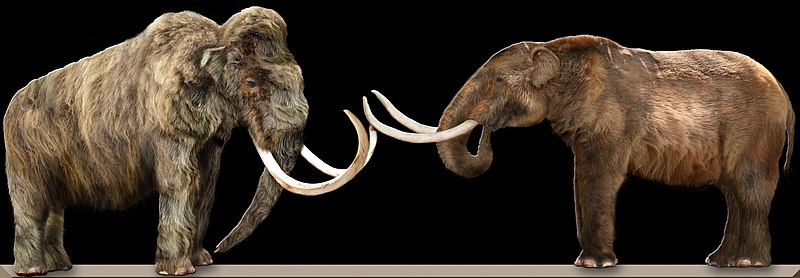
Woolly mammoth left, American mastodon right (Wikipedia).
As much as I cherish the idea of a "Pleistocene Park" with woolly mammoths wandering around, the lack of good cellular material is a huge obstacle.

In a Guardian article, Sir Ian Wilmut of Dolly the sheep fame describes the problems.
Though it is unlikely that a mammoth could be cloned in the same way as Dolly, more modern techniques that convert tissue cells into stem cells could potentially achieve the feat, Wilmut says in an article today for the academic journalism website, The Conversation.
"I've always been very sceptical about the whole idea, but it dawned on me that if you could clear the first hurdle of getting viable cells from mammoths, you might be able to do something useful and interesting," Wilmut told the Guardian.
 First we get mammoths (or mastodons), then we get them to eat tamarisk.

July 29, 2013

Spared by Fire, Black Forest Wildlife Rehabber Carries On

The Colorado Springs Gazette profiles wildlife rehabilitator Linda Cope.

 On the issue of spending time and money trying to save individual fawns or geese or whatever, she says,
"These numbers aren't going to make any difference at all (in their population). It's just people learning to respect wildlife for what they add to our lives. And without them, oh my gosh, I can't imagine that.
M. and I transported a fawn to her just Saturday night, although instead of driving all the way to Black Forest, we rendezvoused at the bosky parking lot of the Hatch Cover restaurant on Cheyenne Mountain Boulevard.

July 28, 2013

Take Your Kid 'Squatching'

Introduce your kids to the outdoors by searching for the most elusive free-range primate of all: Bigfoot.

Tracks and other evidence were found.

Northern Colorado readers, doesn't this look like Roxborough State Park? I have never been there myself.

July 26, 2013

How dry has it been? Tumbleweed Dry

I mowed the lawn at the guest cabin today — such is the payoff after having more than four inches of rain this month.

But it has been dry. How dry has it been? It has been so dry that the usual invasive weeds such as bindweed are gone, except around the flower bed where they can steal some water.

Instead, the area where all the grass died (previous owner planted bluegrass, which survived the late 1990s but not the 2000s) has been colonized by kochia and Russian thistle (tumblin' tumbleweed).

I have never seen tumbleweed growing around here before. I mowed every bit of it that I could find, hoping to stop it from flowering — the tumbling spreads its gazillions of seeds.

July 23, 2013

Dying for Beauty

The Wave (Wikimedia Commons)
You have heard of the Darwin Awards. I propose the Everett Ruess Award.

Ruess was a young California artist who sought inspiration in the southern Utah canyonlands beginning in 1931, nearly dying of dehydration at least once, before he disappeared for good in 1934. "Beauty" was one of his favorite words.

Lately the fatal lure is a rock formation called the Wave. Three people have died this month hiking to and from it.
The Wave is a richly colored geological upheaval, its fiery swirls emblazoned on postcards, posters, maps and computer screensavers. It is said to be one of the most photographed spots in North America.
Ironically, you have to apply for a permit to hike there, it is so popular.
Half of the 20 daily permits are doled out on a walk-in basis at a visitor's center in Kanab, with up to 100 people showing up for each one. For many, it's a lifetime opportunity that can encourage risk-taking during the hottest time of the year.