January 09, 2022

Retrievers and Me (3): A Bulldozer of a Dog

Perk modeling an improvised muzzle, from an article
I wrote for Gun Dog magazine on field first aid.

Already published

Part 1: The Retriever Who Did Not Retrieve

Part 2: A Professional Golden Retriever

Just a few years after I hunted over the "Swiss guide" golden retriever, M. and I found ourselves living in a 1908 smelter worker's cottage on the wrong side of the tracks in Cañon City, Colorado where I had been hired on a start-up outdoor magazine, Colorado Outdoor Journal, edited by my friend Galen Geer, who appeared in Part 2 as a writer-deputy sheriff but was on his way up, or at least out.

You probably have not heard of it — not because you are unhip, but because like 80 percent of magazine startups in the (barely) pre-Web era, it failed. That's another story.

As managing editor, I was the main point-of-contact with the writers. Some were already established, such as John Gierach and Ed Engle for trout fishing, Doug Harbour for upland bird hunting, and David Petersen for elk hunting.

Others were not, like the man from the North Fork Valley who had written a piece about his moose hunt, back when moose were only recently re-introduced in Colorado and licenses very few, available only by a lottery system.

The North Fork Valley in Delta County is on the Western Slope, but he was going to be in Cañon and wanted to drop off some photos or something in person, so of course we said "Come on by."

After taking care of business, he asked Galen and me, "Do you fellas like dogs?" 

"Sure," we said. 

"I have two pups out here from my last litter," he said, "but I have not yet found homes for them." 

He had built a sort of nest with straw bales and plywood in the bed of his pickup truck. He dropped the tailgate, and the two pups emerged. One bounced right out, while other came more cautiously.

They were four-month-old Chesapeake Bay retrievers, born to a dam named Dustbuster of Bone Mesa, sired by a dog named Mount Lamborn's Baron. One or both, take 'em. No cost. I chose the bouncy one.

Galen had no room for another hunting dog but I now had a small house on a large lot with open land beyond that  — and I remembered that superb golden retriever. I knew nothing about Chessies, but they were clearly retrievers too.

I called M. at home and said that I had been offered a puppy. She agreed to my bringing him home. Later she admitted that the word "puppy" to her meant a little guy that you could hold in your cupped hands. Instead, here was a doggie who weighed maybe thirty pounds already!

His first new experience was being attacked by cats. We had three. They all went into full Intruder -Attack Mode, and he was soon backed into a corner of the dining room, going "Please don't hurt me!" The cat line-up would change, but he always drew a line between Our Cats (politely ignored) and Other Cats (could be chased out of the backyard).

His name was Perk, from the idea that free puppies were a perk of the job. I joined the Hunting Retriever Club (HRC) chapter down in Pueblo, and so registered him with the United Kennel Club as "Baron's Editor's Perquisite."

He grew to 105 pounds (48 kg), a stoic bulldozer of a dog. He traveled with us from Puget Sound to the Shenandoah Valley and made the move from Cañon City to the higher hills. He hiked and hunted and accompanied me at the endless summer work of cleaning the irrigation ditch.

At the new place, where houses were farther apart, a neighbor once asked if we still had a dog. "I never hear him," she said. 

That was because he saved his window-rattling Woof! for serious things: "Someone is walking up the driveway!" or "There is a bear out front!"


I took him to HRC training classes. That group makes much of distinguishing themselves from other dog groups. They have "hunt tests" or "hunts," not "field trials."  Handlers wear camouflage, not white coats. Duck calls are blown and blank shotgun shells fired. 

We learned some good things.  But serious competion would require travel around about a four-state area, campaigning a dog through various "hunts" of increasing complexity. I lacked the time, money, and inclination.

It seemed to me that a "Started" dog had the basic skills for a hunting retriever, assisted by his own learning on the job. So I dropped out after that level. He got his one (camouflage-printed) ribbon. It might still be around here someplace.

Plus, I never forgot a conversation I overheard while waiting for an HRC chapter meeting to begin. This woman, one of the club stalwarts, was complaining that her husband had taken their competition dog out the previous weekend for some actual duck-hunting. 

"He ruined [the dog]!" she exclaimed to her friend.

The lightbulb went on for me. It was not about the dogs and actual hunting; it was about humans coming up with increasing complex and unrealistic challenges for the dogs so that they could have canine winners all neatly ranked.

Perk would jump into the Arkansas River flowing with bits of ice and grab a duck. Wasn't that what it was all about? 

Part 4: Hardscrabble Jack

January 05, 2022

Retrievers and Me (2): The Golden Retriever Who Was a Real Professional


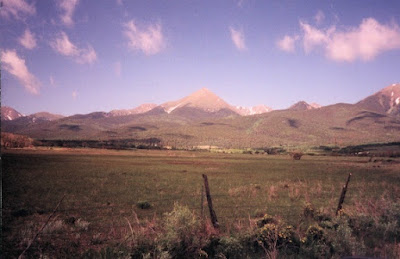
Horn Peak from across the Wet Mountain Valley  (Wikimedia Commons).

It was the early 1980s, I had my grandfather's Winchester Model 12 shotgun,  and my friend Galen Geer, who worked as a deputy sheriff in Custer County, Colorado while developing his skills as an outdoor writer, invited me to go mourning dove hunting in the Wet Mountain Valley, which makes up the western part of the county, bounded by the Sangre de Cristo Range.

The party consisted of him, me, another off-duty deputy, and a man I will call "Charlie." Charlie was an independent operator, a bit of a trickster. He was somewhere on the spectrum between professional hunting guide and poacher, but I was never sure where.

Among other things, he taught me to blow a predator call properly, enough that I was able to impress another pro guide one time.

So we were going dove-hunting, but we had no dog. No problem. Charlie had it covered.

We stopped at a house in the little town of Silver Cliff.

A hunting-line golden retriever.
Charlie went to the back yard, opened a gate, brought out this golden retriever, and put him in one of the trucks.

"It's OK," he said, "I have permission."

The dog was a total professional. He was the Swiss mountain guide of hunting dogs.

 "You are my clients for today? Sehr gut. Let us begin."

We moved from spot to spot, mostly pass-shooting over stock tanks at ranch windmills. 

If a dove was hit, he trotted out, found it, picked it up — and always returned it to the shooter who had hit it.

If you missed a shot, he might turn from where he sat in in front of the guns, curl his lip, and give you a significant look, as though to say, "I am a professional. Please do not waste my time. Do better."

We paid him in head-scratches and bits of sandwich. At the end of the day, Charlie returned him to the back yard in Silver Cliff. I never saw his owner.

I wanted a dog like that.

Of course, I did not get one.

Part 3: A Bulldozer of a Dog

Retrievers and Me (1): The Retriever Who Did Not Retrieve


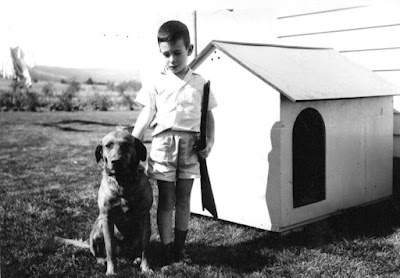
A boy with a shotgun that shot only corks, and a Labrador retriever who did not retrieve.

The yellow Lab's name was Misty. Dad got her cheap. She had been bred several times. He thought she might make a hunting dog. He was wrong. In his phrase, "She wouldn't retrieve hamburger."

He tried to train her, but Misty was just not interested. Maybe he was too impatient. Who knows?

On the other hand, she was sweet-tempered and never harmed anyone. She was an outdoor dog — Dad bought a set of plans and some sheets of plywood and built her that two-roomed doghouse, which was placed on the south side of the house with the inner room generously piled with straw — and she spent South Dakota winters out there. One summer she wandered off, and despite all the searching, was never found again.

The boy, well, he didn't know anything. When Misty followed him to school during first grade, he dragged her home again, then arrived at his classroom crying because he was tardy and embarassed.

The next year, Misty was replaced by Fritz the dachshund, litttermate of Dad's buddy's dog, who for some reason needed a home. Fifteen pounds of dog, but he weighed about sixty pounds in his own mind — which got him into trouble once or twice.

Nevertheless, Fritz went small-game hunting, camping, and backpacking. The month before the boy went off to college in Oregon, Fritz suffered a heart attack or something on a camping trip and never fully recoverered. After an interval, his condition worsened and he had to be put down; the boy never saw him again.

But he knew where Fritz's grave was on the Pike National Forest and visited it occasionally in future years. 

Part 2: "A Professional Golden Retriever"

December 29, 2021

We're Broadmoor Hotel Guests, Get Us Out of Here

Cloud Camp lodge, above the Broadmoor Hotel, Colorado Springs
Known its golf courses (plural), tennis club, riding stable, and other amenities, the sprawling Broadmoor Hotel on the edge of Colorado Springs has recently expanded into more "wilderness" experiences.

Naturally, the hotel is being sued. From the Colorado Springs Independent:

The posh resort certainly did deliver on that promise in October 2019 when a Broadmoor guide leading three couples on a 2½-hour morning hike got lost and then allegedly abandoned them as the sun set and temperatures dropped.

The party was located by El Paso County Search and Rescue (SAR) teams at midnight — some 14 hours after the hike began. They then had to hike another six hours to a trailhead before returning to the The Broadmoor hotel.

Now, one of those couples, Victor and Annamaria Mitchell, has filed a lawsuit against The Broadmoor and Emerald Valley Ranch, alleging negligence, negligent supervision of the guide by the two entities, and “premises liability for breach of duty to exercise reasonable care to protect guests from danger.”

The suit claims that toward sundown, the guide, who had his own food and water,  "took off running and left the Mitchell’s [sic] and the other three couples behind, lost and stranded in the unfamiliar wilderness."

A "three-hour tour." This could be the plot of a long-running TV show. 

UPDATE Jan. 12, 2022: The hotel paid unspecified damages.  How much is diarrhea worth in court?

December 26, 2021

A New Chainsaw, with a Hidden Cost

Santa Claus dropped off a new Husqvarna 120i battery-powered saw this year.
A 1980s Husqvarna chainsaw, rear, with a 2021 batttery-powered saw of similar size.

Santa Claus dropped off a new Husqvarna 120i battery-powered chain saw this year.
 
In back, that is a mid-1980s 49 cc “Rancher” saw, originally Dad’s firewood saw, but mine for some years now. It still works well. It has a 15-inch (38 cm) bar and weighs (without fuel) 13.2 lbs. (6 kg).

The battery-powered saw has a 14-inch (35 cm) bar and weighs 11 lbs. (5 kg). It is, however, longer overall because of the space needed for the battery. And lithium batteries require mining lithium by cutting down rain forests in the Philippines or wherever. Just search on "environmental cost of lithium mining" before you feel virtuous about foregoing gasoline.
 
It is supposed to run for 45 minutes or so before dying — I have not yet tested that part.
 
I cut up some small oak and pine for a test, no problem at all.
 
So this will be the saw for quick jobs, especially those close to the house, and it gives me a backup in case the gas-powered saw has a problem. And it is quiter, probably because the old saw's muffler is kind of rusted out.

Good Husqvarna quality — but not necessarily any more environmentally virtuous than burning gasoline. Californians, however, won't have any choice after 2024.  (I bet all the wildland firefighting sawyers wil hang onto their gas-powered saws as long as they can. Forty-five minutes is not very long on the fireline.)

December 15, 2021

Take the Camo Lifestyle to the Next Step

In a recent post about what feels like an overall decline at Cabela's outdoor stores, I mentioned that they were showing more varieties of camouflage clothing than I had ever seen – although deficient in warm winter hats.

But you need those varieties if you are going to match your camouflage clothing to your part of the country! (Source)

Click to embiggen.


Click this one too, I dare you

What this tells me as a Southwesterner is that  the "Six-Color Desert" pattern, also known as "chocolate chip," is a good bet almost year around. I started using it for waterfowling when I realized in the 1980s that the Woodland pattern or its civilian variants were mostly too dark for southern Colorado marshes. (Simple khaki would better than those.)

Six-Color lost favor with the Army when they realized that while it worked in the American Southwest, it was less than perfect in places like Kuwait, Iraq, and Syria. So we gave away boatloads of it to our valuable allies and switched to the  Three-Color "coffee stain" pattern. (Here is a YouTube on the history of the Six-Color Desert pattern.)

As they say, it was developed for the American Southwest. I like it for brushy or scrubby enviroments too. And remember that 80 percent of camouflage is holding still and sticking to shadows as much as possible.

I wonder what patterns people wore to the Camouflage Cotillion last month in Eden, Texas. Unfortunately, I was passing through Eden the day before, or I would have checked it. For research purposes.

From what I hear, if you go to one of those Texas private-hunting ranches and don't wear camo, you will have committed a social blunder. But camouflage only really matters if your quarry can see color — in other words, birds and humans. 

Otherwise, it is a cultural statement.

November 13, 2021

Old Men Hiking the Appalachian Trail and Growing Out Their Beards


This is not my normal territory, but a new men's age record for the Appalachian Trail was set this month:

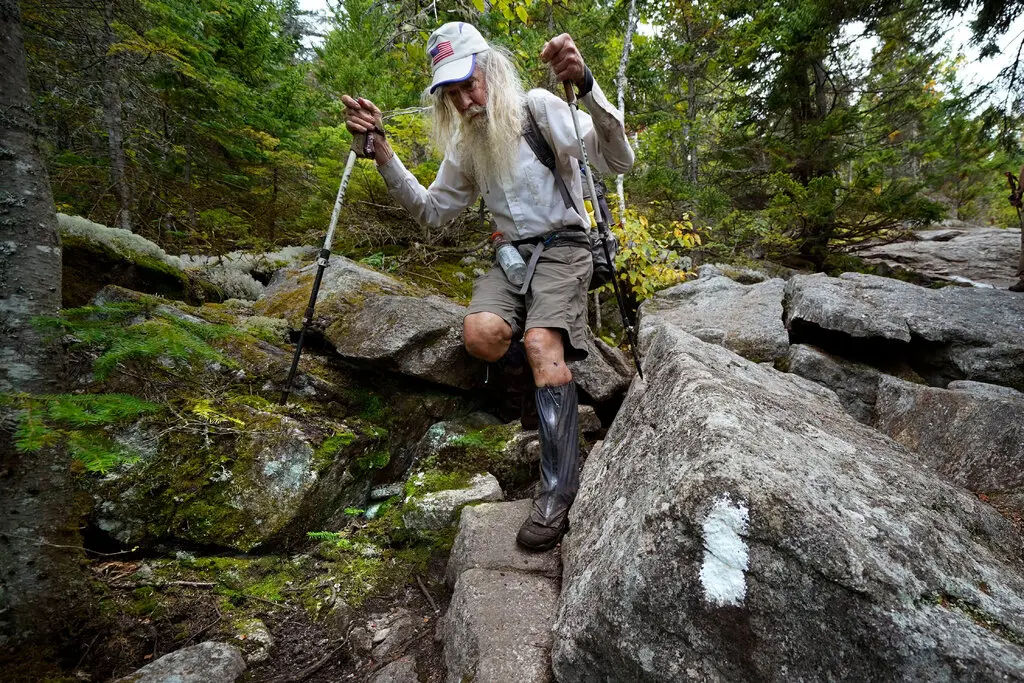
M. J. Eberhart, "Nimblewill Nomad," on the AT.

M. J. Eberhart, an 83-year-old retired eye doctor, had a strenuous weekend.


On Sunday, he pushed through the final few miles of a hike on the Appalachian Trail, becoming the oldest known person to complete the roughly 2,190-mile trail from Georgia to Maine.


It was an odyssey that started in January from his home in Flagg Mountain, Ala., with a series of day hikes that gradually took him to Georgia. From there, he started the journey along the Appalachian Trail. He carried a six-pound pack, with a tent, sleeping bag and other gear (not including food and water).


Known by his trail name “Nimblewill Nomad,” Mr. Eberhart hiked the distance in segments. Sometimes friends and supporters hiked with him or picked him up for overnight breaks of a warm bed and meal, driving him back the next morning to where he had dropped off the trail.

He was met and accompanied toward the end by the hiker who held the previous through-hiking record at age 82. "'He stole my record from me,' [Dale] Sanders, reached by telephone, said, laughing. 'I am not at all disappointed that he took it. I actually promote older people to get out and break my record.'"

So there you have it. 

The famous "Grannie Gatewood" walked the AT at age 67 in 1955, when it was considerably less well-known and less-well-marked  than it is now. A mere youngster. But she did it in sneakers without trekking poles. Without a backpack, even. And she did the AT three times, the last at age 71.

Meanwhile, beards:

"[Eberhart] lost 15 pounds, but said he would not cut his hair or shave. 'The old man on the mountain has got to have a beard,' he said."

But what does that say about testosterone?  The science, shall we say, is not settled.

As a highly sexually dimorphic trait – something that marks a systematic difference between two sexes of a species – facial hair in humans has been traditionally thought to 'honestly signal' elevated levels of testosterone in those who possess more facial hair than their peers, signaling to potential sexual partners, or perhaps their competition, that they are more masculine or dominant.

However, a new study published in the journal Archives of Sexual Behavior has found no relationship between the amount of facial hair and self-perceived dominance in men and their testosterone levels.

November 05, 2021

RMNP Gives Up Its Dead

Searchers in 1983. (Hey, I had those snowshoes!) National Park Service photo.


The remains of ski-mountaineer Rudi Moder, 28, missing since he disappeared in Rocky Mountain National Park in 1983, have now been officially identified.

Actually, they were found last year, but the huge Cameron Peak Fire and then winter got in the way of recovery. 

Modi disappeared while on a solo trip in February 1983, when he started from Cameron Pass and headed into the park.

Since his camping gear was located during the initial search, but not his body, it looks as though he was out on his skis, perhaps scouting a route, when an avalanche caught him.

October 30, 2021

Celebrating October in Cañon City, Colorado

Arkansas River in Cañon City, looking upstream (west).
M. and I were in Cañon City Friday because  . .  . oh right, we had to pick up our mushroom CSA box. Yeah, mushrooms. Fruits-and-vegetables CSA's are like, so 2008.

Arkansas River in Cañon City, looking downstream (east).
After two years of early, bough-breaking snows, everyone is pleased that this year was a proper low-altitude Colorado fall, with deep blue skies and heart-piercing golden cottonwood leaves.

You have to understand that while these views of central Cañon look bucolic, I was practically having my butt brushed by passing cars on the South Reynolds Avenue Bridge while making them.

Because everyone is driving everywhere — and fast.

October 25, 2021

A Depressing Visit to the Cabela's Mothership

Entrance to the Cabela's store in Sidney, Nebraska.

I first visited Cabela's headquarters store in Sidney, Nebraska, when it was still in an old brick commercial building downtown. Having little money, I headed straight for the "bargain cave," the basement, where I bought a pair of shoe-pacs (leather tops, rubber bottoms) that lasted me for years. They were marked XXX inside the tongues — not for adult content, but because someone had ordered them by mail and then returned them.

Then the company built a new store out on Interstate 80, with parking for truckers and RV-ers. Stopping there on trips to the Black Hills or North Dakota became a regular thing — particularly on the way home, thinking "I really need a blaze orange cap with ear flaps for those cold windy North Dakota prairie days," or whatever.

It was that way last Saturday. My old waterfowling cap no longer fit me. I doubt that my skull had grown, so probably the cap had shrunk. So I went Valentine -> Hay Springs -> Alliance -> Sidney and pulled into the parking lot of the "mothership." Which was not very full. During hunting season.

I had last visited in 2018, about a year after Cabela's had merged with Bass Pro Shops.  Here's the corporate blather:

“We are excited to unite these iconic American brands to better serve our loyal customers and fellow outdoor enthusiasts,” Bass Pro founder and CEO Johnny Morris said. “As we move forward, we are committed to retaining everything customers love about both Bass Pro Shops and Cabela’s by creating a ‘best-of-the-best’ experience that includes the superior products, outstanding customer service and exceptional value our customers have come to expect. We’re also deeply motivated by the potential to significantly advance key conservation initiatives.”

A marriage: Cabela's was more hunting than fishing, although they have lots of fishing gear. Bass Pro Shops was more about fishing. Cabela's codes "Northern," while Bass Pro Shops codes "Southern." The Cabela's snack display now includes Moon Pies next to the buffalo jerky. (I believe that a Moon Pie is considered "iconic" elsewhere; I have never eaten one.)

Oh yeah, the same holding company, Great American Outdoors Group, also owns Sportsman's Warehouse.

A year post-merger, the first thing I noticed in 2018 was that the Bargain Cave was gone. I had found some good deals there over the years, including a half-price set of luggage that I crammed into the Jeep circa 2012 and am still using,

Once it was the Bargain Cave; now it is the Camo Cave. If you think of camo
as a lifestyle statement, this is your destination. But no insulated billed caps.
I


But when I went to the Camo Cave last Saturday looking for a fall/winter camouflage cap with ear flaps, there was no such thing on sale. (My old cap carried the Cabela's logo. What happened to them? Not in the online catalog either.)

Meanwhile, the snack bar was closed and dark. I told M. about that when I came home that night, and she said, "The amenities are the first to go." 

Yep. Downward spiral.

The merger, pushed by a hedge fund that owned a sizeable share of Cabela's, was a gut punch to the little town of Sidney. The corporate headquarters had employed about 2,000 people, plus there were spin-off businesses such as Cabela's bank, which issued their affinity-group credit card, a travel agency for hunting trips, and so on.

In 2018, the ax fell. According to the Sidney Sun-Telegraph, 

"What's going to happen on the hill" has been the question many have tried to guess as they hope for their future in Sidney.

That question was answered late last week when those employed at Cabela's headquarters received letters outlining a severance package for those voluntarily leaving the company. It is believed that the letters were sent to the majority, if not all, of those employed at Cabela's corporate headquarters.

That was confirmed Tuesday by Bass Pro spokesman Jack Wlezien, who said that while there might be some exceptions due to individual circumstances, "for the most part, everyone got one."

Bass Pro Shops is headquartered in Springfield, Mo., and most of the jobs went there. Fox News' Tucker Carlson reported in December 2019,

One former [Sidney] employee, speaking on condition of anonymity due to fear of retribution, said, “I cried the second I got the phone call. I couldn't help it. I bawled.”

[Mayor Roger] Galloway noted that “Cabela’s was the keystone employer in town. Everything, not everything, but most things revolved around that" . . . .

City official Melissa Norgard told Tucker Carlson Tonight, “We were going to build a new housing subdivision to meet housing needs . . .  instead, we are working our tails off to try to figure out a way to survive.”

Tucker Carlson Tonight found the proposed subdivision.  It’s full of empty lots. The houses were never built.

Local residents told Tucker Carlson Tonight that it’s hard for them to leave the town as housing values have collapsed.

I just felt that the mood in the store was depressed, and the employees fewer and less well-informed. I had one particular hunting item in mind to buy, and after a bum steer from clerk #1, it took three more sales clerks to help me find it. 

The selection in 12 ga. steel shotgun shells was #2 or nothing — but that could be part of the Great Ammo Shortage, I don't know.

The whole place just felt . . . diminished.

So much for the mothership.

October 23, 2021

An Exciting Archaeological Find — Or It Will Be


In foreground: crest of the natural mound containing possible buried pit house.

A guest post from the far future:

Allow me to begin by congratulating my new collegue Mazakan Petasuta on passing her final examinations and earning her degree of Superba in archaeology. She will be joining the Department of Ancient Studies here at Iron Lightning Regional University at the beginning of the fall term.

She is already in the planning stages of a new excavation at a site about 375 versti to the northeast, a recently discovered pit house of a little-known type. It took a sharp eye to recognize that the depression in this small ridge was not a natural feature, and, of course, the original structure is below the Dust and other wind-deposited materials.

Her initial trench, however,  revealed metallic traces suggestive of artisanal work with ferrous materials, as well as domestic items such as buttons. Fortunately, the overall site is small enough that a student crew should be able to exacavate it completely in a matter of weeks.

Most significant—and this ties into my own work with the Anhydrous Ammonia Cultural Complex—are the two plaques found adjacent to the apparent pithouse. Originally on tall, sturdy fireproof pillars, they projected far enough into the Dust deposits that subsequent heavy rains washed them clear. The two scripts in which they are written suggest that they were not contemporary with each other. In addition, the scripts match many found at AACC sites.

I have been working for several years cataloging the anhydrous ammonia containers found at what perhaps are isolated strongholds of rural clan chiefs. Such containers are not found in the ruins of ancient cities, at least so far. My colleagues in chemistry point out that this substance can release combustible gases, so possibly these gases were produced for lighting or heating.

Should Professor Petasuta find any evidence for anhydrous ammonia in her pit house, that would permit me to extend the AACC's beginnings farther into the post. 

Ciqala Ikiliki, senior archaeological fellow

October 21, 2021

Should SAR Leave the Body on the Peak?

A Colorado Air National Guard Blackhawk helicopter
on a mission near Ouray (Ouray Mountain Rescue Team).

Last August, three volunteers from Mountain Rescue Aspen were injured by rockfall on Capitol Peak as they searched for a missing climber.

One was hit by a "micowave-size rock" that smashed into her hip. "She sustained a comminuted femur fracture (broken in three or more pieces), multiple pelvis breaks and a fractured vertebra."

While she was expected to recover, I suspect that she will feel those injuries for a long time, perhaps the rest of her life.

The injured rescuers were airlifted off the mountain by a Colorado Air National Guard helicopter. (The ANG frequently helps out on these situations.)

The climber, a 32-year-old man from Madison, Wisconsin, was left up there. Some of my climber friends on Facebook were deeply disappointed. 

The Pitkin County team told the family it did not see a way to safely recovery the body at this time.

“It was a difficult decision, but we’ve collectively decided to leave Kelly McDermott’s body on the mountain where it currently rests,” [Sheriff's Office representative Alex] Burchetta told CBS4. “We’ve spent the past month or so working on alternate recovery plans and simply were not able to come up with one that provided the level of safety necessary to conduct another recovery mission.”

But how many people should risk their lives to bring down a body? My county's Search and Rescue Group, which is large and active, has done it multiple times. But no one has ever gotten a smashed pelvis in the process. (I realize that the injuried searchers did not know that their missing climber had died.)

It's a different order of magnitude, but many bodies have been left on Everest and other big mountains. One corpse, nicknamed "Green Boots," is a well-known landmark to climbers on the North Face. There may be as many as two hundred others.

There are several intertwined problems here.

Most Search and Rescue people are volunteers. I know some locally. They work hard and pay a lot of their own expenses. Should they climb after corpses, or should friends and family take care of that?

SAR groups are more focused on living people who need help, however. They defend their "no-charge" policies, saying that free rescues save more people. The Colorado Search and Rescue Association states their policy:

The State of Colorado has declared that backcountry search and rescue is an essential service in Colorado.  The Colorado SAR community believes SAR is a service that should be provided to anyone, regardless of ability to pay.  These civic minded volunteers do what they do for many different reasons, including simple humanitarian support for their neighbors and visitors. They enjoy being outdoors, and many of them talk about the personal pride that comes from working as a team to save lives.   SAR teams, in many ways, help sustain the Colorado way of life.  Charging for services, especially in a punitive context, does nothing to further this culture and likely would injure Colorado outdoor tourism. . . .

The Summit County Rescue group tells the story of a young hiker who became stranded on Colorado’s 14,270 foot Quandary Peak. She called 911, but asked the SAR coordinator just to “talk her out of the area,” which was a dangerous, technical part of the mountain. The sun had already set and it was getting cold, but she repeatedly insisted the team should not come to help her. The SAR coordinator finally asked why she didn’t want help, and she replied, “I can’t afford it.” He explained there would be no charge and she finally relented.

There are a few caveats to the no-charge-for-rescue doctrine. First, if you are rescued by a backcountry SAR team, they may call in other resources that do commonly charge for services, such as ambulances and medivac helicopters.  Health insurance plans may offer coverage for these kinds of medical transport.

Colorado charges a fee on hunting, fishing, and all-terrain vehicle licenses that helps to fund Search and Rescue groups. I wonder what percentage of hikers and climbers buy the stand-alone COSAR card. It is a fundraiser, but it is not "rescue insurance."

A recent New York Times article states,

The coronavirus pandemic has led to a surge of inexperienced hikers venturing into the outdoors. And that in turn has increased the pressure on search and rescue teams, as well as the costs. Increasingly, states are looking for ways to penalize people who take unnecessary risks. But some question whether these laws might also discourage people from seeking help soon enough after putting their lives at risk because of an honest mistake.

New Hampshire passed a law in 2008 that allowed it to seek reimbursement if state officials deemed that a rescued person was negligent.

 Colorado's SAR community is resisting this movement, so far.

When I took National Outdoor Leadership School wilderness first-aid classes, one question always bounced around in my head. The instructors always seemed to assume that the helicopter — or the SAR team — would be there when we needed them. But what if they did not come? What happens when they have too many incidents to cope with, "essential service" or not?

Would people be more careful if they knew that help was not just a cell phone call or beacon activation away? 

My neighbors like to say that if a violent crime occurs, the nearest sheriff's deputy is at best twenty minutes away, so you had better have your own Plan B. And we rural volunteer firefighters are not as quick to respond as an urban fire department either. What will you do until we arrive?

Is it fair to ask that of mountain hikers and climbers? 

How would it change things if you went up the mountain knowing that no one—except possibly your friends—would come looking for you if you did not return on time?

October 19, 2021

Everybody Thinks Something about the Resort-Town Housing Crisis

Victor, Colorado, had lots of houses when it was a mining town.
Not so many second-home owners back in those days.

Mountain and resort-town housing — the lack of it — is lighting up Rocky Mountain news sites. Town councils are suddenly turning nasty and seeing seasonal homeowners as the obstacle to year-around workers finding a place to live. Or they start cracking down on short-term rentals. Breckenridge, for example:

Breckenridge, with its ski slopes reaching into the middle of town, is a short-term rental haven. The town has 3,945 privately owned homes and condos that vacationers can rent. The town council, in an effort town leaders described as a way “to protect our quality of life and the fabric of our community” and “fiercely protect the character of Breckenridge,” on Tuesday unanimously approved a 2,200-property cap on so-called exempt short-term rentals in the town. Those are the homes that are not part of a larger hotel-like complex that offers a staffed front-desk and security. . . . The vacation-rental strategies deployed in Aspen, Breckenridge, Chaffee County, Crested Butte, Eagle County, Grand County, Steamboat Springs, Telluride and  Summit County all differ, but one thing is clear: The largely unfettered growth of short-term rentals in Colorado’s high country is coming to an end.

Hotel owners must like the idea of capping short-term rentals a lot.

I feel like I have been on all sides of this issue. I have sought Colorado small-town housing in situations of "Take it now, it's the best you can get." 

Then not along ago, I was walking down a street in Taos, New Mexico, and recognized a little apartment where as a twenty-something I had a short-term relationship with a woman who lived there. I don't remember how we met or how she supported herself. What I thought instead was, "I bet that's an AirBnB rental now."

Yet my wife and I were staying in an AirBnB rental nearby ourselves! We like to be able to cook our own meals, for one thing. Sneaking an electric hot plate into a motel room gets old.

On the other side, we were short-term rental landlords from 2002 to 2020, when our county briefly shut down all short-term rentals because of the pandemic — just when we had decided to change from a do-it-yourself approach to listing with VRBO. 

When we switched our "guest cabin" from long-term to short-term, we knew we were taking a rental property off the market in an area where rentals are very difficult to find. But there were advantages from our end:

  • Short-term renters do less damage. They don't leave junk cars on the property or mysteriously acquire extra dogs.
  • The cabin's well is a little unreliable. It is easy to call someone to haul water for the cistern for short-term guests, but that would be really expensive to do for long-term renters.
  • The short-term approach let us block out times for family and friends and for our own occasional travel. 

Financially, we probably did not do as well, since the business was highly seasonal, but we paid the taxes and insurance and got the income-tax write-off for rental properties. But we could have rented it to that newly hired schoolteacher that you read about in all the news stories, the one who ends up turning down the job because s/he can't find a place to live.

There’s no affordable housing in Mancos. Zero rental units. Nearly no houses on the market. The town’s school district struggles to hire teachers because they can’t find a place to live. It’s the same story with the town government, the hospital and the nursing home.

Maybe if we get the well-situation worked out, we can do that. And new flooring downstairs. Et cetera.

Small towns that want to build municipally funded housing find problems too. Some have to go with geology, others with the construction economy.

Pagosa Springs, for example, has earmarked land for affordable housing but struggled to get the attention of developers. After receiving zero responses to a request to build a dozen units last spring, the town this fall expanded the development to include up to 64 units on three plots of land, offered at little to no cost. It got three responses. 

“These guys are making good money right now building custom homes,” Pagosa Springs councilmember Mat deGraaf said of developers. “If you’ve ever worked in the trades, you make hay when the sun shines. And right now the sun is shining so I don’t fault them.”

So even when towns want to spend money on housing, there can be obstacles.

I don't think it does much good to beat up on that out-of-state person who owns a "Christmas house" in Blue River or Telluride though. They can rent short-term (given a local property manager), but they are not going to rent to that cop or schoolteacher because they themselves want to use the house or condo at certain times. How do you get around that problem? (And don't suggest expropriating these "exploiters"' houses at gunpoint—not likely to happen.)

Playing the "quality of life" card and capping short-term rentals, however, might be politically feasible, but there will lots of pushbacks from people who depend on that income to pay for the "Christmas house." And there is an economic argument.

One short-term rental manager said,

“All the business owners in Breckenridge who rely on visitor spending, they are getting it from my group,” said Carol Kresge, the manager of the sprawling home that was originally built as a B&B but now can be rented short-term by vacationing groups who pay as much as $4,000 a night. . . . “Hearing that short-term rentals are destroying the character of Breckenridge is disturbing and it’s just not true . . . The visitors who visit the lodge are the character of Breckenridge. They come into town and they spend their money at the local restaurants and shops. A cap on short-term rentals is a broad brush approach designed to solve a problem that hasn’t been well defined.”

The economic argument leads to a larger question: Can outdoor recreation "save" small towns in pretty places. Some economists say no. But that is a separate blog post.

October 10, 2021

Down-on-the-Ground Local: A SE Colorado Tarantula Photo Contest

At the SECO News (southeastern Colorado*), an irregular news site for that corner of the state, they are marking tarantula migration season with a photo and video contest. It seems unclear what the deadline is, if any, but here is the contest information.

First you have a photo contest, then in a few years there will be a festival with street food and a Tarantula Queen beauty contest, judged on best costuming and tattoos.

Tarantula-themed street rods and lowriders. Talks by spider experts. Ghost stories. Archaeology and rock art. T-shirts, leather work, and all that. Salsa made from Pueblo chile peppers.

Pizzica would be good too, but too few of the Italians who settled in southern Colorado a century or more ago seem to have come from Salento. Can't have it all.

What lens for tarantulas?

* Did this abbreviation trend start with SoHo in Manhattan? Denver is so proud of their LoDo that they have now started RiNo, a name which you know was picked by a committee. My Missouri relatives mostly live in Mid-Mo nowadays. And there are SoCal and NorCal, if you are into that.

October 05, 2021

Who Will Make Me These Old Skis?

Skis from 1300 years ago (Secrets of the Ice.)

I have always enjoyed messing around with old cross-country ski gear. In high school, I picked up some World War Two-era ski boots as used by the famous 10th Mountain Division. These boots were fearsome—they must have weighed five pounds apiece. 

As for their skis, you would be better off siding your house with those planks rather than skiing on them.

Nevertheless, I do intend to be one of the last skiers in Colorado with bamboo poles. I am on my second pair. The first pair was recycled as trekking poles.

Lately I've gotten into the Altai skis, using a long stick.

But forget about those. These are old skis. Prehistoric skis! From the Secrets of the Ice website:

We have found [in Norway] the best-preserved pair of skis from prehistory! Back in 2014, the Secrets of the Ice program found an exceptional pre-Viking ski, 1300 years old, at the Digervarden Ice patch in Norway. The ski was complete, including the binding – one of only two skis from prehistory in this condition. Ever since, we have monitored the ice patch, hoping and praying for the second ski of the pair to melt out. Now it has happened! The new ski is even better preserved than the first one! It is an unbelievable find.

"Fate of the owner still unknown" says this Science magazine article.

The skis, which would have been used as wintertime transportation tools, were extensively repaired, a sign they were too valuable to easily replace. They’re not identical, suggesting a set cobbled together from other pairs. And although researchers once thought the skis might have been lined with fur on the bottom for grip going uphill, a wide groove running down the center of the newly recovered ski would have no purpose if it was covered—suggesting fur wasn’t part of the design.

The find leaves one big question: What happened to their owner? Perhaps, the long-ago skier took them off to hunt and lost them in the snow, the researchers speculate. Or maybe an early skiing accident left the hunter too injured to descend to safety from the frozen heights. In that case, the ice might hold yet more surprises.

The researchers who found them say,

Another possibility is that there was an accident. Maybe the skier fell and destroyed the toe bindings in the fall? The skis could no longer be used and were left behind. An argument against this explanation is that the skies must have had a significant value. One of them had repairs. In addition, they have holes at the front which would have made it easy to drag them behind in a rope when exiting the mountains. So why leave them behind when they could have been brought along and repaired in the lowlands?

Perhaps there was an accident that left the Iron Age skier dead or seriously injured? Is the skier still inside the ice at Mount Digervarden? This is probably hoping for too much. What we can say for sure is that we have not seen the last finds from the Digervarden ice patch. We will be back.

You can read about the first Digervarden ski and other ski finds from the ice here.

So who will replicate them for us throwback skiers? Yes, I am thinking about winter. Just a little.