October 01, 2012

Blog Stew at the Hot Springs

Bathing at Pagosa Springs, Colorado. See third link below.
•  I did not know it at the time, but I spent most of my childhood in the "state of Absoroka," one of twelve proposed states that never formally existed. "Jefferson," the one in northern California-southern Oregon, came close to formation in 1941 and still lives on in the hearts of some.

•  Despite campaigns against it, fashion designers are returning to fur. Some are conflicted:
Alice + Olivia designer Stacey Bendet, herself a vegan, wears fur and uses it in her collection. "It doesn't make sense," she once admitted. "Something about putting it inside me [sic] feels really barbaric. Something about wearing it just feels a little glamorous."

 • Peruse some photos taken 150 years ago in Nevada, Colorado, New Mexico,  and Utah.

Recycling is Good — Recycling is Bogus

Earlier this month I made the weekly drop-off at the recycling bins in town. While tossing the wine bottles into the "Clear and green glass" bin, I looked through the porthole and saw . . . a bunch of plastic water bottles. Like somebody could not read G-L-A-S-S.

But I'm sure that whoever did it felt virtuous about recycling, so virtuous that they did not have to even think about whether you can, in fact, recycle plastic bottles hereabouts. (You cannot, although I know that some places accept them.)

(When I taught a university composition class focused on environmental issues, early student writing would focus on recycling ("recycling is good") and riding bicycles — even though almost none of them rode a bicycle to school. But they knew how to recycle the platitudes of "green" virtue.)

When the paper-recycling stream is dirty, it raises costs at the mill — which in this case led to bankruptcy and thus further narrowing of the already narrow profit margin for recycling paper.

On the other hand, Denver Post reporter Aldo Svaldi does not explain how some recyclers can ask that shredded paper be bagged. Who removes the bags?

A university blogger (universities often try to be "green") explains the obvious:
But while higher recycling or diversion rates are generally better than low ones, that "conventional wisdom" kind of misses the point.  Recycling is good to the extent that it reduces the solid waste stream -- converts a portion of what otherwise would have been waste into a resource. 

But an individual or an institution can only reduce its solid waste output just so much without also reducing its solid stuff consumption.  Think about it -- however much stuff you buy, it all goes one of three places: waste, recycling, or storage.  For most of us, storage capacity is (in practical terms) fixed, so once that fills up the sum of waste out and recycling out is pretty much equal to the amount of stuff consumed.  We want to recycle as much of what we buy as possible, but we should want more to reduce the amount of stuff that we buy.  As individuals.  As institutions.
So, yes, recycling is good. It works well with metals (just ask the people stealing copper, brass, and bronze), pretty well with paper when the market is right . . . glass is still sort of iffy, I think. Plastic, I don't know, I wonder where all the bags dropped at the supermarket actually go.

But the real point is how much you buy (particularly packaging materials) in the first place.
 

September 29, 2012

Playing the Rancher Card in a Legislative Race

Down at our one-clerk post office, I was talking with A. behind the counter about how it seemed that we were getting more election-related mailing pieces this year than ever before.

She was angry at a 9:30 p.m. telephone polling call ("When my kids are asleep!"). Me, I like the survey calls that you respond to by pressing numbers on the pad. To paraphrase the famous New Yorker cartoon, in the voter survey, no one knows that you're a dog.

Here in my state senate district, the two candidates are attempting to out-rancher and out-family roots each other.

But have I been missing something? Is it the new fashion to not mention party affiliation?

Exhibit A: Crestina Martinez is a young (for a politician) rising political figure from Costilla County. She knows retail politics — she called me twice (herself, not a robo call) during the primary season, and I could not even vote for her.

Her campaign slogan is "As Independent as Southern Colorado."

Independent? I spotted the "union bug" on her mailing piece. Only Democrats make a fetish of hunting up a unionized printing shop — there are a few* —to print their campaign brochures.

Exhibit B: Unlike Martinez, who can talk about working as a kid on the family ranch near San Luis, the other candidate, Larry Crowder ("Farmer. Rancher. Veteran.") grew up outside the district, though he pointedly mentions that he is a "fifth-generation Coloradan." His mailing piece does say "Republican" in one spot.

And there is more about "rural values" and "protect our rural economy."

A recent High Country News piece explored how candidate wearing the "rancher" or "farmer" label — this time in Montana — actually might be more or other than those labels suggest.

Today's mailer  is a hit piece (from a PAC that specializes in them) on Martinez, accusing her of having a "political agenda that is from New York City — not southern Colorado."

Yep, vote for Martinez and soon you won't be able to buy 40-oz. soft drinks at the Loaf 'n' Jug in Alamosa. You see, Mayor Bloomberg has made the "maximum legal donation" to her campaign.

I wonder if this campaign shows that Mitt Romney's coattails are not very long, while Barack Obama's are nonexistent. 

* How you find them, I don't know. The website of the Communication Workers of America, which absorbed the old ITU, is not very helpful. The Pueblo local's website domain name has expired — way to go, communications workers.

How Do Our Dogs Get To Be So Old?

Last year Shelby, although arthritic, charged a black bear and made it run.

This morning, coming back from our walk, she slipped a little on the stairs up to the veranda, one leg down between the open steps, and had to muscle herself back up with her forelegs. And she does not want to "sit" for treats anymore. She just sort of shuffles her hind legs. "Do I have to?"

Then I read "Geezers," one of Tom Reed's latest posts at Mouthful of Feathers.
Like the surprise that is autumn—the suddenness of things that happen while you are living it instead of watching it—I’ve found myself with a herd of old dogs. 
Yeah.

September 25, 2012

"Hunting Heritage" Does Not Really Express It

A University of Wisconsin paleoanthropologist argues that organized hunting activities — as opposed to opportunistic scavenging — is even older than previously thought.
Two million years ago, our human ancestors were small-brained apemen and in the past many scientists have assumed the meat they ate had been gathered from animals that had died from natural causes or had been left behind by lions, leopards and other carnivores.

But [Henry T.] Bunn argues that our apemen ancestors, although primitive and fairly puny, were capable of ambushing herds of large animals after carefully selecting individuals for slaughter. The appearance of this skill so early in our evolutionary past has key implications for the development of human intellect.
Your job is to figure out a way to monetize this assertion for the outdoor-products industry. 

September 24, 2012

A Chinese Invader in American Agriculture

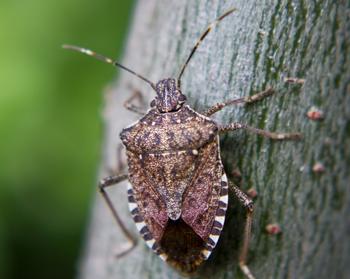
As bugs, stink bugs suck. They suck the juices out of plants. And then they stink — sort of like rotting apples but more repulsive.

We have our native brown stink bug — and I think it is going to be a good (in other words, bad) winter for them invading the house.

Now a Chinese stink bug is working its way across the country, as shown in this website devoted to the brown marmorated stink bug. Read all about 'em.

There is even a section for organic farmers.

September 22, 2012

A Tough Season for Bears

The bear that knocked over the camera, I suspect,

"Black body" — a black bear in infrared light.
Two scout-camera bear photos from late August. The top one was taken just inside the adjacent national forest, while the bottom was in infrared shot in a gully that runs through our property.

Although the upper photo's bear is out of focus, I think I caught it sniffing suspiciously before it came over and batted the camera, which was on the ground, propped up with rocks, and aimed downhill along a game trail.

And why was it on the ground? Because a bear broke the bracket for the tree strap. I need to make a new T-post mount for it.

All well and good, but this looks like another tough autumn to be a bear. I walked one of my favorite nearby trails this morning and I hardly saw an acorn on the Gambel oaks. When I thought it did, it would just turn out to be one of those pale galls (some kind of wasp makes them) that are the size of a small grape.

There were acorns forming in the spring, but they vanished during the hot, dry summer. Fell off? Eaten while immature?

There were wild plums — they are all gone now, and bear turds full of plum pits lined the county road last week. One was so huge and symmetrical that it could have been entered in the state fair's animal-poop exhibit — if, of course, there were such a category.

But hardly an acorn. How is a bear supposed to bulk up?

A couple of evenings ago, after dark, M., who was outside,  heard two shots from down the road. My first thought is always, "Oh no, someone found a bear in the garage/garbage can/wherever and just executed it."

Later, about ten o'clock, we took the dogs for their before-bed walk. Passing a little cluster of houses where the shots might have originated, we heard a couple of large bangs, like someone smacking something metal.

A couple of porch lights were on, but nothing else. No voices. I carry a large Maglite flashlight at night, and I shone it around from the shoulder, cop-style, but what with bushes and trees in the way, could not see any movement or eye-flash.

The breeze was not helping — the dogs did not appear to smell anything.

So had a bear been around earlier too, and someone tried to scare it off? If so, it did not get the message.

September 21, 2012

"Diario de un bombero"

Pine trees . . . yellow-clad firefighters . . . helicopter with buckets— it looks like the Southern Rockies, but it's Spain.

Bill Gabbart links to a short video on Spanish wildfire-fighting.

The use of flappers (batefuegos) in woody brush seems odd to me too, but maybe they make it work when backed up by water drops.

September 18, 2012

On the Road: The Kudzu of the Coast

Of the invasive plants in my country, I think that tamarisk and cheatgrass are the worst.

On the recent train trip to California, I saw stands of tamarisk that looked mostly defoliated along the Colorado River downstream from Dotsero. Maybe the beetles are starting to have an effect.

California has its own problems with invasive species — Scotch broom was one that I knew about.

The Monterey Peninsula, where M. and I were staying, offers every kind of succulent from everywhere (particularly southern Africa). It reminded me of places that I have visited in southern England, where the horticultural spoils of empire adorn thousands of suburban gardens.
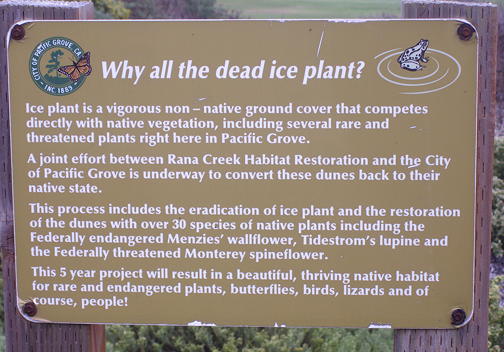
Ice plant on coastal dune, Pacific Grove, California
There ice plant is the villain. Like kudzu in the South, it was introduced partly for erosion control on highway cut banks and such — and it controlled and controlled until it had driven everything else away and formed big solid monocultural mats.
Death to ice plant!
At least it comes up easier than kudzu.

September 16, 2012

On The Road: M's New Villa


M. has a new dream house.


We walked by this house a number of times in the past few days. It's a little bit Tuscan villa, a little bit Arts & Crafts.  Some touches, such as the rounded ends of exposed beams, have a Green & Green vibe. M. was ready to pick it up and bring it home.


Obviously the residents are tired of architecture fans.


But another big draw for me was this huge Brugmansia, also known as "tree Datura," thriving in that mild climate.

The house is on Lighthouse Avenue in Pacific Grove, California, uphill from the downtown business district, should you happen to be in the neighborhood.

September 15, 2012

Major Conservation Easement for Southern Colorado

Louis Bacon, current owner of what used to be the Forbes Trinchera Ranch, has placed a 77,000-acre conservation easement on the property.

This builds on the June announcement that he would donate a perpetual conservation easement on his 90,000-acre Blanca Ranch.

Together, they bring the total amount of permanently protected land to nearly 170,000 acres — the largest easement ever given to Fish and Wildlife.
It's good to see a hedge-fund trader do something worthwhile with the money. I had the opportunity to travel around on parts of that land back when Malcolm Forbes owned it, and because it was managed partly for trophy elk hunting, it was in excellent condition — great wildlife habitat. 

Forbes, however, had sold off a lot in 5-acre lots —the "own your piece of Colorado" ads were everywhere in the 1970s and 1980s. You could still get one, I am sure, but they tended to be the lower altitude, drier parts of the land. The Blanca Ranch had been subdivided back then, but not put on the market, so I hope that this means it never will be.

September 14, 2012

On The Road: Sea Lions, Bird Rock, the Stench

Sea lions on Bird Rock.
Just a portion of the hundreds of sea lions that hang out at Bird Rock, off the Monterey Peninsula.

My little point-and-shoot camera can't really capture much resolution at that distance, but take my word for it, there were lots of them.

And they stink. I have seen sea lions before, but never what looked like a sea lion feedlot.

The wind off the rock is like dog anal-gland secretion times one thousand. The old days of guano-mining here cannot have been any worse.

September 13, 2012

I Went Down to the Mont'rey Bay Aquarium

I went down to the Mont'rey Bay Aquarium,
I saw no baby otter there.
They were laid out on a green kelp bed,
"Exhibit closed" —the sign I read.


Let her go, let her go, God bless her,
Wherever she may be.
Otter-watching from an Aquarium overlook.
So the exhibit was closed for remodeling, but with spotting scope or binoculars you could watch a "raft" of otters not far off-shore. Some are radio-tracked, wherever they may be.

Weirdly related: this blog about the song referred to as "SJI."

September 10, 2012

On the Road: Grand Junction's Sad Railway Station

The California Zephyr stopped in Grand Junction, with the empty station on the right center.
Riding the train through Grand Junction, Colorado, is sad if you are any kind of architecture buff, because you get a long stop right alongside the boarded-up Classical Revival station that desperately cries out for adoption by some "friends" group or a developer with taste.

Meanwhile, railroad, snack, and souvenir business is conducted next door in some bland little box.

A close-up.

The front door.
"Pufferbelly Station"? A failed nightclub? The interior is semi-gutted.