February 22, 2014

February 21, 2014

Gold Medal Water versus Over the River

In January, the Colorado Div. of Parks and Wildlife named much of the Arkansas River a Gold Medal stream, a designation given to the state's best fishing waters.
The Gold Medal reach is 102 miles long from the confluence with the Lake Fork of the Arkansas River, near Leadville, downstream to Parkdale at the Highway 50 bridge crossing above the Royal Gorge.

The designation has been 20 years in the making, and although anglers have enjoyed the improved conditions for years, it is an official acknowledgement of the myriad efforts undertaken by state and federal agencies to turn an impaired river into one of the most popular fishing destinations in Colorado.
Now Rags Over the River (ROAR), the group opposed to ze artiste Christo's "Over the River" plan to hang plastic sheeting over several miles of the river, is trying to use that Gold Medal designation to leverage a new environmental assessment.
“Gold medal designation is an extremely high standard for any body of water to meet. The art project threatens to seriously affect the Arkansas River’s important and sensitive fishery and the ability of anglers to access the river,” [ROAR's Joan] Anzelmo said.
Christo's people say otherwise. A lawsuit is still pending. Christo is 79, so one imagines certain actuarial calculations at work.

February 20, 2014

Mountain Snow Pack, February 1, 2014

Snow levels in central and northern Colorado are good (I can attest to that after last weekend's trip). Sierra Nevada and Cascade ranges still way low.

February 19, 2014

Testing Tipis in the Jet Stream

16-man tipi and woodpile (Photo: Jamie Marchbank)
The sociologist of religion Peter Berger is known for his 1967 book The Sacred Canopy. I was thinking about it Friday night as I lay in the snow just outside the Eagles Nest Wilderness, as the Jet Stream ripped across the Gore Range.

Berger writes, "The sheltering quality of social order becomes especially evident if one looks at the marginal situations in the life of the individual, that is, at situations in which he is driven close to or beyond the boundaries of the order that determines his routine, everyday existence"

Such as winter camping, for example — definitely not part of my everyday existence.

Ira Chernus, a religious-studies professor at CU-Boulder, summarizes what Berger means by "the canopy":
What we want more than anything else, according to this sociological view, is to be in balance--to have a permanent stable order in our lives, so that we can predict both the environment and the responses to it that we and others around us will choose. Society's main project is to create this sense of stable predictable order and to make all of us believe in it, although in fact it is always a false illusion.
We want a stable order, yes, which means that the tent stays up. But in one sudden 60 mph-or-higher blast, the high-tech "16-man" cooking/dining tipi, centerpiece of the annual Colorado Kifaru Winter Rendezvous, has simply vanished — and I lay in my sleeping bag, looking up at an angry murky sky, semi-illuminated by the Moon.

The canopy, sacred or otherwise, was gone. Stability was a false illusion.

Up, out of the sleeping bag, pulling on my boots, I made sure that the fabric had not snagged on the wood-burning stove — now tipped on its side — that still held a few embers.

Plan A, check with Kevin, my near neighbor, who had an "8-man" tipi set up. I turned that way and—where was the tipi? It was down too, and its stove had tumbled a pot of melting snow onto his sleeping bag. Luckily, the temperature was only slightly below freezing, and so Kevin had covered his sleeping bag with a bivvy sack, zipped it up, and planned to deal with everything in the morning.

Since I had no bivvy sack, my Plan B was to wrap up in the tent fabric like a human tamale and wait out the night. 

Then I saw a head lamp moving over in another direction. Another tent was down. It was Eric's, and he had room, so I traded help in re-rigging his small tipi for shelter space. By shoveling snow around the edges, we cut down on the ground blizzards that were moving through the tent.

Kifaru's tipis should have stood up to that wind, and in fact, not every one of them went down. For the big tent — maybe the others too – I blame the fact that it was erected late in the afternoon, and the snow had not really set up around the long snow pins. We re-did it the next morning, making everything extra-taut and weighting down the edges with snow, and it did fine.

Eric cooking in the snow cave's vestibule.
But Eric had another idea: he had started a snow cave the day before, and on Saturday we spent another hour enlarging it to two-man capacity.

Snow caves are so quiet. You can hear yourself blink.

February 15, 2014

Disfigure that Peacock!

Now that you have the whole "murder of crows," "parliament of owls," etc. in your vocabulary — expressions probably never used by persons who actually dealt with crows and owls, but which, to use great-grandpa's expression, "smell of the lamp"* — let us move on to the culinary.

Just remember this: pigeons are "thighed," but quails are "winged," while hens are "spoiled." 

Or people teleporting in from the late seventeenth century will think that you are uncultured.

This reminds me, I think there is one grouse in the freezer. What do I do? Allay it?

* Odd expression? Well, dip a wick in some whale oil, light it, and smell for yourself.

February 11, 2014

A Red Fox with a Missing Tail

While watching birds out the bedroom window yesterday I saw this fox go by. Obviously something has sheared off part of its tail — a pursuing predator?

It walked to each of the sunflower feeders and checked for fallen seeds, then circled around the house and climbed the hill up into the trees.

The same fox.
I thought it seemed a little stiff in the hips, but was I projecting that, still thinking of the loss last month of Shelby, our arthritic old dog?

We watched it from the kitchen, and M. said something about the hard lives of wild animals.

I wonder if we will see it again.

February 10, 2014

In the Dust Bowl of 2014

There is nothing to see in eastern Colorado. It's all flat and treeless.
 Almost a month ago — January 18th — I took County Road 11 south from Manzanola, Colo., toward part of the Comanche National Grassland. I had driven nine or ten miles when something struck me — I had seen only one small herd of cattle, maybe six head, no more. The rest had all gone to the sale barn, apparently.

I was right about where the red arrow is pointing in the graphic from the United States Drought Monitor, and what was in theory a quail-hunting trip was, admit it or not, turning more into disaster tourism.

Outdoor writer Chad Love blogs from a location downwind of that location, and he has posted some photos that, once converted from color into black-and-white, evoke the Dirty Thirties.

I didn't photograph those six cows, nor the herd I saw somewhere on Colorado  Hwy. 10 grazing in the slanting sunset light in a pasture that was about half dirt, even though it would have been nice and National Geographic-y. Like something from East Africa.

Windmill on the national grasslands. Not pumping.
Fisher the dog and I took a walk around this windmill. There was no water in the tank, no bird tracks of any sort in the dust.

We drove on to another spot closer to the Purgatory River where there was a little water, but all we saw was a single mule deer slipping away. Very quiet. Very dry. Just a general sense of absence.

Chasing scaled quail involves a lot of a windshield time—and to be honest, I have done better in more agricultural areas, but this trip was degenerating into disaster tourism.

So I admitted that I was doing that, ate a late lunch of crackers and coffee, and drove around.

We drove past the Huerfano River Wind Farm outside Walsenburg—as usual for wind farms, not all the blades were turning—and Fisher got a piss break at Huerfano Butte.

And there is the mystery of those deserted commercial buildings on the gravel road in totally misnamed Apache City.

It was good to be back into the mountains and seeing snow.

February 06, 2014

They Walk Among Us

Over in Frémont County, a/k/a "Prison Valley" (photo essay), people must be extra-worried about other people walking down the road. Reading the sheriff's blotter in the Cañon City Daily Record, I keep seeing entries like these, from late January:
CR 123/Brush Hollow/Penrose, reporting party reported a male party going down the road waving his arms and talking to himself. Subject was contacted, and he was walking home from Walmart and was OK.

Colo. 115/Telck/Florence, report of a party dressed in black walking on the edge of the road. Deputy checked the area with no contact.
Maybe it is because every year there are a few actual escaped inmates wandering around, most of them caught fairly easily.

On the other hand,
Fremont Street, Penrose, deputy dispatched to check on a party acting strangely in his driveway. Party's behavior was part of his religious practice.
If he had a colander on his head, he would be a Pastafarian. Otherwise, we need more information!

February 05, 2014

Ancestral Air Produced Ancestral Maize

A wild grass from Mesoamerica called teosinte is accepted as the ancestor of maize/corn, but it does not look much like varieties of corn we know:
How teosinte looks today. (Wiki Commons)
The vegetative and flowering structures of modern teosinte are very different from those of corn. These and other differences led to a century-long dispute as to whether teosinte could really be the ancestor of corn.
But some greenhouse studies that replicated different atmospheric conditions resulted in teosinte growing more modern corn-like stalks and ears! According to one of the researchers,
“When humans first began to cultivate teosinte about 10,000 years ago, it was probably more maize-like—naturally exhibiting some characteristics previously thought to result from human selection and domestication. The environment may have played a significant, if serendipitous, role in the transition through inducing phenotypic plasticity that gave early farmers a head start.”

January 29, 2014

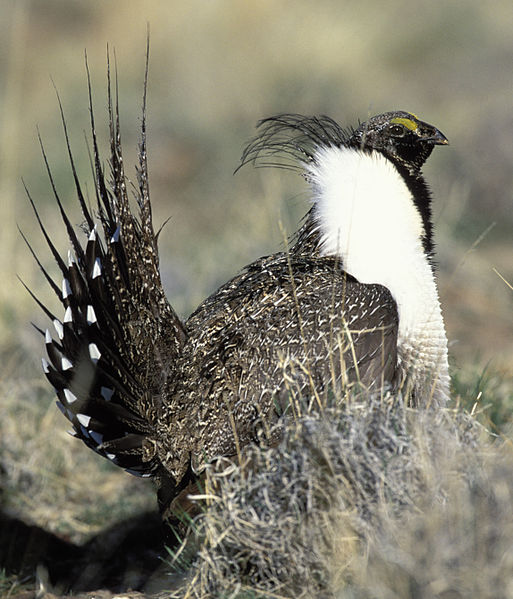
Pity the Sage Grouse, Victim of Politics

Sage Grouse (Wiki Commons)
Sally Jewell, shiny new Secretary of the Interior, comes to northwest Colorado to discuss the threats to sage grouse — then shuts local news reporters out of a "public meeting," is rebuked by the Colorado Press Association.

She has not been in office long, but evidently she has picked up this "most transparent administration's ever" operating style.

Later she issues a typical bureaucrat's non-apology in which it's no one's fault.

Forgotten in all of this: what, if anything, can be done to help the sage grouse. Secretary Jewell has managed to make the story all about her blunders instead.

Her trip was supposed to be about a local, ground-up plan to preserve sage grouse without listing them as endangered or threatened, with the associated federal regulations. But the controversy over Jewell's disrespecting of the local news media drowns that out. One might wonder why. With her way, people who did not personally attend the "public" meeting will never hear about how the local plan works and how the feds reacted to it.

January 24, 2014

Bears on the Fire Scar

Bears at Camera Trap Spring

Since the October 2012 forest fire behind our house, I have been tracking changes in the land, particularly the public land (the highest ridge) that was re-seeded by the federal Bureau of Land Management in April 2013.

In late September, I decided to put a scout camera there at Camera Trap Spring, my favorite spot, and leave it for a few months.

The spring is on BLM land, although not easily accessible without trespassing, if you're not local. Nevertheless, I have seen boot tracks up there — rarely.

Also, Camera Trap Spring has attracted camera-hating bears in the past.

Thinking I was clever, I took my worst camera, spray-painted it flat black for camouflage, and hung it on a burnt ponderosa pine with a black strap.

And it was there when M. and I hiked to the spring in early December. Based on weather recorded (this camera is too cheap to record date and time), I think its batteries had died in mid-November, but not before recording more than two hundred images.

I wished that I had left a better camera up there!

There were groups of deer, flocks of turkeys — and to my surprise, flocks of crows landing at the spring.

Something did knock or bump the camera at one point about 45° from horizontal.

And bears — this cinnamon-phase black bear and her cub made several visits, and the low-light photo almost makes up for the low-quality image.

Given the really poor crop of acorns, apples, and other favorite bear foods in 2013, I was surprised to see them, and I hope they went into hibernation in good shape.

So many questions. We live among them — or they live among us — and yet it feels like they are in separate worlds. Maybe if I was the kind of person who could just leave everything and watch the bears day after day, I might feel as though I had entered their world, to some degree.

January 19, 2014

Blog Stew Followed by Pie

¶ That there is, in fact, an actual place called Pie Town, New Mexico, continues to fascinate food writers. Going to Pie Town is compared to eating beignets at the Cafe Du Monde in New Orleans — a culinary "rite of passage."

¶ We are still thinking about what Colorado forests will look like after the big beetle kills.
During a year of extreme drought, in 2002, the first signs of this latest North American mountain pine beetle outbreak started appearing. From 2006 to 2009, three million acres of red-needled lodgepole pines blossomed into nine million acres of dead trees spanning from New Mexico to Montana, west to Washington, and all the way up into Canada. West of Fort Collins, the picturesque landscape of Rocky Mountain National Park was transfigured when the majority of the park’s large pole [sic. Should be "lodgepole"] pine died.
(That is what happens when editors never leave the asphalt.)

¶ "Why Americans are the Weirdest People in the World." A funny read on perception.

"Rye whiskey, rye whiskey, rye whiskey I cry. "

News you can use: A history of bourbon and rye whiskeys.

The reviewer writes,

I must admit that I too once looked down from the highlands of Scotland on what I viewed as the low ground of American whiskey. Like Risen’s friend, I was undoubtedly influenced by my own introduction to bourbon during American whiskey’s low point in terms of both sales and quality during the 1970s and 1980s. Like my grandfather before me, I lived in Louisville at the time. However, most of the bourbon available then (at least to me) was a choice rightly relegated to the bottom shelves, fit for those with either undiscriminating palates or light wallets. . . .  Spurning bourbon, not to mention moonshine, as an upwardly mobile professional I began to sample single malts from Scotland and thereby missed the astonishing revival of bourbon and its kin that is the subject of Risen’s book.

January 16, 2014

Mountain Snowpack, January 1, 2013

And now the news that matters: water. Some graphics whiz at the Natural Resources Conservation Service has changed the style of the map. Instead of shading in drainages and sub-drainages, now it looks as though they are color-keying the individual measurement stations.* Click image for a larger view.

You can view previous winters' maps here. For Colorado, links to individual SNOTEL stations are here.

* Official explanation: "Due to data system changes and resource constraints, basin-filled maps for SNOTEL & Snow Course Snow Water Equivalent are no longer being produced and are replaced by point maps."