Where Nature Meets Culture—Plus Wildfire, Dogs, Environmental News, and Writing with a Southern Rockies Perspective.
June 26, 2019
Give a Man a Pile of Rocks . . .
. . . and he will spend a while trying to stack them into a balanced cairn.
I say "man" because the boot tracks down here were pretty large, just in case you are questioning my gender assumptions.
There used to be a road under this slide, but then came a forest fire, followed by flash-flooding. I used to know the area well. Now it's all changed. Time for re-exploring.
Yes, the ridge in the background was burned pretty thoroughly. Gambel oak is coming up in profusion, so the deer, bears, and turkeys will benefit from acorns.
June 17, 2019
How Can You Be Neutral in the Chile Wars?
![]() |
| To be loyal to my bioregion, I have should have this license plate, but . . . |
In August 2018 the state of Colorado announced an addition to its growing collection of specialty license plates — the Pueblo chile plate.
The Empire, however, had made a preemptive strike. New Mexico's 2017 chile pepper license plate was already winning awards in 2018.After months of working to get the famous pepper to appear on a Colorado specialty license plate, Pueblo farmers, the Visit Pueblo Convention and Visitors Bureau, Pueblo Chile Growers Association and Greater Pueblo Chamber of Commerce celebrated its availability at the steps of the Pueblo County Courthouse Monday morning.
The new plates went on sale for $50 early Monday [August 6, 2018].
“This is a great thing for the Pueblo Chile. People in Colorado want to be a part of it,” said Dalton Milberger, president of Pueblo Chile Growers Association and of Milberger Farms in Pueblo County. . . . Former Pueblo County Commissioner Liane “Buffie” McFadyen, who helped Esgar kick off the idea for the license plates, said the plate represents another part of brand layering to increase Pueblo Chile’s market share competing with the rivals from New Mexico.
Gov. Susana Martinez said she was proud to accept the award.
“Chile plays a significant role in our state’s culture and is one of our greatest treasures," she said. "This license plate lets the world know that New Mexico is — without a doubt — the Chile Capital of the World.”
In a bid to become the Princess Leia of the Pueblo Chile Rebel Alliance, Colorado State Representative Daneya Esgar (D-Pueblo) announced in February 2019 that she had gotten a tattoo of a Pueblo chile pepper with the words "Death Before Hatch."
She also sponsored the license plate bill. (Photo: Pueblo Chieftain.)
I would put the Pueblo chile plates on my Jeep, but I admit to some fear. I am in New Mexico two or three or four times a year. Would I face road rage from Hatch Empire loyalists? Would pickup truckloads of Hatch Stormtroopers blast me with their pepper cannons? Should I risk it? Maybe I should stick with the generic "greenie" plate.
Meanwhile, our Mirasol peppers are getting hotter. Last year (2018), dry weather kicked up the hotness of Pueblo chiles, this expert says:
Dr. Mike Bartolo with Colorado State University's Arkansas Valley Research Center looks specifically at local crops around the area, especially chili peppers.
“I don’t know if we have any scientific evidence to validate that peppers are getting hotter," said Dr. Bartolo. "But certainly with hot dry conditions we experienced earlier in the summer, it wouldn’t be too surprising if that was the case. Especially if they were water stressed."
Not everyone in Pueblo is in agreement on whether the new crop's heat has increased. Pueblo chile pepper growers, like Kasey Hund with DiTomaso farms, says the pepper's level of spiciness is noticeable.
The power of the Pueblo Alliance continues to grow. And there is a long-range plan at work here — I blogged about it in 2007: "Chile Peppers and Pueblo's Identity."
How Your Dog Controls You with "That Look"
That Look. It is the one that makes you say, "Oh, poor puppy! Would you like part of my sandwich?"
It's evolution at work, say some scientists.
A paper published today in the Proceedings of the National Academy of Sciences found that dogs’ faces are structured for complex expression in a way that wolves’ aren’t, thanks to a special pair of muscles framing their eyes. These muscles are responsible for that “adopt me” look that dogs can pull by raising their inner eyebrows. It’s the first biological evidence scientists have found that domesticated dogs might have evolved a specialized ability used expressly to communicate better with humans.
June 16, 2019
June 15, 2019
They Are Sandbagging La Veta
Along Main Street in the little resort town of La Veta, where sandbags are piled (sometimes) in front of the shops, in case the Cucharas River floods due to run-off from the area burned a year ago in the Spring Fire, west of town.
June 14, 2019
The Poppies of Taos
One strong visual memory from the two summers that I spent working in
the Taos, New Mexico, area during my undergrad years — away from
Portland's drizzle -- was orange Oriental poppies against adobe walls.
It is always rewarding to come back in June and see them again.
These are at the museum named for Taos artist Ernest Blumenchein (appropriate name, right?), but you can see them all over town.
June 11, 2019
Our First Trip to Trinidad Lake State Park
| Part of Carpios Ridge Campground from an overlook. |
"That must be the visitor center," I said to M. But I was so wrong. It was the "camper services" building — toilets, plus coin-operated showers, laundry room, and vending machines. The actual visitor center was more modest.
By happenstance, the first weekend of June found us holding reservations for the dogs at the boarding kennel, but our original planned destination was impossible. What to do? A lot of the high country was still snowy and/or in the middle of the Big Melt, so we looked lower down.
| A view from our campsite. The forest here is mostly piñon-juniper. |
The Purgatory River was dammed to create the lake in 1979, making it slightly younger than Pueblo Reservoir. The lake's level fluctuates, but it is around 800 acres.
Creating the lake drowned some former "coal camps," but you can see visit Cokedale at the park's west end, with its long row of former coke ovens aging under the Colorado sun — when they were working, that little valley must have filled with choking smoke.
One morning I went down to fish before breakfast, and I admit to being skunked—I saw a couple of fish, but they rejected my lures. Some anglers in boats were not doing well either, but I saw one hooked by a fisherman on the shore.
| Muddy water flowing into the lake. |
| The riparian zone meets the P-J in Long's Canyon. |
It also includes a geological feature, the KT (KPg) Boundary, as described in "An Earth-Shattering Kaboom at Trinidad Lake State Park."
If all this is not enough, you are only about five miles from the Corazon de Trinidad National Historic Area.
June 10, 2019
Attacked on the Trail by a Mountain Lion (4)
![]() |
| "Stinky" in November 2018. |
(Here is CPW's news release about her.)
I called her "Stinky," for lack of a better name. She soon gained a cage-mate, another kitten from down the Arkansas River in Otero County, whose even more antisocial demeanor — a good thing, really — earned him the nickname of "Hissy." He would hide inside a hollow log in the enclosure, peer out, and hiss in the most hostile manner that he could.
![]() | |
| "Stinky" six months later. She is crossing the hollow log but would not fit inside it. |
This was Stinky at the end of May, when she and Hissy were deemed sufficiently grown to be released into their original territories. They weighed 50–60 pounds, Hissy being a bit larger.
So I thought back to the case of Travis Kauffman, who got his fifteen minutes of fame last February when he "fought off" and killed a mountain lion west of Fort Collins.
A subsequent necropsy put the little lion's weight at 24 pounds (9 kg.) So it weighed maybe half or less what Stinky weighed upon release.
Kauffman stomped a kitten, albeit a big one.
I and everyone else who wrote about that thought that he had been attacked, his running triggering a predatory reflex.
But the rehabber had a different view. She pointed out that Kauffman's injuries were on his front, whereas a mountain lion normally attacks from the rear or side. She thought he was probably bent over the kitten snapping photos with a smartphone when it literally got in his face.
The kitten was big enough to scratch him up, but not big enough to take him down.
Part 1 here
Part 2 here
Part 3 here
June 06, 2019
Wildflowers in a Scrambled Spring
![]() | |
| Penstemon virens, low penstemon — I think. |
The early wildflowers (spring beauties, pasqueflower) were nothing much, but these penstemons came on strong. M. and I were in south central Texas in April when the bluebonnets (which are lupines) were blossoming—the slope behind the house is almost like that.
| Clematis hirsutissima, hairy clematis or sugarbowl. |
Rocky Mountain locoweed, Oxytropis sericea. They are blooming in full force too. On the other hand, the apple trees in the neighborhood had a very few blossoms. It was chilly for so long.
| Four-nerved daisy or "Perky Sue" |
Its botanical name is Tetraneuris Ivesiana. Photographed at Trinidad Lake State Park on the first of June.
June 02, 2019
An Earth-Shattering Kaboom at Trinidad Lake State Park
| Right here is when (most of) the dinosaurs died. |
In a recent New Yorker article, "The Day the Dinosaurs Died," Doug Preston writes,
Today, the layer of debris, ash, and soot deposited by the asteroid strike is preserved in the Earth’s sediment as a stripe of black about the thickness of a notebook. This is called the KT boundary, because it marks the dividing line between the Cretaceous period and the Tertiary period. (The Tertiary has been redefined as the Paleogene, but the term “KT” persists.) Mysteries abound above and below the KT layer. In the late Cretaceous, widespread volcanoes spewed vast quantities of gas and dust into the atmosphere, and the air contained far higher levels of carbon dioxide than the air that we breathe now. The climate was tropical, and the planet was perhaps entirely free of ice.You stand there, and you look at it, and you think, "Right there. Death and chaos like we cannot imagine."
His X-Acto knife unearthed the edge of a fossilized fin. Another paddlefish came to light; it later proved to be nearly six feet long. DePalma probed the sediment around it, to gauge its position and how best to extract it. As more of it was exposed, we could clearly see that the fish’s two-foot-long snout had broken when it was forced—probably by the flood’s surge—against the branches of a submerged araucaria tree. He noted that every fish he’d found in the site had died with its mouth open, which may indicate that the fish had been gasping as they suffocated in the sediment-laden water.
| Here is another view of the layer from sciencebuzz.org. |
May 18, 2019
The Lone Lilac Abides
I was climbing the steep dirt road up behind the house, following the dog, mind off somewhere (probably volunteer fire department stuff) when I ran into a wall of lilac scent.
There it was — the survivor. A family from down in Rocky Ford used to have a cabin up there — really just a parked camping trailer with an addition. They planted a lilac bush on a southwest-facing slope behind it, and they must have picked just the right variety, in the late 1960s or whenever it was.
They stopped coming much after 1998, when the father died. Eventually the adult children sold us those acres, and one tough lilac bush.
Through drought years, blizzards, and total neglect the lilac prevails. This is one of the good years. Among the scent of sun-warmed ponderosa pine — pungent lilac.
May 13, 2019
Nevertheless, She Pointed
Wendy, the visiting German wirehaired pointer, is a . . . pointing dog. She is impressive on pheasants, but she cannot pass up a robin in a city park either.
Tonight it was the broad-tailed hummingbirds that earned her concentrated and beady/birdy stare. They. Are. Birds.
Evidently that's how it works.
'False Spring' Pasta
We are used to "false spring" along the Eastern Slope of the Rockies.
Maybe now, with the last snow melted, this is the real spring, but I am still calling this dish pasta falsa primavera — with fillaree, lamb's quarters (quelite cenizo), clover, and dandelion, all picked within yards of the house.
May 09, 2019
Tranquilized Mountain Lion Bites Game Wardens
![]() |
| Colorado Parks and Wildlife photo, as far as I can tell. |
Cats — you can never trust them.
[Colorado Parks and Wildlife] said that while the cat was being lowered down, it awoke from the tranquilizer and bit two officers before being subdued again.I know these guys, so I will have something to say the next time that I see them. Leather gloves, at least?
The cat was then put in a bear trap and relocated.
April 27, 2019
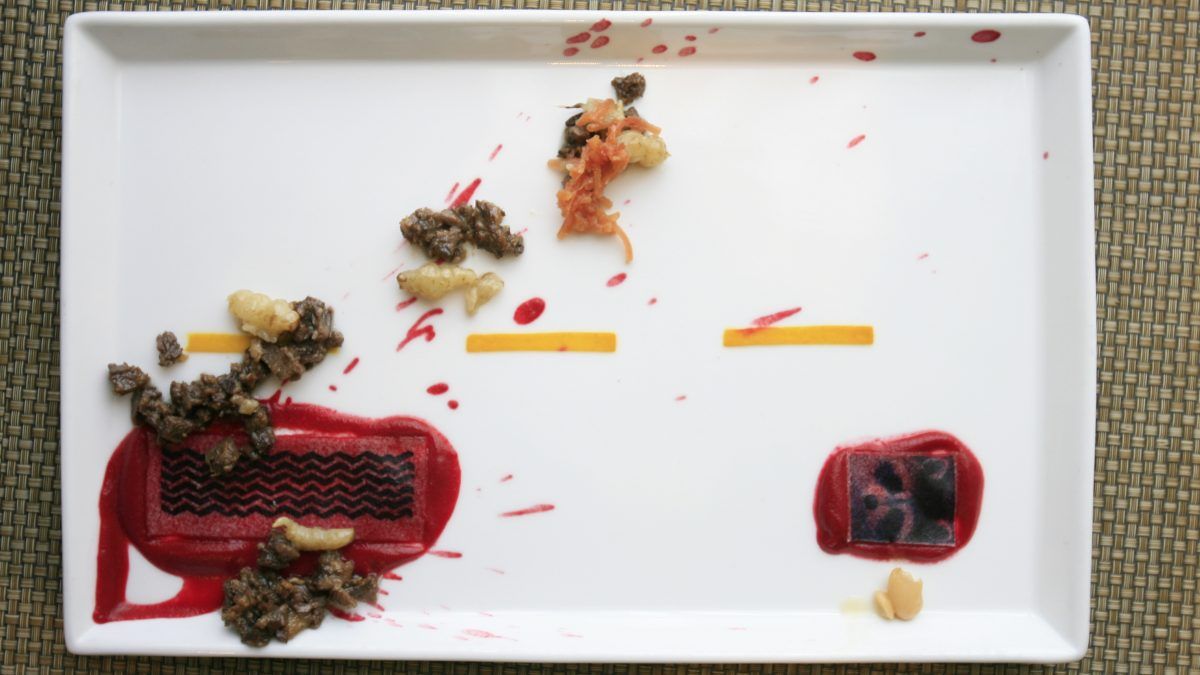
Trendy Chefs, Libertarians Discover Roadkill Cuisine
![]() |
| A presentation of raccoon meat resembling the scene of roadkill created by the late Moto executive chef Homaro Cantu and Chris Jones, chef de cuisine, at their now-closed restaurant at Fulton Market on the west side of Chicago, Illinois. (Alex Garcia/MCT/Newscom, published in Reason magazine.) |
One of them was the "roadkill pickup," inspired by the time when, while following him along US 50 in Cañon City, I had seen another car smack into a cock pheasant near Colon Orchards, and I had stopped, hopped out, grabbed it, and driven on as though someone were standing behind me with a timer.
His wife cooked it that evening. It was fine.
At Hit & Run, the blog of Reason magazine, food lawyer Baylen Linnekin applauds laws (including Colorado's) that liberalize the collection of road kill.
Bizarrely, though, many states prohibit the practice. In fact, as I detail in my recent book, Biting the Hands that Feed Us: How Fewer, Smarter Laws Would Make Our Food System More Sustainable, nearly half of U.S. states prohibit harvesting roadkill. Nevada, for example, conflates roadkill harvesters with poachers. Last year, a Louisiana man faced a fine of up to $750 and up to a month in jail for harvesting a dead fawn.
But help is on the way. Oregon's roadkill law, which I discussed in an earlier column, was adopted in 2017 and took effect this January. Subject to certain conditions, the law allows anyone who obtains a permit to harvest a deer or elk, which a person can eat, share, or give away. (Sorry, no skunk meat; though it's fine to harvest stink steaks in Idaho.)Then there are the "concern trolls":
"Our concern really is where people might intentionally hit animals for trophy or food," says John Griffin, senior director of urban wildlife programs with the Humane Society of the United States. "Like an elk or something large. It's incredibly dangerous. For both species."Does John Griffin know what hitting an elk does to your car, and maybe you? How many people would sacrifice a minivan or SUV for a free meal? He just does not want anyone eating wild game under any circumstances, that much is obvious.
Subscribe to:
Posts (Atom)